Library help, grant to keep precious collection in tune
Assistance will allow KU Archive of Recorded Sound to be cataloged, made more accessible to students and public
You can read the Declaration of Independence in just about any American history textbook.
So why do researchers consult the real deal?
“It’s really a different thing entirely to see it, to touch it, to feel the actual historical document as it was laid down,” says Roberta Freund Schwartz, assistant professor of musicology at Kansas University.
The same is true of original recordings, she says.
Schwartz oversees the KU Archive of Recorded Sound, a little-known treasure trove of more than 35,000 jazz and opera recordings housed in Murphy Hall.
“I ran a graduate seminar, and every single student who accessed those recordings — there’s something very immediate and very vital about hearing that old scratchy recording, warts and all,” Schwartz says.
Trouble is all the rarities don’t have much value if no one’s exposed to them, which has pretty much been the case since the first of the year, when the archive’s endowment funds dried up, forcing Schwartz to limit public access to the collections.
But a new grant from a Chicago-based philanthropy soon will change all that.
The $7,200 gift — albeit relatively small — will pay for a staff member or two to work on cataloging the collection and assisting visitors 40 hours a week. It also will pay for a new computer to house the massive collection database.
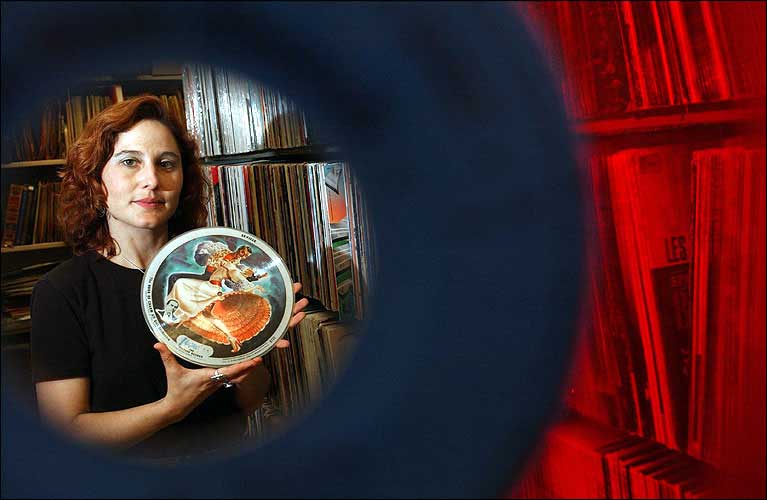
Framed by a red transluscent record, Roberta Freund Schwartz, Kansas University assistant professor of musicology, displays a Vogue Picture Disc from the 1940s at the KU Archive of Recorded Sound. The archive, one of the top 10 of its kind in the country, received a grant from a Chicago foundation that will keep it afloat through the fall semester.
Juanita Bellavia, co-founder of the Bellavia Foundation, which awarded the grant, said she and her husband, Frank, chose to support the archive “because it will help young people learn. That’s basically what our foundation wants to do is help people better themselves.”
Library help
The grant will bridge the gap between now and the time KU Libraries steps in as the full-time administrator of the archive, a role it hasn’t played since 1988, when librarian Ellen Johnson retired.
The music and dance department then assumed control of the orphaned archive, which at the time included the opera collection of James Seaver and a complete discography of jazz artist Red Nichols.
(Although the archive is housed in the music and dance department, it doesn’t receive funding from the school, instead relying on independent donations and grants.)
KU jazz history professor Richard Wright bolstered the archive in the early ’90s when he donated his personal jazz collection of 15,000 records. Schwartz says without equivocation that the jazz portion of the archive ranks among the top 10 in the nation. She wasn’t sure about the opera collection’s status.
Sarah Hamilton, a music history lecturer at KU, spearheaded the Bellavia grant. Keeping the collections open is crucial to the music history courses she teaches at the university.
| The KU Archive of Recorded Sound received a grant of approximately $7,200 from the Chicago-based Bellavia Foundation that will help staff the archive and catalog the collection.The archive is on the third floor of Murphy Hall at Kansas University. Regular hours for the collection of more than 35,000 jazz and opera recordings will be announced this fall.For more information, contact Roberta Freund Schwartz at 864-9737. |
“Last semester I had wanted to send my students to the archives, but there were no set hours for archivists or anybody to be there,” Hamilton says. “The big idea of the grant was to get the doors open, have somebody in there so that students and any interested party could have access to the collection.
“From there we’re hoping if we can prove it to be a worthwhile educational tool we’ll maybe get some university funding or additional funding from the community.”
Easier access
Larry Mallett, chair of music and dance, says the libraries will take administrative control of the collection as early as this fall.
Their goals are to provide staff to help finish cataloging the collection and then preserve it, says Bill Myers, director of library development.
About 90 percent of the jazz collection has been cataloged, according to Schwartz, but none of the opera holdings have been cataloged digitally.
“We have a paper catalog, but one that’s very hard to navigate and certainly one that unless you came to the archive and had a decent idea of what you were looking for it would be very, very difficult to find recordings,” Schwartz says.
The fully cataloged archive will allow people writing theses or dissertations from across the country to come to KU and tap this resource, Mallett says.
“And of course the status of KU is increased tremendously just because of those kinds of connections,” he adds.
The collection won’t just be open to students. Anyone can take a look. Patrons can even bring in blank CDs to burn copies of recordings they’d like to hear more often.
Among the rarities in the collection are 1896 flat disc recordings, wax cylinders and the equipment to play them, an irreplaceable collection of Fonotopia opera records and singular jazz recordings that would make any astute collector drool.
Schwartz, who has been working on a National Endowment for the Humanities grant to help keep the struggling archive afloat, says she can finally table the grant-writing process and rest easy with the knowledge that the collection is in good hands and its full potential will soon be realized.
“Recordings are so important,” Schwartz says. “For popular music, it’s the way that we store information. … To have those recordings accessible is absolutely vital.”
Arts and Entertainment
Watkins Museum to open special exhibit detailing how Douglas County celebrated America’s Bicentennial

Go, See, Do: Kaw River Roots Festival, markets and more
Soccer gear honoring Lawrence history’s all-star team is now on sale as part of city’s public art exhibition
Nominations, call for artists open for Lawrence’s 2026 Phoenix Awards
Go, See, Do: ‘Addams Family’, PRIDE parade and a host of library events among offerings