Marines continue Fallujah air strikes
Fallujah ? Marines surrounding this war-battered city called in air strikes for a second day Wednesday, saying they were provoked by insurgents who launched attacks with small arms fire and rocket propelled grenades.
Intensive fighting moved from a train station to a mosque to the edges of neighborhoods. Air strikes from an AC-130 gunship destroyed a flat-bed truck Tuesday night that was believed to be ferrying guerrillas and ammunition through the streets. Heavy artillery also leveled a house. In both cases, “secondary explosions” continued for 20 minutes, indicating the strikes hit large caches of weapons and ammunition, according to U.S. Brig. Gen. Mark Kimmitt, deputy director of operations in Iraq.
“The cordon around Fallujah remains tight,” said Kimmitt, adding that U.S. forces have not initiated the recent fighting. He said there have been a “number of provocations” by insurgents but U.S. officials still believe negotiations “have promise” for a peaceful solution. The general quickly added, however, that U.S. military patience was not infinite.
To the south in the holy city of Najaf on Wednesday, U.S. forces continued to encircle the militia protecting radical Shiite cleric Muqtada al-Sadr. The imam has been camped in Najaf since leading an insurrection against American occupation early this month. U.S. officials said negotiations with Iraqi religious and political leaders to end the standoff are continuing, but offered no details.
Kimmitt said there was “validity” to reports that rival Shiite organizations in the region, opposed to al-Sadr and his lack of religious credentials, have begun attacking and intimidating al-Sadr’s followers.
But, much of the focus in Wednesday in Iraq was on Fallujah.
Kimmitt, asked to explain why the United States insists there’s a cease fire when fighting seems to erupt daily, conceded it was “somewhat paradoxical.” He added that the Marines were defending themselves, and as long as that continued, a cease fire would be in effect, despite barrages from insurgents.
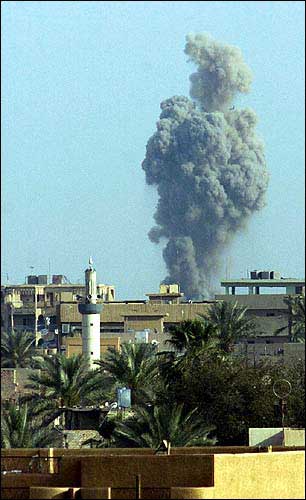
A plume of smoke rises from a large explosion that appeared to be from a U.S. bomb on the southwest side of Fallujah, Iraq. Fighting continued Wednesday in the area, and the United States again delayed plans for a dual patrol in the area with Iraqi police.
The general said the military would allow the political track to progress “as long as it shows promise.”
Masked insurgents appeared Wednesday on Arabic television. They burned the new Iraqi flag and condemned the country’s political leadership as being controlled by American infidels.
In one skirmish Wednesday in Fallujah, four Marines were injured during a firefight that ended when the Marines summoned F-16 and F-18 aircraft to bomb insurgent positions.
In a second fight about a mile away, Marines used Cobra helicopters firing Hellfire missiles and infantry troops in heavily-armed Humvees to push insurgents from an abandoned train station where they had stored weapons.
The insurgents fought back for several hours, including firing at the Cobras. Some Marines reported seeing women and children with the insurgents as they carried off weaponry in the early stages of the fight.
Meanwhile, plans for joint patrols between Marines and Iraqi Civilian Defense Corps members were delayed again, this time to Friday to allow for more training. The Marine Corps is struggling to “put an Iraqi face” on efforts to eradicate the insurgency movement in Fallujah.
National
Lawyers for man accused of killing Charlie Kirk try to block death penalty
Trump’s name poised to come off Kennedy Center
Suspect in Texas shooting had fired at police days earlier, officials say
Man pleads guilty to killing a top Minnesota Democrat and her husband
New tornadoes outside Chicago as severe storms pummel the Midwest