Gender gap not just academic
KU faculty, students say women face conflicting choice between career, family
When Omega Tadesse hangs out with her Kansas University engineering classmates, the conversations tend to center on football and cars.
She puts up with it. She’s often the only woman there.
Such is life for women in the electrical engineering and computer science department, where male students outnumber females by a ratio of 5-to-1, and men outnumber women on the faculty 26 to 2.
“After a while, I realized the same two girls kept coming up in my classes, and there’s 20 guys,” Tadesse said. “It dawned on me that there were very few girls.”
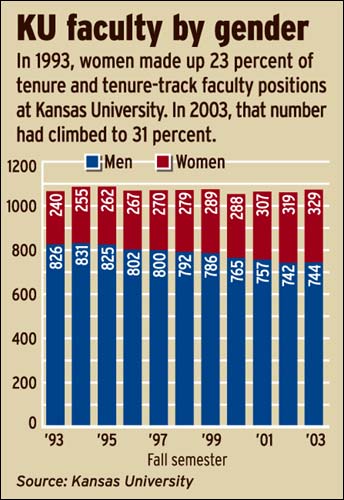
The number of female students and faculty members at KU has climbed steadily over time. But while female students now slightly outnumber men on the KU campus, women make up only about 30 percent of the faculty.
And some departments have glaring gender gaps. According to fall 2002 data, women comprise less than 15 percent of the faculty in eight departments, and two — aerospace engineering and engineering management — have no female faculty members.
According to 2002 data provided by Big 12 universities, KU ranks fifth in the conference for its percentage of female faculty — 29.5. The percentages range from 18.5 at Texas A&M to 36.6 at Baylor.
Nationwide, women filled 36 percent of university faculty positions in 1999, according to a study by the American Association of University Professors.
Fewer female applicants
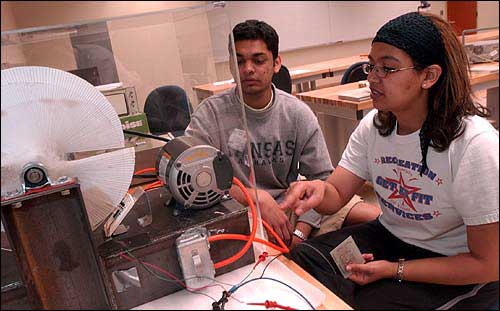
Arpit Gupta, left, a Kansas University senior from India, explains his computer science true 3-D display system to Omega Tadesse, a senior in computer engineering from San Diego. Tadesse is one of only a handful of women majoring in electrical engineering and computer science at KU.
KU administrators say they’re hiring more women than ever to fill positions. The challenge, though, is finding women to apply. It’s a problem faced by universities across the country.
“It’s a matter of increasing the number of women in the hiring pool,” said David Shulenburger, provost and executive vice chancellor. “If the women are in the pool, there’s as good a chance they’ll be hired as a man.”
That means KU advertises in publications geared toward women and personally contacts women that might be interested in positions, Shulenburger said.
Ann Cudd, director of KU’s women’s studies program, said women still felt more pressures from family life than men, which leads some would-be female professors to choose a different career path.
“Faculty life still tends to be more difficult for women to manage,” Cudd said. “It’s the timing of tenure and timing of people wanting to have children. When you’ve finished your Ph.D., you tend to be about 30 years old and want to have children. On the other hand, you have an enormous effort to do research and publish to get tenure.
“The family pressures can slow down one’s research career and even derail it.”

 KU faculty gender comparison
A balancing act
Maria Orive, an assistant professor in ecology and evolutionary biology, has felt those pressures. She has a 17-month-old son and currently is undergoing tenure review.
“It’s a crazy balancing act,” she said.
Orive, who has been at KU since 1997, said she thought having a more consistent maternity leave policy would help KU attract female faculty. KU currently follows the federal Family and Medical Leave Act, which allows employees to take up to 12 weeks of vacation and sick leave after giving birth. But any unpaid leave after that is at the discretion of department chairperson.
Orive also favors providing more day care for children of faculty members. She said her son had been on a waiting list at Hilltop Child Development Center for more than a year.
“If I was a young faculty member looking for a job, the No. 1 thing I would negotiate for — even before salary — is a spot in day care,” Orive said.
Looking for mentors
In KU’s division of biological sciences, there were 440 female and 349 male students in fall 2002. But men outnumber women on the faculty 49 to 13.
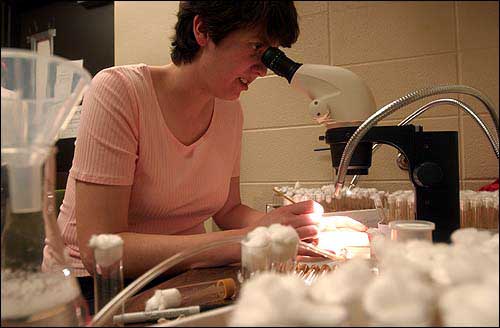
Jennifer Gleason, assistant professor in ecology and evolutionary biology at Kansas University, monitors some fly specimens in her research work at her lab at Haworth Hall. Gleason's biological sciences department has more female than male students but fewer female than male faculty.
Jennifer Gleason, an assistant professor of biology, said women started dropping from biology at the graduate school level. The numbers fall even more at the postdoctoral and faculty ranks.
“Compared to what I’ve seen at other places, it’s a lot better (at KU),” Gleason said. “Which is sad, considering the numbers.”
Gleason said having more female faculty would inspire undergraduates to careers in higher education. Having more experienced faculty as mentors could help younger professors with their careers, she said.
“For myself, it would be nice if there were more senior women,” she said. “Now I’m at the assistant professor level, and I’d like to see how well they’ve managed to follow the track to higher levels.”
Christopher Haufler said he had served on “dozens” of search committees in his 25 years as a KU biology professor. Some searches seem to attract high numbers of female applicants, but others have few, he said.
“It’s always part of the concern in filling positions, involving women in the process as well as attracting qualified women to apply,” Haufler said. “It’s got to start early (in students’ careers).
The percentage of women filling tenure and tenure-track faculty positions at Big 12 universities in fall 2002:
|
“In my generation, women were not encouraged to go into science. The pipeline narrows as you get higher and higher in education units to the point it’s tough to get more than a trickle of qualified female candidates to compete for positions.”
Engineering a solution
Starting early is the philosophy the KU School of Engineering is taking in attracting women. Currently, only nine of the school’s 87 faculty members are women.
Unlike the biology department, engineering faces gender gaps from the undergraduate level through the faculty level. In fall 2002, only 24 percent of KU’s engineering undergraduates were women.
Dean Stuart Bell said closing the gender gap would take time. His school offers summer and weekend programs exclusively for girls in junior high and high school.
“It’s going to be a process of getting more and more women interested in engineering as a discipline,” he said. “We’re very committed to do this.”
Nancy Kinnersley is one of two female faculty members in KU’s electrical engineering and computer science department.
She knows how difficult it is to balance home life with academia. After receiving her master’s degree, she took 15 years off to raise three children before returning for her doctorate.
Theories for why women aren’t interested in computer science range from computer games being geared more toward boys than girls to simple archaic stereotypes, she said.
“There have been a bunch of studies, and I don’t think we’ve reached any definite conclusion,” Kinnersley said. “When you look at your classroom and have two women in a class of 40, you say, ‘What’s going on here?’ If we have more women faculty, those women students will be less intimidated.”
Cudd, the women’s studies director, said she wasn’t sure there was any magic formula to attracting female faculty and students in under-represented areas. While gender gaps are still an issue, she said she didn’t think KU’s situation was any worse than the situation across the country.
“We’re doing OK,” Cudd said. “Of course I think we should keep struggling and reaching for equity until it’s reached.”
Kansas University departments vary widely when it comes to the number of faculty in their ranks. A look at the top and bottom departments by percentage of women in fall 2002.The best
The worst
|
City Government

Developer seeks incentive from City of Lawrence to build 131 units of housing near Wakarusa and Queens

Lawrence city leaders will consider whether to keep Community Building open, make 2 other rec centers free to access
A STAR Bond application raises questions for city leaders about Costco and housing west of the SLT

Soccer gear honoring Lawrence history’s all-star team is now on sale as part of city’s public art exhibition
To honor public servants, Lawrence’s July 4 celebration will have a whole gallery of their photos on display; submissions open now