

Graves blamed for car misuse
Former official says governor had no interest in correcting problem
Topeka ? As the state was raising taxes and cutting funds to education and social services in mid-2002, an internal report found that hundreds of state employees were improperly using state-owned vehicles to commute to work.
Then-Gov. Bill Graves was aware of the problem but did nothing about it.
“There was no interest in the governor’s office to do that,” said Joyce Glasscock, who was secretary of administration. “He was preoccupied and didn’t want to create a lot of disgruntled feelings as he was walking out the door.”
The report, obtained by the Lawrence Journal-World, was issued by the state Division of Accounts and Reports, which surveyed every state agency.
It found that:
- State employees commuted 2 million miles between work and home at a cost of nearly $600,000 per year.
- 229 employees at 22 agencies were using state cars for commuting even though those employees weren’t regularly called to work after normal work hours.
- 277 state cars at 28 agencies failed to meet the minimum mileage guidelines for permanent assignment to individual employees, according to the report.
The report also questioned the use of state vehicles by employees who commuted more than 10 miles one way. Some of those employees did not have the required approval to use those cars, while many commutes were not seen as “an efficient use of state resources.”
No action taken
The report was forwarded to Glasscock, who is now head of the Boys & Girls Club of Manhattan.
Contacted Friday, Glasscock said she conducted several meetings in an attempt to resolve the problems, but that agency chiefs resisted change and Graves didn’t want to act on it.
In June 2002, the Legislature had just completed a bruising session in which it increased taxes by about $250 million. Graves had fought for the tax increase and already had secured a job as president of the American Trucking Assns., which he took over in January.
The state’s fiscal situation continued to worsen, and in August Graves cut $41 million from the budget, including cuts to public schools, higher education and social services.
A call to Graves at his Alexandria, Va., office seeking comment about the use of state vehicles and his response to the report was not returned.
Agencies cited
The Graves-era report has surfaced at a time Gov. Kathleen Sebelius’ administration has promised to change the way the state buys and uses vehicles.
Howard Fricke, the current secretary of administration, is scheduled to give Sebelius recommendations this month on the vehicle situation.
Recent Journal-World reports have shown that the state has a parking lot filled with more than 130 new state vehicles that have never been used.
In addition, Kansas has 8,661 state-owned vehicles, nearly one for every four state employees. Illinois, with five times the population of Kansas, has only 14,000 vehicles, and that state’s governor has announced plans to sell off 1,000 vehicles.
One month into office, Sebelius issued an executive order that sought to limit the use of state vehicles for commuting.
But has the order worked?
The earlier report said that within the Kansas Bureau of Investigation, 45 employees were using cars for commuting even though they seldom were called to duty after hours, and another 16 employees commuted more than 10 miles each way.
Glasscock said she met with KBI officials and found them hesitant to change their practices. “I do know there were administrators that weren’t getting called out on a regular basis and had cars,” she said.
She described the agency’s attitude as “we’ve always done it so we’re going to keep doing it.”
New administration
Sebelius’ executive order provided an exception for law enforcement.
Kyle Smith, a spokesman for the KBI, said law enforcement vehicles, in which guns and bullet-proof vests are often carried, should not be left near the KBI headquarters because the surrounding neighborhood was a relatively high-crime area, and because the officials driving those vehicles could be called to appear at a crime scene.
“It’s not how often you are called out; it’s if you are subject to be called out,” he said. He said the agency hadn’t reduced the number of cars that go home with employees.
The earlier report also said the Kansas Department of Transportation had 166 employees who were either using cars for commuting when they were seldom needed after hours, commuting more than 10 miles each way or using cars not driven a sufficient number of miles to warrant being permanently assigned to an individual.
After a review, the agency reduced that total by 22 by not allowing area engineers to use state vehicles to commute, according to Jim McLean, a spokesman for KDOT. The remaining vehicles that are in use have been allowed by the current administration, he said.
“We think we have a very responsible plan in place,” McLean said.
State Government
State legislators push back against federal energy regulators ending competitive bids
TOPEKA — Two Kansas legislators asked federal energy regulators to ensure competitive bidding occurs on ...
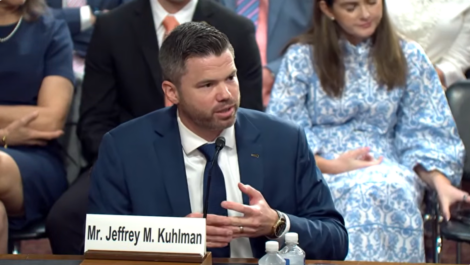
Senate confirms 1st of 3 Kansas nominees to U.S. District Court
Corporate income tax collections falling sharply in Kansas; Republican, Democratic leaders disagree on what it means
TOPEKA — Corporate income tax collections in Kansas have almost halved since last year, while other sources trend ...
Candidate’s campaign manager created website with documents used to attack rival
TOPEKA — Kansas U.S. Senate candidate Patrick Schmidt’s campaign manager left his digital footprint on ...
GOP secretary of state files to run for governor
