

Water returning to state’s priority list, official says
New work must make up for past 'backsliding'
Joe Harkins opened a Kansas University conference on water issues and their ties to the state’s economy with an admission that startled much of the audience.
Of the past five governors, Harkins said Friday, three cared a lot about water. Two did not.
“Water was simply not at the top of Governor (Joan) Finney’s list of priorities,” said Harkins, who ran the Kansas Water Office from 1981 to 1992 under former Govs. John Carlin and Mike Hayden. “And it wasn’t on the top of Governor (Bill) Graves’ list, either.”
The state’s water policies, Harkins said, have been marked by 14 years of slow progress, followed by “12 years of backsliding.”
Harkins’ comments surprised the 140 people — a mix of city, county and state officials and leaders — because he’s well-known for his tact. A feather-ruffler he is not.
“I was surprised he said what he did, but I’m glad he did,” said David Brenn, who lives in Garden City and serves on the Kansas Water Authority, the Arkansas River Compact and the governing board of Groundwater Management District No. 3. “I think what he said set the tone for the discussions that followed, and I think it showed just how much that tone is changing.”
Top priority
Harkins said he was surprised and disappointed “the word ‘water’ was never mentioned” during the state’s 2002 gubernatorial campaign.
Harkins said he agreed to come out of retirement and return to the Kansas Water Office only after Gov. Kathleen Sebelius vowed to make water a top priority of her administration. Since then, he said, Sebelius has commissioned a Cabinet-level subcommittee that meets for two hours weekly on water issues.
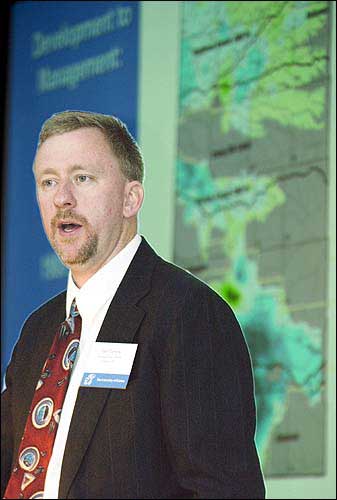
Earl Lewis, civil engineer and manager of the hydrology and evaluation unit of the Kansas Water Office, gives a presentation on the Ogallala Aquifer. Lewis was a presenter during Friday's conference on water issues at Kansas University.
“No other state has anything like it,” Harkins said. Hayden serves as the subcommittee chairman. He also is secretary of wildlife and parks in the Sebelius administration.
Though Harkins said water issues were again a top priority, he and other conferees warned that salvaging groundwater supplies in western Kansas likely would require solutions that were politically thorny and that defied easy consensus.
And the solutions, said the conferees, remain ill-defined.
No easy answer
Karl Brooks, a history and environmental studies professor at KU, warned that “without change, western Kansas will be up against it (serious water depletion) within our lifetimes.”
But the route to change, said the conferees, remains poorly marked.

 6News video: Economic policy conference centers on water
 Kansas Water Authority sets public hearings on water storage purchase plan (10-15-03)
Hannes Zacharias, former Hays city manager and now a Johnson County assistant county manager, proposed major investments in preserving the state’s reservoirs and in a “pipeline infrastructure” that would let low-supply cities buy water from high-supply areas.
He also proposed that the state reduce groundwater consumption by buying irrigators’ water rights.
“That’s got to be done and in a robust manner,” Zacharias said. Such a buyout, he said, probably would cost taxpayers several hundred million dollars.
“I don’t think it would take a billion,” he said.
‘Major problem’
David Traster, a Wichita lawyer who specializes in water-rights cases, wondered aloud whether the state’s judicial system could handle all the legal issues that would accompany curtailing irrigators’ water rights. Still, he said, something must be done because the state has “over-appropriated water rights by three or four times. This is a very, very major problem.”
Allie Devine, a former secretary at the Kansas Department of Agriculture and now vice president of the Kansas Livestock Assn., said a state-financed buyout wasn’t feasible. It would make better sense, she said, to begin “enforcing the laws we already have,” protecting those with the most senior water rights.
Afterward, Donald Worster, a distinguished history professor at KU, said much of the discussion sidestepped the controversy that history had shown would define the future of western Kansas.
“(Irrigation) is a mining economy, an extraction economy,” Worster said. “Now ask yourself, what does a mining community do when the resource is gone? Go to any mining town out West, and ask if they planned for the future — you’ll find that most mining towns are ghost towns now.”
State Government
State legislators push back against federal energy regulators ending competitive bids
TOPEKA — Two Kansas legislators asked federal energy regulators to ensure competitive bidding occurs on ...
Senate confirms 1st of 3 Kansas nominees to U.S. District Court
Corporate income tax collections falling sharply in Kansas; Republican, Democratic leaders disagree on what it means
TOPEKA — Corporate income tax collections in Kansas have almost halved since last year, while other sources trend ...
Candidate’s campaign manager created website with documents used to attack rival
TOPEKA — Kansas U.S. Senate candidate Patrick Schmidt’s campaign manager left his digital footprint on ...
GOP secretary of state files to run for governor
