Civilian deaths usually outnumber troops’
They get in the way of bombs and bullets, stumble over mines, flee homes, clog roads, get sick, go hungry and generally outnumber combatants when it comes to dying.
Civilians are one of the wildest wild cards in the campaign to dislodge Saddam Hussein. They are the softest targets in a hard war and are often seen as expendable: U.S. intelligence officials contend Saddam might use his people to pin an atrocity on the Americans, even if it means dressing his soldiers in U.S. uniforms to carry out war crimes.
Nowhere is the danger greater than in urban areas, and this time the target is Baghdad, a city of 5 million.
“Historically, civilians have the greatest number of casualties than anyone else,” said Russell Glenn, a Rand Corp. urban warfare analyst who served with the U.S. Army’s 3rd Armored Division in the 1991 Gulf War.
The list of lopsided casualty counts in urban areas is legion. When the Allies recaptured the Philippines city of Manila in 1945, for example, slightly more than 1,000 Americans were killed, compared with 16,665 Japanese.
Civilian deaths? Roughly 100,000, or one of every 10 residents. The invasion to oust Panamanian dictator Manuel Noriega in 1989 killed 26 American soldiers and 202 noncombatants.
The 1991 Gulf War was something of an anomaly in terms of civilian casualties, Glenn said, because most of the saturation bombing was directed at Iraqi soldiers hunkered down in bunkers in the open desert, isolated from population centers.
Civilian casualties are notoriously difficult to count. Baghdad put its war deaths from 1991 at roughly 100,000 soldiers and 45,000 civilians. U.S. intelligence estimates roughly matched the Iraqi figures for soldiers, but contended only 3,000 civilians were killed.
Caring for casualties
Despite the greater accuracy of today’s bombs, Iraqi civilians are still at risk in urban areas, where city living combined with the hunger and disease caused by the last war have left a weaker population.
“We’ve got the potential for a lot more noncombatants doing the suffering than either (military) side,” Glenn said. “Eisenhower did not want to take Paris in 1944 because he did not want to use his resources to support the population. The allies did take Paris and as a result there was a reorientation of the resources.”
U.N. relief agencies and private groups are expected to swoop in with food and shelter if or when the Western coalition takes the country, but the gap in between could be long enough for the United States to come under global pressure to use the military for humanitarian aid.
“Military forces are equipped to take care of their own. They have enough trucks to transport what they need, enough doctors to treat their own wounded,” Glenn said. “It’s one thing to deal with an enemy. It’s another to do it when mobs are attacking your trucks because they’re starving.”
Potential for catastrophe
A long bombing campaign or ground war could be the fuse that ignites the sort of epic humanitarian catastrophe that frequently accompanies a war. Unlike the 1991 Gulf War, Iraqis have not had the money to store food and water to weather shortages.
Roughly 60 percent are dependent on food rations that still fall below adequate nutritional requirements, said Roland Huguenin-Benjamin of the International Committee of the Red Cross operation in Baghdad.
U.N. relief agencies left Iraq on Tuesday, and no major private relief agencies have been allowed to enter. The Red Cross, because of its traditional neutrality, has been able to operate out of Baghdad and reach all sections of the country since 1980.
Iraq has 45,000 food-distribution centers under the U.N.-sponsored program that allows the country to sell oil to buy food. Yet, with the United Nations gone and the government likely to be occupied by an invasion, Huguenin-Benjamin said the gap between the war and when it is safe to staff food centers must be brief.
Military operations and relief missions usually mix poorly. Humanitarian workers like the pacifying presence a multinational army can bring, however fleetingly, but bristle at any curbs on their freedom to move around. Commanders often see relief groups as ripe for infiltration and exploitation by an enemy desperate for food, clothing and shelter. Interventions in Somalia, Bosnia and Kosovo were all hampered by fractious relationships between relief groups and the military.
Civilians pose other dilemmas. There are fears of revenge killings, reprisals and movements by Kurds to reclaim lands seized by Saddam. Drought and clan warfare in Somalia turned farmers into roving gangs of murderous bandits.
In the south, where Saddam’s troops crushed an uprising by Shiite Muslims after the 1991 Gulf War, roughly 300,000 Iraqis sought refuge in Iran. Many have formed paramilitary brigades that some analysts believe could be a factor in the conflict.
National
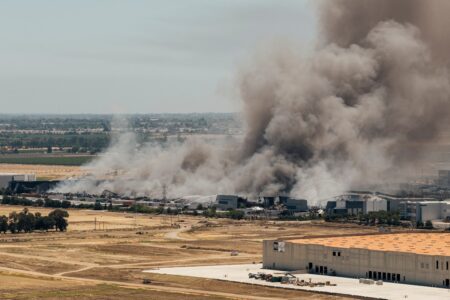
Unhealthy air quality in California city as huge warehouse fire burns for 3rd day
Judge orders Trump administration to restore National Park changes at sites that ‘disparaged’ US
Teens’ reading and math scores have stagnated, US test results show
WASHINGTON (AP) — Younger students have regained ground academically after the pandemic's disruptions while older ...
Lawyers for man accused of killing Charlie Kirk try to block death penalty
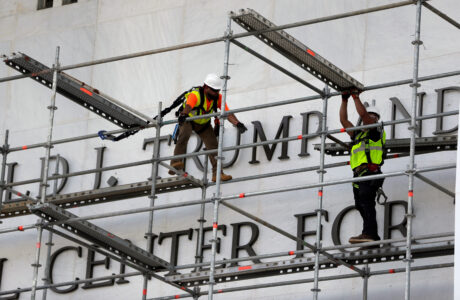
Trump’s name poised to come off Kennedy Center