Iraq weapons hunt switches gears
Baghdad, Iraq ? U.S. military units assigned to track down Iraqi weapons of mass destruction have run out of places to look and are getting time off or being assigned to other duties, even as pressure mounts on President Bush to explain why no banned arms have been found.
After nearly three months of fruitless searches, weapons hunters say they are now waiting for a large team of Pentagon intelligence experts to take over the effort, relying more on leads from interviews and documents.
“It doesn’t appear there are any more targets at this time,” said Lt. Col. Keith Harrington, whose team has been cut by more than 30 percent. “We’re hanging around with no missions in the foreseeable future.”
Over the past week, his and several other teams have been taken off assignment completely. Rather than visit suspected weapons sites, they are brushing up on target practice and catching up on letters home.
Of the seven Site Survey Teams charged with carrying out the search, only two have assignments for the coming week — but not at suspected weapons sites.
Lt. Col. Ronald Haan, who runs team 6, is using the time to lead his troops through a training exercise.
“At least it’s keeping the guys busy,” he said.
The slowdown comes after checks of more than 230 sites — drawn from a master intelligence list compiled before the war — turned up none of the chemical or biological weapons the Bush administration said it went after Saddam Hussein to destroy.
Still, President Bush insisted Monday that Baghdad had a program to make weapons of mass destruction. “Intelligence throughout the decade shows they had a weapons program. I am absolutely convinced that with time, we’ll find out they did have a weapons program,” he said.
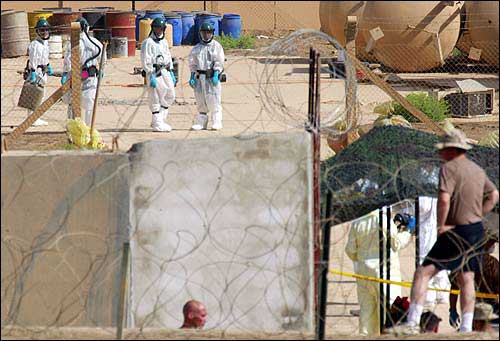
U.N. inspectors from the International Atomic Energy Agency work at the nuclear facility in Tuwaitha, Iraq. The agency's inspectors are trying to assess Iraq's largest nuclear facility, which was looted during the war that toppled Saddam Hussein's regime. U.S. troops hunting for weapons of mass destruction are pulling back for the time being; a new Iraq Survey Group will operate more along the lines of the U.N. weapons inspectors.
The Pentagon’s Defense Intelligence Agency said work would resume at a brisk pace once its 1,300-person Iraq Survey Group takes over.
Ahead of the war, planners were so certain of the intelligence that weapons teams were designed simply to secure chemical and biological weapons rather than investigate their whereabouts, as U.N. inspectors had done.
But without evidence of weapons, the CIA and other intelligence agencies have begun reviewing the accuracy of information they supplied to the administration before the March invasion of Iraq. Government inquiries are being set up in Washington, London and other coalition countries to examine how possibly flawed intelligence might have influenced the decision for war.
“The smoking guns just weren’t lying out in the open,” said David Gai, spokesman for the Iraq Survey Group. “There’s a lot more detective work that needs to be done.”
The group will work more along the model of U.N. weapons inspectors.
Future sites in the search will be compiled from intelligence gathered in the field, and the teams will be reconfigured to include more civilian scientists and engineers, Gai said.
Several former U.N. inspectors from the United States, Britain and Australia, who know many of Iraq’s top weapons experts, will also be brought in.
National
Lawyers for man accused of killing Charlie Kirk try to block death penalty

Trump’s name poised to come off Kennedy Center

Suspect in Texas shooting had fired at police days earlier, officials say

Man pleads guilty to killing a top Minnesota Democrat and her husband
New tornadoes outside Chicago as severe storms pummel the Midwest