Parking ticket policy not fine with everyone
Taxpayers help cover county's tab
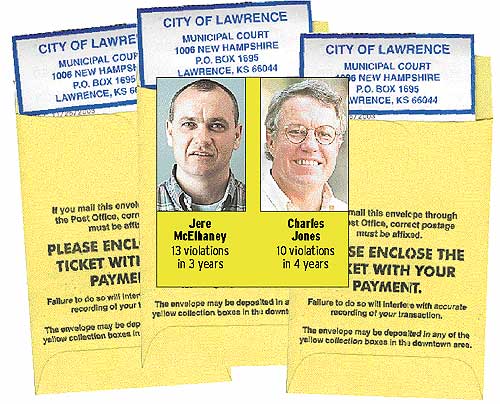
Jere McElhaney often criticizes Douglas County officials for spending too much money for new equipment, replacing old vehicles or financing outside programs.
But when it comes to having taxpayers pay for the handful of parking tickets he gets while on county business, the county commissioner doesn’t see a problem.
“You know, it’s a small and minor detail,” McElhaney said. “I mean, I bet it accounts for less than a hundred dollars a year. Every now and then I turn in a few tickets. I haven’t turned in a lot, but I’ve turned in a few.
“But truthfully, it’s the lowest thing on the radar screen. It’s not that important.”
Don’t tell that to Joe Purcell.
The clerk at Jock’s Nitch Sporting Goods, 837 Mass., spent $434 on downtown parking fines last year — so much that he finally got rid of his 1988 Oldsmobile Cutlass, opting instead for a full-suspension Mongoose mountain bike to ride to class, go shopping and get to work.
Jock’s Nitch didn’t pay for Purcell’s parking tickets, and the Kansas University junior doesn’t much appreciate having to pay for some of McElhaney’s.
“It’s ridiculous,” Purcell said last week. “I didn’t turn around and give mine to anybody. It came out of my pocket. I make $6.50 an hour, and I can pay mine. I’m a college student, and I can pay mine. There’s absolutely no reason they shouldn’t have to pay theirs.”
Both McElhaney and fellow Commissioner Charles Jones — who are paid $20,155 annually by the county — count on taxpayers to pay at least some of the tickets they receive in downtown Lawrence while tending to county business. It’s part of a longtime county policy to cover such costs, said Craig Weinaug, county administrator.
Business justification
The county also pays for ticket violations incurred by county residents called for jury duty, he said. The county has covered $554 in fines for 277 violations so far this year.
It’s a small price to pay for proper public service, Weinaug said.
“We don’t want jurors leaving trials to go feed a meter,” he said. “Nor do I need county commissioners leaving county commission meetings to go feed a meter.
“I tell them all when they first get elected, if they get a parking ticket as a result of their service as a county commissioner, and they’re on county business, that the county will pay it. I don’t have any problems justifying it as county business.”
Not everyone on the commission buys that argument.
“Craig’s told me that, but I’ve told him that’s not how I do business, so count me out,” said Commissioner Bob Johnson, who’s never turned in a ticket to Weinaug for payment. “I’ve never felt it was the county’s responsibility to pay my parking tickets. I don’t consider myself different from any other county employee, and if other employees overpark when they come to work, I wouldn’t expect the county to pay their tickets.
“As a county commissioner, I get paid, and as such I think that I’m responsible for my own day-to-day expenses. That’s just my personal philosophy.”
City officials
Lawrence city commissioners have the ability to get parking tickets voided, provided the commissioner was tending to city business, City Manager Mike Wildgen said. It’s the same provision extended to vendors who haul supplies into city buildings, and to other city employees who handle responsibilities directly related to their jobs.
City commissioners don’t write off their tickets often, Wildgen said, but not doing so would be “unfair, given the amount of time they spend on city business, and we need to take that into consideration.”
“They don’t take advantage,” Wildgen said. “It’s once in awhile. It’s not hardly once every two or three weeks.”
From July 2002 through the end of October of this year, city officials have voided 2,685 of the 139,705 tickets issued by Parking Control officers.
Some of the voided tickets involved city commissioners, but not nearly all, said Vicki Stanwix, Municipal Court manager. Many tickets are voided because a meter had malfunctioned at the time the violation was issued.
Then again, plenty of folks simply go ahead and pay.
“I pay mine,” Stanwix said. “Even when I’m on city business, I pay them.”
‘It’s the principle’
Money collected from fines and meter fees is used to operate and maintain the city’s supply of public parking spaces.
The system generated $244,000 in fines last year, while meter fees brought in nearly $200,000 more. The money pays for parking maintenance and enforcement, downtown landscaping and the presence of two police officers on foot patrol in the central business district.
Sunnye Bertrand, who works as a clerk at The Palace, Eighth and Massachusetts streets, can understand why commissioners get a break. It’s a city system, she figures, and commissioners are in charge.
“If I was a city commissioner, I’d like to have free parking,” she said.
But she’s not. The KU senior figures she’s paid more than $150 in parking tickets during the past year, and she doesn’t like the idea of paying any more to help keep county commissioners off the hook.
“It’s just too much,” Bertrand said last week at the shop. “To void the tickets, that’s fine. But to take the money out, and have the people pay for it? That’s a different story.
“If it’s just a couple bucks, they should just go ahead and pay it. It’s the principle.”
The county administrator’s office has paid $58 in fines on 13 municipal meter violations issued against McElhaney during the past three years. Nine of the violations triggered $2 fines that were paid on time; four of his violations were for $10, the penalty for paying at least two weeks late.
“We get tickets now and then — everybody does,” said McElhaney, who also had a towing bill covered. “Sometimes we just stick them in the truck and we forget about it.”
Jones has had 10 tickets paid by the county during the past four years. He’s had one paid this year.
Having the public shoulder the burden of such costs made sense, Jones said, given the demands of the job. He recalled his tickets coming from parking downtown for lengthy meetings away from the county courthouse, such as at the Lawrence Chamber of Commerce.
“I’d say I’ve spent hundreds and hundreds of hours parked at the meter while on county jobs,” Jones said. “In that time I’ve had maybe a handful of tickets. It happens.”
Freeing up space
When it comes to regular commission meetings, both Jones and McElhaney say they typically park at meters on Massachusetts Street to free up spaces alongside the county courthouse for regular customers. The county’s lot has about 20 spaces, and parking there is free.
“I try to keep the free spaces available to the public,” Jones said. “I think staff ought to be encouraged to park away from the free spaces and let our customers use the spaces that are closest to the building and free.”
McElhaney also said he opted for a metered space because of the size of his truck. He doesn’t want to squeeze too close to a car in the courthouse lot, which would make it more difficult for others to get in and out of their own vehicles.
“I feel very strongly that I don’t have to park that close and I can park out in the street somewhere,” McElhaney said.
Megan McKeague appreciates the sentiment, but doesn’t much understand the logic.
The waitress at Buffalo Bob’s Smokehouse, 719 Mass., parks in the city’s dedicated long-term lots — ones with meters that can accept a full day of payments — instead of at short-term spaces intended for shoppers.
Part of that’s because her boss, Bob Schumm, forbids employees from taking up short-term spaces. McKeague doesn’t understand why some commissioners don’t take the same approach.
Either that, or pay their own violations.
“It’s not fair,” said McKeague, who’s been working downtown for four years. “Why should we have to pay for their tickets? That doesn’t make much sense at all.”
City Government
Soccer gear honoring Lawrence history’s all-star team is now on sale as part of city’s public art exhibition
To honor public servants, Lawrence’s July 4 celebration will have a whole gallery of their photos on display; submissions open now
North Lawrence study consultants look at possibilities for a grocery store, food truck park, traffic calming and more
Algerian ambassador gives Lawrence a gift for supporting national team – a piece of art
Lawrence City Commission approves incentives for Alarm.com’s office project in downtown building