Technology aids dispatchers
When Melinda Hegeman was hired as an emergency dispatcher 15 years ago, she had two weeks of training.
Hegeman still dispatches for what has evolved into the Douglas County Emergency Communications Center, but now it takes eight months to train someone for the job she does. It takes at least two years before someone becomes proficient, center director Jim Denney said.
“It’s a lot of technology,” Hegeman said, describing how the dispatching job has changed. “It’s gone from stamping cards to being all computerized.”
Hegeman is one of 19 dispatchers and 911 call-takers employed by the center in the Douglas County Judicial & Law Enforcement Center, 111 E. 11th St. They dispatch for all municipal and county law enforcement agencies as well as all fire departments and ambulances.
“We’re a public safety dispatch center. We dispatch for everything,” Denney said. “In the days of old, you had a police dispatcher and when they had the time they dispatched a fire truck.”
The dispatchers operate in a center that includes about $1.8 million worth of high technology radio, dispatch computers and phone equipment, Denney said. That doesn’t include radio tower transmitters and other integrated computer systems, he said.
The center’s budget for this fiscal year is about $900,000, Denney said.
Although there are consoles for six dispatchers usually there are only three or four working at a time.
One console contains three computer screens for accessing nearly 20 computers housed in another room, Denney said. The computer system keeps track of radio communications, telephone call record checks and other related functions.
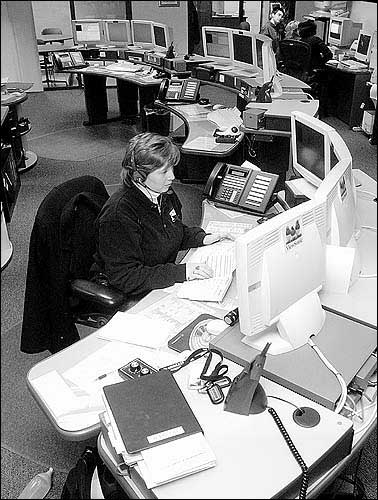
Heather Lemon, a 911 call-taker, receives a call at the Douglas County Emergency Communications Center. Additional computers in the dispatch center show detailed maps of the entire county.
If three dispatchers are working, one is assigned to handle all law enforcement radio calls. The second dispatcher handles all fire and medical calls. The third dispatcher takes requests from officers wanting records checks and handles all nonemergency phone calls.
The county’s 911 calls come in over one of 32 phone lines, Denney said. Any of the dispatchers who aren’t busy can answer the 911 calls. The phone ring for a 911 call differs from the sound of other phone calls. It sounds like the honk of a goose.
“There is a prioritization on how things are handled,” Denney said of dispatching operations. “It allows the operators to triage business.”
Additional computers in the dispatch center show detailed maps of the entire county, which Kansas City area trauma centers are open for patients and even which officer or firefighter is keying his radio microphone.
The radio system makes use of nearly 40 channels, most on a two-year-old 800 megahertz system. Many of the transmissions on those channels, however, flow back through one of five repeater amplified channels. Groups of radios, such as those used by detectives and patrol cars, are constantly switched electronically from one repeater channel to another so the talk groups don’t interfere with one another.
In case of emergencies such as a loss of power, a dispatcher can use a laptop computer to access much of the information available at a radio console. They would talk over a walkie-talkie.
“We can dispatch from the back of a car or just about anywhere,” Denney said. “It keeps us from having an unused dispatch center for backup that would cost us millions.”
Communications center equipment will get more complex in the future, Denney said. A system will eventually be developed to trace 911 cell phone calls.
The Douglas County Sheriff’s Office last year received a $318,000 grant approval that, among other things, will allow installation of another computer data system in the communications center.
City Government
Developer seeks incentive from City of Lawrence to build 131 units of housing near Wakarusa and Queens

Lawrence city leaders will consider whether to keep Community Building open, make 2 other rec centers free to access
A STAR Bond application raises questions for city leaders about Costco and housing west of the SLT

Soccer gear honoring Lawrence history’s all-star team is now on sale as part of city’s public art exhibition
To honor public servants, Lawrence’s July 4 celebration will have a whole gallery of their photos on display; submissions open now