

Roberts resists resting on laurels, claiming easy Senate victory
Washington ? The man regarded as America’s funniest senator can afford to sit back and have a laugh or two: He’s in the type of zone that politicians rarely enjoy.
U.S. Sen. Pat Roberts, a Kansas Republican, has the respect of his peers in a job he loves. He has a high-visibility oversight role in the war on terrorism, and best of all for any politician Roberts has no major-party opponent in his bid this year for a second term. He’s one of just three senators with that particular blessing.
On the lighter side, Roberts recently was named funniest senator for the second straight year in a poll of congressional staffers.
“I think they call me pleasantly irascible,” Roberts said. “I sort of like that.”
Even that seemingly trivial accolade is a boon to Roberts, said Norman Ornstein, a congressional expert at the American Enterprise Institute.
“He’s basically a pretty straight down the line conservative,” Ornstein said. “But if you leaven that with a good sense of humor, it makes your relations with your colleagues on the other side of the aisle a little bit easier, and you don’t get pigeonholed the same way.”
Yet with all that going for him, Roberts says he isn’t taking anything for granted in his re-election bid.
“Every time you put your name on the ballot, I think you have to earn the respect and the vote of your constituency,” Roberts said. “I don’t think there’s any substitute for personal contact.”
Roberts, 66, has labored to make that personal contact, having just completed a listening tour of all 105 Kansas counties. He plans to augment that by spending some of the $925,000 in his campaign treasury on TV and radio ads to remind people not only of his record but also in a year dominated by the gubernatorial race to remind them that he is on the ballot.
Observers say the longtime congressman made a smooth transition to the more staid Senate and that his low-key style is well suited to the collegial upper house.
“As a politician, he’s an institutionalist,” said Burdett Loomis, a political science professor at Kansas University. “This is a guy who believes in representative democracy, with all its flaws. He goes to work each day and tries to make it work, unlike a lot of people up there.”
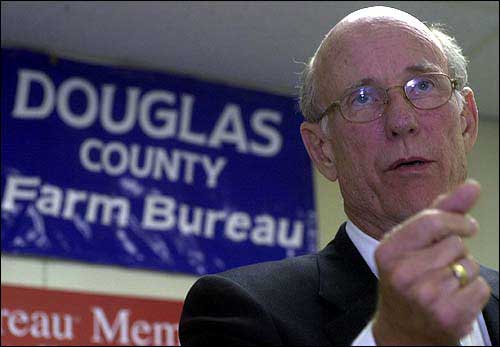
US. Sen. Pat Roberts, R-Kan., addresses the Douglas County Farm Bureau's annual meeting, about a likely lack of federal funding to combat farmers' troubles with the 2002 drought. The senator has a fairly clear path to re-election in November because no major contenders have stepped forward.
Roberts said simply, “if you’re willing to work with people, it’s amazing what you can get done.”
As a member of the Agriculture Committee, Roberts continued to work in the Senate on the farm issues that defined his eight-term career in the House.
But he also became a well-respected voice on foreign policy. As a member of the Intelligence Committee and as ranking Republican on the Armed Services Committee’s subcommittee on emerging threats, Roberts has become, since the Sept. 11, 2001, attacks, an important player in the war on terrorism.
Should the Republican Party retake the Senate, Roberts may be in line to lead the Intelligence Committee. If so, a large chunk of his time would be spent working with a proposed independent commission that would investigate Sept. 11, as well as continuing to monitor the nation’s progress in the war.
“People knew him,” Ornstein said. “Sixteen years in the House will do that. So senators were very comfortable giving him responsibility to begin with.”
Veteran lawmaker
Indeed, Roberts, of Dodge City, may cultivate the sardonic humor and pragmatic approach of a Kansas plainsman bringing a dose of common sense to the big city, but he has spent most of his working life on Capitol Hill and is as comfortable in the halls of Congress as anyone.
Starting in 1968, Roberts served as an aide to U.S. Rep. Keith Sebelius. Roberts won his boss’ western Kansas House seat in 1980 after Sebelius chose to retire. In 1996, Roberts ran to succeed retiring Sen. Nancy Kassebaum. His Democratic opponent was state Treasurer Sally Thompson, against whom Roberts won 62 percent of the vote.
It will be even easier this time around.
Former congressman and former U.S. Agriculture Secretary Dan Glickman was widely viewed as Roberts’ toughest potential opponent, but Glickman decided against taking on his old friend.
“To run for the Senate you have to do nothing else, you have to want it more than life itself,” Glickman said. “If I had felt negatively or viscerally about Pat Roberts, I might have done it. But I didn’t feel that way.”
Little competition
Because of the Democrats’ inability to find a candidate, only two opponents, both third-party candidates, stand between Roberts and a second term.
Steven Rosile, 50, a self-employed Wichita construction worker and freelance computer troubleshooter, is running on the Libertarian Party ticket. He advocates eliminating the federal income tax, federal foreign aid and all forms of welfare.
Reform Party candidate George Cook, 34, of Mission is a Navy veteran who works for an armored-car company. He would try to repeal the North American Free Trade Agreement and partly privatize Social Security.
Farm Act considered failure
Both opponents point to the Freedom to Farm Act of 1996 which largely was Roberts’ creation when he led the House Agriculture Committee as Roberts’ biggest failure in Congress. The law was designed to give farmers more flexibility and to remove the long-used price support system for crops. But it went into effect just as a recession hit the worldwide farming market.
Roberts acknowledged that Freedom to Farm “didn’t work out as anybody would have hoped,” but he said the farm bill that was passed this year and signed into law by President Bush “doesn’t work out on the High Plains or in wheat country.” Roberts said he hopes to make the bill more helpful to Kansas farmers, who, he said, are in “desperate shape.”
Roberts’ political fortunes do not appear to have been affected by the failure of Freedom to Farm.
“I think people just throw up their hands at agriculture and say, ‘What are you gonna do?,”‘ Loomis said.
State Government
State legislators push back against federal energy regulators ending competitive bids
TOPEKA — Two Kansas legislators asked federal energy regulators to ensure competitive bidding occurs on ...
Senate confirms 1st of 3 Kansas nominees to U.S. District Court
Corporate income tax collections falling sharply in Kansas; Republican, Democratic leaders disagree on what it means
TOPEKA — Corporate income tax collections in Kansas have almost halved since last year, while other sources trend ...
Candidate’s campaign manager created website with documents used to attack rival
TOPEKA — Kansas U.S. Senate candidate Patrick Schmidt’s campaign manager left his digital footprint on ...
GOP secretary of state files to run for governor
