Grand Rapids students help KU researchers track butterflies
Grand Rapids, Mich. ? Every fall thousands of Monarch butterflies emerge from chrysalises in America to begin a long journey to the mountains near Mexico City.
This year a few of those butterflies got a little help from students at a Grand Rapids elementary school and a program designed to track their trip.
Students at the Stepping Stones Montessori School were enlisted to help research the butterflies’ journey a feat that’s unequaled in the insect world.
“People have been studying Monarchs for a long time, but so much about their migration is still a mystery,” biologist Mat Douglas told students at the school last week.
Douglas heads up the regional office of Monarch Watch, a collaborative project to study Monarch butterfly migration, from the biology department at Grand Rapids Community College, where he is chairman.
More than 600 educators and their students in 30 states are participating in Monarch Watch, The Grand Rapids Press reported in a Friday story.
Volunteers capture and tag migrating monarchs with tiny adhesive tags on the right hind wing. Each tag includes a Kansas University return address and an identification number, allowing it to be matched to the releasing school.
Douglas hopes to expand the program to other Grand Rapids schools as soon as Monarch populations rebound from a freak winter storm which last year wiped out about 100 million butterflies in a single roost.
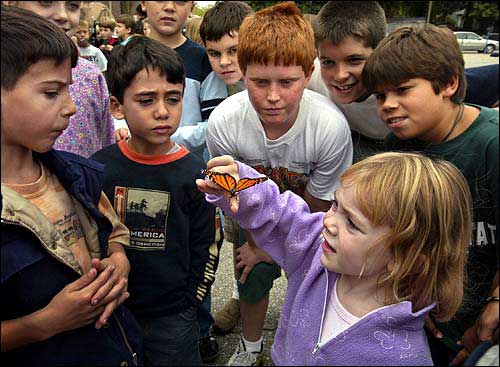
Students from the Stepping Stones Montessori School in Grand Rapids, Mich., wait and watch to see if the Monarch butterfly Emma Wright, 5, is trying to release will take to the air. The students were enlisted to help research the butterflies' journey.
An estimated 20 million Monarchs survived, but it will take a few years of good conditions for the species to recover.
Douglas supplied Stepping Stones teachers Linda Wynbeek and Becky McNamara with leaves with caterpillars on them. Their development was at about day two of the butterfly 25-day metamorphous cycle.
The young students studied the Monarch life cycle. They even helped Douglas feed the butterflies sugar water to fuel up for their two-month trip.
“It only takes a few minutes from the time the skin splits to the time the chrysalis emerges, and we got to see it,” Wynbeek said. “That’s a great moment for everybody.”
City Government

Soccer gear honoring Lawrence history’s all-star team is now on sale as part of city’s public art exhibition
To honor public servants, Lawrence’s July 4 celebration will have a whole gallery of their photos on display; submissions open now
North Lawrence study consultants look at possibilities for a grocery store, food truck park, traffic calming and more
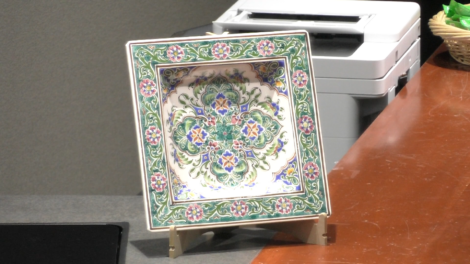
Algerian ambassador gives Lawrence a gift for supporting national team – a piece of art
Lawrence City Commission approves incentives for Alarm.com’s office project in downtown building