Haskell student uses shock value to convey film’s message
The ritual helps them work out their anger.
Every Columbus Day, the young American Indian men in Thomas Yeahpau’s film “Hate Equals Hate a.k.a. Columbus Day” find an innocent white man and convince themselves he’s the real Christopher Columbus. Then, they kidnap, beat and murder him.
Sound grisly? It is, but that’s the point.
Yeahpau, a 27-year-old business management student at Haskell Indian Nations University, was gunning for shock value when he shot the film last year in Lawrence.
“It was a strong way for me to get my message across about how Native Americans have mixed emotions about Columbus Day,” said Yeahpau, a member of the Kiowa tribe and native of Anadarko, Okla.
Screenings of the film at Haskell, the Bare Bones Film Festival in Muskogee, Okla., and this summer’s Harvest of the Arts Film Festival got good reviews, though “Hate Equals Hate” didn’t place in the competitions.
Later this week, Yeahpau will get feedback from a national audience when he shows his 18-minute movie at the 27th annual American Indian Film Festival in San Francisco. Big names like Chris Eyre, who directed 1998 Sundance Film Festival winner “Smoke Signals;” Sherman Alexie, who wrote the book on which that movie is based; and American Indian writer Joy Harjo will be premiering movies or speaking at the festival.
“My hope is just to branch out with the Native-American cinema community, get myself known,” he said. “I want to keep on doing this, making short films, until I get noticed so I can become a feature film director.”
Unexplored territory
Yeahpau said not many American Indian filmmakers had explored the mixed emotions the native community feels toward Columbus Day, a federal holiday that celebrates the European explorer’s discovery of the New World ” never mind the fact that the genocide of indigenous peoples followed his arrival.
“On a personal level, I would say almost everybody on campus, almost every Indian I know, doesn’t celebrate Columbus Day. They find it offensive,” he said. “We see it as America celebrating a murderer and a rapist.
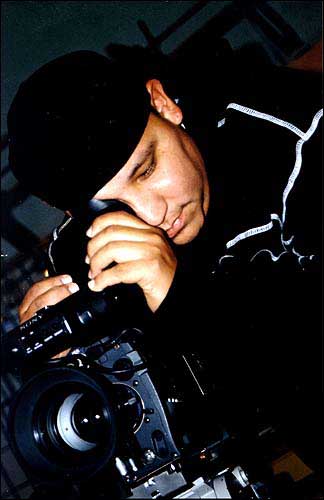
Haskell Indian nations university student Thomas Yeahpau shot his short film Hate
“He never really found America. It was already found.”
In “Hate Equals Hate,” Yeahpau plays the main character, Savage, who for years has participated in the homicidal ritual. But this year is different because, unbeknownst to his friends, he has married a white woman while away at college. He manages to conceal the secret until his wife, whom he leaves cooped in a motel room while he goes to shoot a white stranger in the head, begs to go for a walk in the park.
He caves and too soon realizes the consequences of his decision when his still-hostile friends find him with his bride.
“It seems like it’s going in the wrong direction until the very end, when my character chooses love over hate,” Yeahpau said.
Yeahpau flirts with American Indian stereotypes, like the savage, in this and his other films. He said Caucasian audience members occasionally felt threatened by the graphic violence in “Hate Equals Hate,” but that’s not his intention.
“Everything I do, writing and everything, I go to the extreme level,” he said. “I do it so the Native Americans know that I’m just being entertaining. But it has a downfall to it: People who don’t know that I’m just toying with this take it really, really seriously.”
Waiting for a breakthrough
Yeahpau and his crew shot the film footage during two days last December. He and his urban hip-hop band, “NDNS,” created an original score for the film. The editing took three months.
It was Yeahpau’s first movie. He has since finished two more: “An Indian Couple at Supper” and “Bros.”
He’s been helped along by Haskell’s Stories in Motion Film Club, from which he pulled some of the actors and actresses for the movie. The club’s faculty adviser, TV production instructor Bill Curtis, has given him pointers on using the school’s editing equipment.
Beyond technical advice, though, Curtis stays out of the creative process.
“It’s been really kind of exciting to me to see the kids really taking an interest and really wanting to do something,” Curtis said of Yeahpau’s and other projects coming out of the club.
“With the advance of the small digital cameras that are pretty good quality, they’re able to get pretty good results with their shooting.”
Yeahpau’s hoping his efforts will, one day, hurdle him into the film industry.
“I have feature scripts already written,” he said. “I’m just waiting until I make my breakthrough.”
Arts and Entertainment

Watkins Museum to open special exhibit detailing how Douglas County celebrated America’s Bicentennial

Go, See, Do: Kaw River Roots Festival, markets and more
Soccer gear honoring Lawrence history’s all-star team is now on sale as part of city’s public art exhibition

Nominations, call for artists open for Lawrence’s 2026 Phoenix Awards
Go, See, Do: ‘Addams Family’, PRIDE parade and a host of library events among offerings