

Elephant breeding project hopes to spark romance
SPRINGFIELD, MO. ? Sabu ambles up and down a well-trodden path, occasionally stopping to slip his trunk outside his pen and sniff in the girl’s direction before snatching a clump of grass.
Pinky gives him the once-over and gurgles.
The first signs of elephant love?
Keepers at Dickerson Park Zoo in Springfield hope so.
The zoo is looking to revive its nationally recognized Asian elephant breeding program that has been in a state of uncertainty since its bull Onyx ” who sired 12 calves ” died in May.
Sabu, a 14-year-old caught wild in Malaysia, arrived in September at the southwest Missouri zoo. He is on loan from the Cincinnati Zoo.
“Sabu is particularly important because he is wild and his genes are not overly represented in the captive population,” says Jeff Glazier, senior elephant keeper at Dickerson Park. “He also is a proven breeder.”
Sabu has only one offspring ” a 4-year-old calf he sired while in Cincinnati.
A good match
The committee of elephant management professionals overseeing the American Zoo and Aquarium Assn.’s captive breeding program has blessed the union of Sabu and Pinky.
Mike Keele, committee chairman, sees their offspring as an asset because it would add diversity to the gene pool. Of the 13 males in captivity under age 25 years old, Sabu is only one of two that were caught wild, he says.
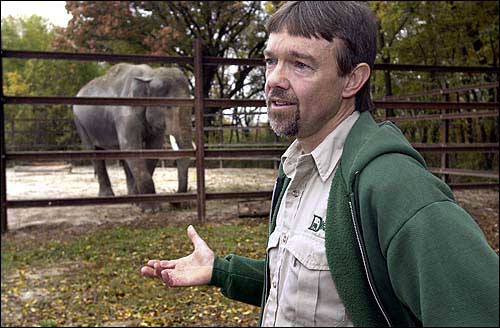
Dickerson Park Zoo's senior elephant keeper, Jeff Glazier, is shown at the zoo in Springfield, Mo., in front of Sabu, a male elephant. The zoo is looking to revive its nationally recognized Asian elephant breeding program that has been in a state of uncertainty since its bull Onyx who sired 12 calves died in May.
While Dickerson Parks’ first pregnancy occurred in 1983 between Onyx and Pinky, the calf was stillborn in 1985. Pinky has since successfully delivered two other calves ” one in July 1991 and another in February 1995.
It remains to be seen whether Sabu will develop a romantic interest in 38-year-old Pinky.
Glazier leaves the concrete doors to their pens open slightly overnight in hopes of fostering a relationship. Elephants communicate by touch, sound and scent.
“They’re eyeballing each other,” Glazier says.
The two will be united in an outdoor fortress-like pen when Sabu enters the breeding period of “musth” ” the elephant equivalent of rutting ” and blood tests indicate Pinky’s progesterone level is conducive to conception.
Other means
That is about as much as Glazier and his staff can do to help the 8,000-pound Sabu hook up the old-fashioned way with the 7,400-pound Pinky. But there are options in the event of unrequited love, Glazier says.
“If it just isn’t working out and it appears natural breeding isn’t going to work, then we have other options such as artificial insemination,” he says. “But that would be further down the road.”
Still, Dickerson Park is hopeful and eager to get back on course the breeding program it started in 1980 with the donation of Onyx.
It is one of a handful of zoos in the United States with a successful Asian elephant breeding program. Most are in larger cities ” Syracuse, N.Y, Portland, Ore., and Houston ” with larger facilities.
The programs are important, Keele says, to ensure the species’ survival. Only about 38,000 Asian elephants remain in the wild. The captive population hovers around 350.
Dickerson program
Onyx sired 12 of the 126 calves born in captivity since 1962. Five remain: Raja is at St. Louis Zoo; Asha and Chandra are at Oklahoma City Zoo; Shanti is at Houston Zoo; and Hansa is at Woodland Park Zoo in Seattle.
Onyx also was the focus of much research and helped the zoo learn about semen collection, analysis, extension and cryopreservation.
After some 15 years of elephant reproductive system research and failed attempts, Dickerson Park made world history in November 1999 with Haji ” the first Asian elephant born by artificial insemination.
The zoo was dealt two blows this summer. Onyx died in May of a ruptured intestine, and Haji died in July of a herpes virus.
“It illustrates how tenuous captive breeding programs can be,” says Keele, who also is assistant zoo director in Portland. “Here you have Dickerson Park Zoo that had three bulls ” one of them was very prolific and one of them was the first artificial insemination baby. Seemingly overnight, everything changed.”
Dickerson Park’s reputation made it relatively easy for them to find another bull, Keele says.
“The kind of commitment that they have taken on with elephants is not one that you would expect for a zoo their size,” he says.
State Government
State legislators push back against federal energy regulators ending competitive bids
TOPEKA — Two Kansas legislators asked federal energy regulators to ensure competitive bidding occurs on ...
Senate confirms 1st of 3 Kansas nominees to U.S. District Court
Corporate income tax collections falling sharply in Kansas; Republican, Democratic leaders disagree on what it means
TOPEKA — Corporate income tax collections in Kansas have almost halved since last year, while other sources trend ...
Candidate’s campaign manager created website with documents used to attack rival
TOPEKA — Kansas U.S. Senate candidate Patrick Schmidt’s campaign manager left his digital footprint on ...
GOP secretary of state files to run for governor
