Witness describes al-Qaida cave complex
GARDEZ, Afghanistan ? A man who claims he was abducted and taken to the al-Qaida and Taliban mountain base under siege by the U.S. military estimated Saturday that there were more than 1,000 fighters there and said they have managed to remain relatively secure inside their elaborate caves despite heavy U.S. bombing.
Abdul Rahman Beheshti, a 22-year-old satellite television technician, would be the first eyewitness to speak out about recent events inside the Shahi Kot cave complex, where a combined force of Afghan Taliban and foreign al-Qaida fighters has held out despite an intensive, eight-day U.S.-led air and ground campaign.
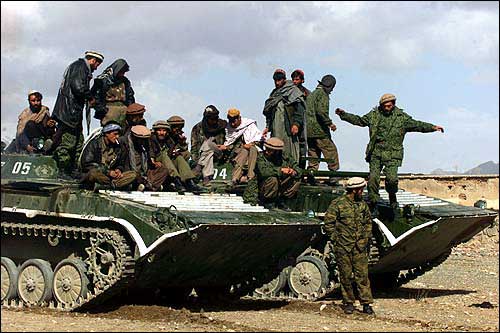
Afghan soldiers sit on top of armored personnel carriers at their base in Gardez, the capital of the eastern Paktia province of Afghanistan. Afghan troops and tanks continued to rush to the battle zone Saturday as U.S. forces pushed ahead in the biggest U.S.-led military offensive of the war on terrorism.
While his account could not be verified independently, Beheshti sounded convincing as he sat nervously in a dingy restaurant and later at a private house and for almost 2 1/2 hours described being captured, moved from cave to cave, and let go after seven days during which he installed and programmed five satellite TV dishes and receivers for his captors.
Allied assault continues
The assault on the Shahi Kot complex began March 2, but so far the only information about it has come from U.S. military spokesmen and some of their Afghan allies reporting that the Taliban and al-Qaida fighters have suffered more than 500 dead, that their escape routes are being choked off and that they are near to being wiped out or surrendering.
Navy Lt. Timothy Boehlke, a spokesman for the U.S. Central Command in Tampa, Fla., which is directing the war, said the tempo of the battle near Gardez had changed little Saturday as airstrikes and ground activity continued. No new casualties had been reported within the U.S.-led coalition, which continued to dominate the battle, Boehlke said.
Beheshti’s account, given to a small group of reporters that included representatives of the Los Angeles Times and The Washington Post, presented a sharply different view. He said that the Taliban and al-Qaida forces deep inside their granite caves were amply supplied with arms, food and creature comforts, including Walkman televisions.
He said that they were well-sheltered and that from the caves in which he was held he barely could hear bombs falling in the distance. During the course of the week, he said, he saw only two dead Taliban.
Inside the caves
Beheshti said that judging from the large number of fighters who crowded into the caves when the bombing started, and those whom he could see when he was being moved around, he believes there are more than 1,000 fighters there.
For the most part, Beheshti said, the cave floors were covered in carpets, with pillows and mattresses lining the walls. Light came from solar-powered tube lamps, he said, and some of the caves had paved terraces in front.
The caves had many entrances and exits and were often connected to one another, he said. Some were used to store weapons and ammunition, he said.
Aside from himself, Beheshti said, his captors had one Western prisoner who had been taken captive sometime earlier, before the beginning of the assault on Shahi Kot, and who was being tortured with severe beatings. Beheshti said that the captive was tall and light-haired and spoke English but that he did not know his nationality.
During the week, the Taliban and al-Qaida fighters captured about seven Afghans who they said had been fighting alongside the Americans, Beheshti said. He said they were later taken away and likely freed.
According to Beheshti, his seven-day ordeal began March 1 when a man came to his workshop in Gardez and asked him to install a satellite dish in the town of Zormat, southwest of Gardez.
But when he got there, he said, he was taken farther, to a village named Kolalgu. From there, he said, he was forced at gunpoint into a pickup truck, blindfolded and led on foot into the Shahi Kot cave complex, where he was informed that he was a prisoner.
His captors demanded that the satellite dishes he installed be able to tune in the Al Jazeera channel, an all-Arab news station based in Qatar.
National
Unhealthy air quality in California city as huge warehouse fire burns for 3rd day
Judge orders Trump administration to restore National Park changes at sites that ‘disparaged’ US
Teens’ reading and math scores have stagnated, US test results show
WASHINGTON (AP) — Younger students have regained ground academically after the pandemic's disruptions while older ...
Lawyers for man accused of killing Charlie Kirk try to block death penalty

Trump’s name poised to come off Kennedy Center