LMH features innovative prostate treatment
Lawrence Memorial Hospital has become the first site in Kansas to perform a new, minimally invasive laser treatment for enlarged prostate, a condition that affects more than 13 million men in the United States.
The problem can now be treated at the hospital with a laser that relieves symptoms immediately with no side effects.
The new approach — called Niagara PVP, for photo-selective vaporization — is a laser with the strength of an 80-watt light bulb that vaporizes excess prostate tissue.
The 20-minute procedure, performed under anesthesia, has many advantages over traditional forms of treatment for the condition: It causes no blood loss, is relatively painless, often requires no overnight hospitalization and has an extremely quick recovery period with excellent results.
Doctors thread a laser tip, through a thin tube, into the urethra. Niagara Laser Treatment works by completely vaporizing the excess prostate tissue quickly, immediately sealing the surrounding area and preventing any bleeding.
Patients typically go home within a few hours and can return to nonstrenuous activities in a day or two.
Dr. Jon Heeb, a urologist on staff at LMH, trained with the laser’s inventor and has already used Niagara PVP in 11 or 12 cases at the hospital.
“This procedure seems destined to revolutionize the treatment of BPH (benign prostatic hyperplasia). The beneficiary, of course, is the patient who can now receive excellent relief from symptoms with minimal risk,” he said.
“The community of Lawrence, especially with its considerable retirement-age population, has numerous men who would benefit in many ways from this treatment.”
A grant of $86,400 from the Ethel and Raymond F. Rice Foundation of Lawrence to the LMH Endowment Assn. made the purchase of the laser system possible.
“This is a generous recognition of community support. We are so grateful for the Rice Foundation’s commitment to enhance health care for our (Lawrence) residents by funding this innovative equipment,” said Nancy Longhurst, the endowment association’s president.
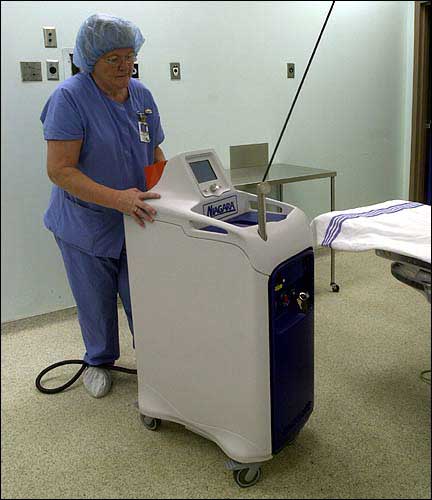
Mary Smith, registered nurse, works with the new Niagara PVP at Lawrence Memorial Hospital. The equipment performs a minimally invasive laser treatment that eases enlarged prostates.
Niagara PVP was federally approved last year. Originally demonstrated for three years at the Mayo Clinic in Rochester, Minn., it has successfully passed a multisite, clinical evaluation.
The new laser procedure has the potential to be used widely to help many patients.
More than half of all men over the age of 60 develop an enlarged prostate, a common condition that forces men at mid-life to make frequent trips to the bathroom. By age 80, nearly 80 percent of all men have Benign Prostatic Hyperplasia.
Without treatment, the urethra can eventually become completely blocked. Symptoms include the urge to urinate frequently, difficulty urinating and incomplete urination.
Until now, treatment options included medication therapy, ultrasound and transurethral resection surgery.
Medication therapy can improve symptoms of this condition, but it requires daily medication for life with expensive drugs that have fairly significant side effects.
Surgery offers inconsistent benefits, and it requires general anesthesia, a one- to two-day stay in the hospital, and can lead to incontinence and sexual dysfunction.
It also causes significant bleeding and can require patients to leave the hospital with a catheter in place.
City Government

Soccer gear honoring Lawrence history’s all-star team is now on sale as part of city’s public art exhibition
To honor public servants, Lawrence’s July 4 celebration will have a whole gallery of their photos on display; submissions open now
North Lawrence study consultants look at possibilities for a grocery store, food truck park, traffic calming and more
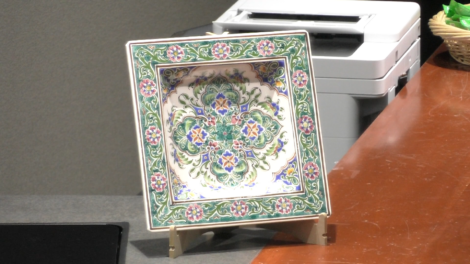
Algerian ambassador gives Lawrence a gift for supporting national team – a piece of art
Lawrence City Commission approves incentives for Alarm.com’s office project in downtown building