Intersections ranked by crash rate
Lynn Brien didn’t find it particularly difficult Thursday to maneuver through the intersection of Seventh and Kentucky streets on his way to the post office.
So he was a bit surprised to learn the intersection tops the list of sites city traffic engineers say could use a traffic light.
“I would doubt if they need one,” Brien said. “I don’t have any problems going through there.”
But Brien and other drivers probably won’t have to slow for a red light at the intersection anytime soon.
That’s because traffic lights are expensive enough that the city can generally afford to add only one or two a year, unless state officials agree to pay for an intersection they deem particularly needy.
“In a perfect world, we’d try to take care of everything we possibly could,” said Mayor Sue Hack.
The city each year compiles and ranks its list of top intersections needing signals. The ranking is based on the daily volume of traffic multiplied by the number of crashes that have happened at that site in the past three years.
Traffic engineers then use that number to calculate how many crashes might be expected at an intersection for every 100 million cars driving through. For Seventh and Kentucky, the number is 162.73.
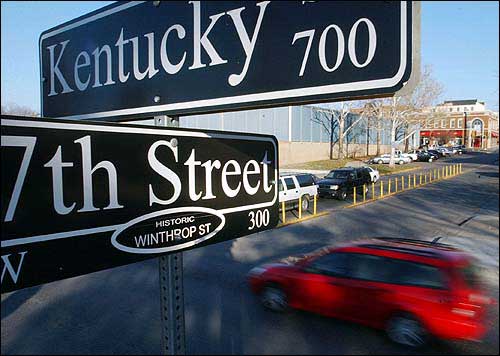
The intersection of Seventh and Kentucky streets is the most in need of a traffic light, according to city traffic engineers, based on daily traffic volume and frequency of accidents. But a tight budget means the site probably will not get a light anytime soon.
It’s a number deliberately designed to impress. At its current rate of 14,000 cars per day, it would take roughly 19.5 years for 163 crashes to occur at the intersection.
“If we did it per million (cars), some of these numbers would be 0.05, which doesn’t mean anything to anybody,” said David Woosley, the city’s traffic engineer.
That’s still an average of eight crashes per year. But Seventh and Kentucky still isn’t getting a signal this year. Thirty-first Street and Nieder Road, third on the city’s list, gets that honor.
The intersection of 31st and Nieder has a crash rating of 79.98 — a little more than five crashes per year for the 18,000 cars entering the intersection every day.
Thirty-first and Nieder moved to the head of the list because nearby 31st and Iowa already is being torn up to expand lanes and add a traffic signal to make way for a new Home Depot store being built nearby.
“It’s a matter of opportunity,” said City Manager Mike Wildgen. “Instead of tying up the intersection for three years, we thought we’d do it in one year.”
Where lights are needed
*Based on three-year crash history, 1999-2001; crash rate is per 100 million cars. 15th and Wakarusa makes the list because of its high traffic volume. |
It also helps if the city can get help paying for a signal. The Kansas Department of Transportation deemed 31st and Iowa traffic sufficiently bad to warrant it paying $300,000 for the new signal there.
“We look for grants first,” Wildgen said.
The city won’t be able to take care of all its traffic signal priorities in one year, though.
It costs as much as $750,000 to put in a new signal; more if it’s done in conjunction with other improvements to the intersection.
“Every one of them,” Wildgen said of intersection improvements, “is more complicated than the signals themselves.”

 6News video: City has priority list for stoplights
City Government

Soccer gear honoring Lawrence history’s all-star team is now on sale as part of city’s public art exhibition
To honor public servants, Lawrence’s July 4 celebration will have a whole gallery of their photos on display; submissions open now
North Lawrence study consultants look at possibilities for a grocery store, food truck park, traffic calming and more
Algerian ambassador gives Lawrence a gift for supporting national team – a piece of art
Lawrence City Commission approves incentives for Alarm.com’s office project in downtown building