

Cyber actress comes out as real
Los Angeles ? The movie’s credits don’t include her name. But Rachel Roberts, who plays the title character in “Simone,” at last can tell the world she’s a flesh-and-blood star, not a pixellated performer stitched together by some cyber-Frankenstein.
New Line Cinema kept Roberts under wraps for almost two years in hopes of building buzz that Simone was purely a computer concoction.
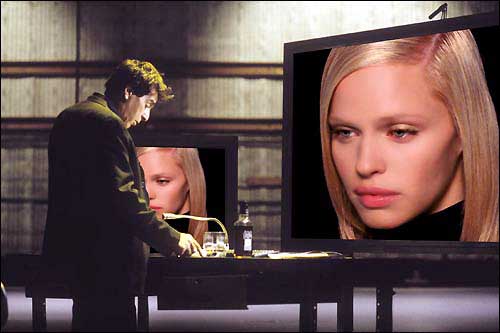
Al Pacino, left, stars as a disillusioned director in the new film Simone with Rachel Roberts, right. The movie's credits don't even include her name, but Roberts, who plays the title character in Simone, finally can tell the world she's a real person, not a cyberspace creation.
The film, opening Friday, stars Al Pacino as a washed-up director who creates a virtual actress that the public believes is real.
The truth is, Simone is both real and computer-simulated, but most of the character is Roberts, a Canadian model who has been on the covers of Vogue and Elle and appeared in the Sports Illustrated swimsuit edition. This is her film debut.
“There is a real person in there,” said Roberts, only recently freed from New Line’s gag order that prevented her from disclosing she’s in the film. “People who know me recognize the character as me.”
For months, Internet movie sites have named Roberts as the actress playing Simone, but the film’s production notes exclude her and describe the character largely as a computer amalgam of voices and body parts from other Hollywood leading ladies.
Simone’s voice and body were augmented by computer with elements of other actresses, but Roberts is the principal source, said writer-director Andrew Niccol, who until recently had been mum about her identity.
“Simone is 98.6 percent Rachel Roberts, and I use that percentage just because that’s the temperature of the human body,” said Niccol, who wrote “The Truman Show” and wrote and directed “Gattaca.”
During filming last year, Roberts was unable to tell even family and friends what she was up to. She worked under the pseudonym Anna Green, short for “anamorphic green screen,” a technical term in shooting sequences that will be enhanced digitally later. Roberts sneaked onto the set in wigs and other disguises and was known as “the stand-in” for Simone to much of the film crew, who thought she would be replaced in post-production by a digital actress.
The end credits list “Simone as Herself,” with no mention of Roberts. While Pacino and other “Simone” co-stars did publicity interviews in person, Roberts in character still pre-recorded responses that were played for reporters on a TV monitor.
Concealing Roberts’ identity as a marketing gimmick fit the themes of the movie, which satirizes Americans’ obsession with celebrities, Niccol said. It also brought home the point that Hollywood often fools audiences by tweaking images and performers with digital wizardry, he said.
“I alter real actors all the time,” Niccol said. “You stretch them to make them look thinner or do face replacement on stunts. There’s a lot of manipulation that goes on.”
Computer animation has evolved rapidly, producing such cartoon hits as “Shrek” and “Monsters, Inc.”, the Jar-Jar Binks character in the current “Star Wars” movies, and the semi-realistic adventure “Final Fantasy: The Spirits Within,” a flop last year.
It’s common for filmmakers to create digital people for crowd scenes or stunts, as in “Gladiator,” but in many scenes in “Simone,” Roberts clearly is the backbone for the title character. Digital animation has yet to match subtle nuances of expression that could produce such a genuine human performance.
Arts and Entertainment

Photos: Lawrence begins World Cup festivities with downtown block party

Watkins Museum to open special exhibit detailing how Douglas County celebrated America’s Bicentennial

Go, See, Do: Kaw River Roots Festival, markets and more

Soccer gear honoring Lawrence history’s all-star team is now on sale as part of city’s public art exhibition

Nominations, call for artists open for Lawrence’s 2026 Phoenix Awards