Preparing for an unknowable threat
Washington ? Last fall, with anthrax in the mail and fear in the air, Tommy G. Thompson was under fire. Since then, he’s lighted a fire under the Department of Health and Human Services.
The former Republican governor of Wisconsin was facing criticism that his agency did too little, acted too slowly and responded too awkwardly to a grave health crisis. In truth, the response inspired little confidence that the nation could react to a major biological or chemical attack. Even the disclosures meant to calm Americans’ fears the assurance, for example, that the federal government could have 40 million doses of smallpox vaccine delivered in three years’ time only heightened anxieties and confirmed the worst fears.
Since then, Thompson has stared down the limits of political philosophy and made substantial progress. An advocate of small government, he has assured that Washington will have more than 286 million doses of smallpox vaccine on hand by October. A skeptic of centralized authority, he has assembled what he calls a “bioterrorism dream team.” As a renowned skinflint, he has assured that the Bush administration budget calls for a 45 percent increase in funding to fight these threats, the largest onetime investment in public health in American history.
That’s the good news. The bad news is that Thompson is involved in a race to accomplish what is doable as he prepares the nation against a threat that is unknowable.
“Realistically,” said Margaret A. Hamburg, vice president of biological programs for the Nuclear Threat Initiative, “it is not possible to fully prepare for every potential, imaginable threat.”
The threat grows daily, with new means of manufacturing influenza strains that haven’t been seen before, with new techniques for making the Ebola virus from fragments of genetic material, with new ways to assure that anthrax and plague are resistant to antibiotics, and with new technologies that can make toxic biological agents more persistent in the atmosphere and thus more likely to be inhaled by humans and animals. “The long-term threat,” says Thomas V. Inglesby, deputy director of the Center for Civilian Biodefense Strategies at Johns Hopkins University, who outlined the dangers before a Senate committee last month, “is certainly grave.”
All of which has forced Thompson, one of the leaders in the 1990s generation of innovative Republican governors, to make subtle adjustments in his own philosophy. Thompson thrived in Wisconsin by being perhaps the governors’ leading advocate of devolution, the passing of power from Washington to the states. As president of the Council of State Governments, he repeatedly attacked what he called the “Washington-knows-best attitude.”
Indeed, it is instructive to compare Thompson’s testimony before a Senate committee in the spring of 1999, when he spoke glowingly of “a return of power and control to the state level,” with his testimony before a Senate committee this spring, when he spoke of emergency command centers, federal coordination of anti-terror preparedness and Washington management of bioterror response. His prepared testimony this month said that terrorism was “both a national and local issue,” and while his department is allocating substantial money to the states, the emphasis today is on command and coordination.
There’s need for both. “Only the federal government can ensure that the necessary programs are in place to protect the American people,” argues Sen. Joseph I. Lieberman, the Connecticut Democrat who heads the Senate Committee on Governmental Affairs, which has oversight responsibility for the fight against biological and chemical terrorism.
Thompson knows this. He’s working to assure that state and local authorities develop what is known in the hospital industry as “surge capacity” the ability to take care of large numbers of sick or dying people swiftly after the onset of a biological, chemical or nuclear attack.
He’s working to have the power to move large mobile military hospitals into affected areas at rapid speed. He’s arranging for “push packages” with as much as 600 tons of antibiotics to distribute within hours of an attack.
He’s worrying about the threats that food pathogens pose to a nation that has 175 ports of entry for food and only 125 food inspectors. It sounds as though Thompson has concluded that a big threat is requiring a big response from big government.
But some of his old instincts may serve him well. He needs to slay the sort of bureaucratic drift that permits one department to have five incompatible bookkeeping systems and more than 200 different computer systems, some with 20-year-old software. He needs to succeed in his pledge to respond within 30 days to the 38 states that have submitted terrorism response proposals (the remaining dozen states have asked for extensions).
He needs to let the states revert to their roles as laboratories of experimentation, for if Illinois can come up with a response plan that Connecticut can use, the nation as a whole will be better prepared. In a time of peril, politicians have discovered they need to be flexible and so do their political theories.
National
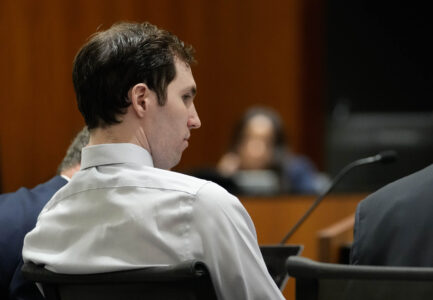
Lawyers for man accused of killing Charlie Kirk try to block death penalty

Trump’s name poised to come off Kennedy Center

Suspect in Texas shooting had fired at police days earlier, officials say

Man pleads guilty to killing a top Minnesota Democrat and her husband

New tornadoes outside Chicago as severe storms pummel the Midwest