Despite surprise ‘no’ votes this week, city commissioners want public, state officials to know they still support affordable housing
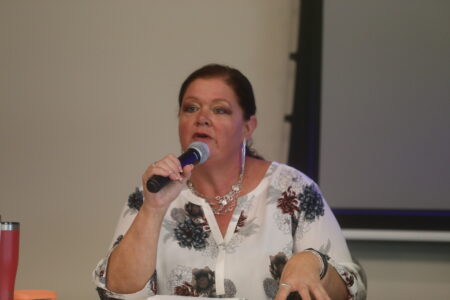
photo by: Chad Lawhorn/Journal-World
Kristine Polian is pictured at a candidate forum on Sept. 24, 2025.
Affordable housing has been the issue that’s caught the eye of Lawrence voters recently.
After Tuesday night’s Lawrence City Commission meeting, it might also have caught the eye of state officials who control the fate of millions of dollars in affordable housing tax credits — and not in the way that local advocates would like.
This week’s City Commission meeting included an agenda item that normally would be routine: Commissioners were being asked to give final approval to $14 million in industrial revenue bonds related to the affordable housing project New Hampshire Street Lofts in downtown Lawrence.
The matter was considered routine because the City Commission more than two years ago already had taken the key vote saying that it was appropriate that industrial revenue bonds be issued for the project. With that vote, local businessman Tony Krsnich built the project near the corner of 11th and New Hampshire streets, which provides below-market-rate rents to residents 55 and older who meet certain income guidelines.
But what happened on Tuesday wasn’t exactly routine. The City Commission ended up approving the issuance of the bonds on a 3-2 vote.
What would have happened if that margin flipped the other way and the commission refused to issue the bonds?
“It would have bankrupted the project,” Krsnich said.
Krsnich was surprised and concerned that the bond issuance drew negative votes from newly elected Commissioners Mike Courtney and Kristine Polian. While he wasn’t overly worried that the project was going to be bankrupted — he figured the city wouldn’t want that stain once it was explained — Krsnich was very worried that the close vote would send a negative message to the Kansas Housing Resources Corporation, which provided millions of dollars in affordable housing tax credits that helped pay for the New Hampshire Street Lofts project.
Importantly, Krsnich and other builders of affordable housing projects undoubtedly will be applying for tax credits for future Lawrence affordable housing projects. Would the 3-2 vote by the City Commission cause the housing corporation to question whether Lawrence was still devoted to improving housing affordability? The tax credits are extremely competitive, and projects are scored, in part, based on whether they have the full support of local government.
In the days following the Tuesday vote, the two commissioners who voted against the project told me they want to make sure state officials don’t have any misunderstanding on that point. Both commissioners support affordable housing projects, including the New Hampshire Street Lofts.
Their negative votes on Tuesday, both said, were the result of not understanding that the New Hampshire Street Lofts project was an affordable housing project. The key votes for the project occurred long before Courtney and Polian joined the commission in December. The brief staff presentation at Tuesday’s meeting did not highlight that the project was an affordable housing project.
Polian reached out to me to discuss her vote after she learned that the project was an affordable housing project. She said she thought it was important to set the record straight and make clear that she didn’t understand the affordable housing component when she made her vote against the bonds. She said she wanted the public, and any state officials who may be paying attention, to know that she would have voted for the bonds had she better understood the affordability provisions attached to the project.
“I want everybody to know that I’m 100% supportive of affordable housing projects,” Polian said.
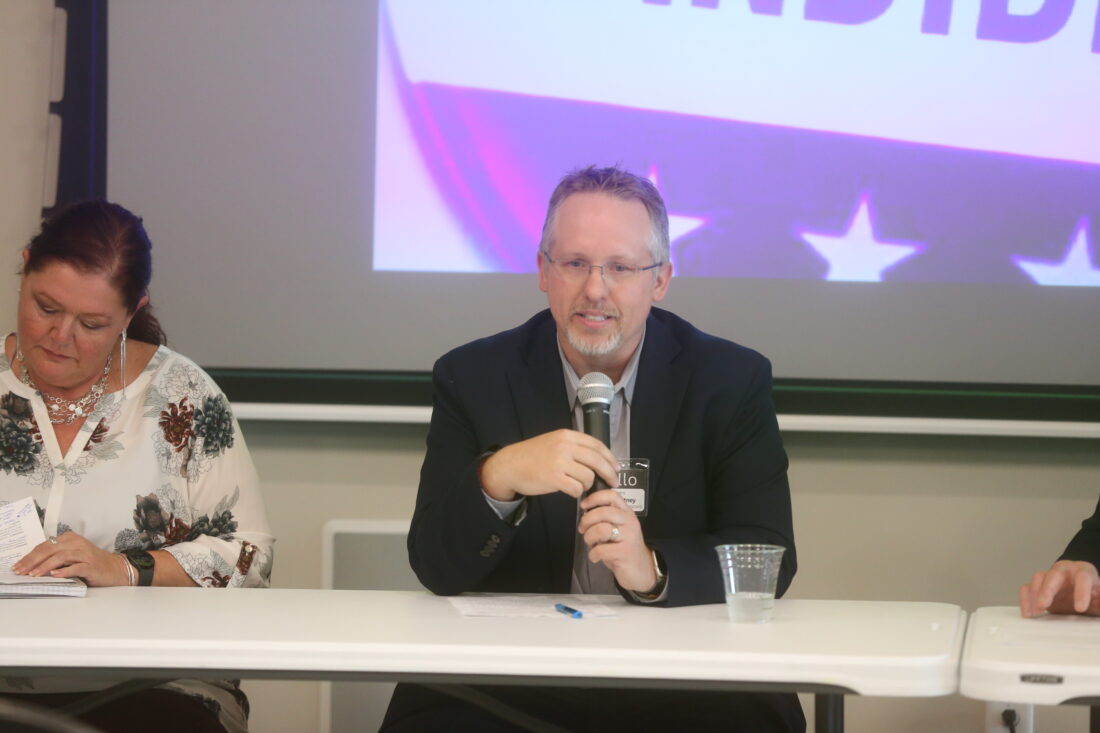
photo by: Chad Lawhorn/Journal-World
Michael Courtney is pictured at candidate forum on Sept. 24, 2025.
When I reached out to Courtney, he said much the same.
“If I would have known that ahead of time, I would have voted for it,” Courtney told me of the affordability issue.
Instead, both commissioners said they were viewing the project through the lens of a traditional mixed-use project that has commercial space on the ground floor and apartments above it. Without the affordable housing component, both Polian and Courtney said they did have questions whether such a project should receive industrial revenue bonds.
The industrial revenue bonds serve as a financial incentive for a project because they automatically confer upon the project a valuable sales tax exemption. Any construction materials used in an industrial revenue bond project are exempt from sales taxes. In the case of New Hampshire Street Lofts, that amounted to about a $100,000 savings.
Polian said she wants to ensure the city is consistent in how the city grants such sales tax exemptions, and she’s not sure every mixed-used project should qualify for such an exemption.
Courtney said he also wanted to be judicious in approving such exemptions for projects because he knows many voters want the city to be judicious in such matters.
“I got into this race because people in town are saying property taxes are really high and utility rates are really high,” Courtney said. “When we look at the money we are spending for these projects, it is super important that we also factor in how this is going to impact the community.”
The discussion on industrial revenue bonds actually was the smaller of the two bond discussions commissioners had at Tuesday’s meeting. As the Journal-World reported, commissioners on Tuesday approved $184 million in new debt for a variety of capital improvement projects. Just like the New Hampshire Street Lofts project, many of those projects already had been completed and commissioners were being asked to take the final procedural step in issuing the bonds.
Both Courtney and Polian voted against issuing those bonds, even though fellow commissioners expressed alarm at the financial risk the city would face — in the form of lawsuits, lower bond ratings and higher interest rates in the future — if the city decided at the last minute to cancel the bond issuance.
Courtney and Polian, however, didn’t back away from their ‘no’ votes on that issue. Polian, however, did emphasize that she wouldn’t have ultimately allowed the bond package to fail on Tuesday night. In other words, if Mayor Brad Finkeldei and Commissioners Mike Dever and Amber Sellers hadn’t agreed to vote for the bond package, Polian said she would have changed her vote to a ‘yes’ to ensure that the bond package had enough support to advance. She said she agrees that the city would have faced serious consequences if it had pulled the plug on the bond package at the last minute.
But given that there were three votes to approve the package, she said she wanted to vote ‘no’ to send a message about how future bond packages should be considered.
Polian, who has served as a chief financial officer for various governmental entities, said she wants the city to start using more sophisticated modeling techniques to predict future sales tax revenues and property tax revenues so that commissioners can make better-informed decisions about how much debt the city really must take on to complete projects.
“I was trying to tell the community that I was paying attention to their concerns,” Polian said of her ‘no’ vote on the large bonding package.
Town Talk column

As housing starts slump in Lawrence, Douglas County loses population in 2025; only urban county in Kansas to post a loss
A look at which Kansas counties have the highest wages and the best match between earnings and home values

Former pool hall space to become a ‘pubcade’ with video games, pinball, Skee-Ball, plus full service bar
Lawrence developer has trio of projects underway, ranging from $600K row houses in downtown to new neighborhoods on city’s edge
Despite surprise ‘no’ votes this week, city commissioners want public, state officials to know they still support affordable housing