


Lawrence single family home construction hits new low in 2025; activity falls by more than 35% from a year ago
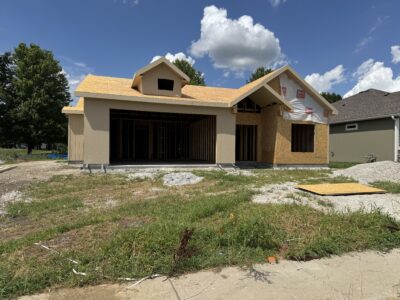
photo by: Chad Lawhorn/Journal-World
A single-family home under construction along Cedar Grove Way in west Lawrence is shown on July 7, 2025.
There used to be a time before the 2008 recession where Lawrence would build 360 new single family homes a year. Now, the city is back to a point where that number is again accurate — if you drop the 0.
Lawrence builders started just 36 new single family homes in 2025, according to City of Lawrence building permit data. That is a new low for Lawrence, but setting a new low-water mark has become nearly routine in recent years. The 2025 totals marked the third time in four years that single-family building starts have been at their lowest levels ever recorded by the city, which keeps building permit records back to the mid 1950s.
Chris Huston, a local builder who is president of the Lawrence Home Builders Association, however has another statistic he uses to illustrate the downturn.
“I tell people I’m the president of the Lawrence Home Builders Association and have been building for 25 years, but I have not done anything in Lawrence for the last year,” said Huston, owner of Huston Homes. “I’m building in rural Douglas County, Leavenworth County, Jefferson County. We don’t have problems finding jobs there, but there is just nothing going on, or very little going on, in Lawrence.”
As such, the new record-low for 2025 didn’t catch anybody in the Lawrence home building industry by surprise. The Journal-World has been reporting that a new low likely would be set based upon periodic checks of building permit data that showed significant softness over 2024 levels.
Indeed, 2025 single family building starts not only set a new low, but were down more than 35 percent from the previous record low set in 2024. In 2024, Lawrence had 57 single family housing starts compared to the 36 in 2025.
What may be different about 2026 is that some home building leaders are openly expressing optimism for a turnaround.
“I’m optimistic. I think it is coming,” Bobbie Flory, executive director of the Lawrence Home Builders Association, told me.
She said the past year created an important political change in the community. The top two-vote winners in the November Lawrence City Commission elections — Mike Courtney and Kristine Polian — both made the issue of building more housing in Lawrence a central part of their campaigns.
Since the election, plans have been announced for annexations that would add nearly 900 new acres to the Lawrence city limits, with nearly all of that acreage devoted to residential development.
The largest announcement has come from Wichita-developer Phil Bundy, who has has contracted to buy about 800-acres of property west of the South Lawrence Trafficway and Bob Billing Parkway interchange. About 700 of those acres would be devoted to residential development over the next five to 10 years, with the other hundred used for commercial development. Bundy, though, still needs to get the necessary annexation and rezoning requests approved by City Hall before development could actually begin on the property.
The second piece of annexation news is a smaller plan to annex about 60 acres north of the existing city limits along Queens Road. A concept plan with that application showed the property could accommodate about 200 new homes. That project also requires City Hall approvals before it can begin development.
Those two projects are welcome news, Huston said, but unlike Flory he is not expressing full-fledged optimism that 2026 will be the year Lawrence’s single family housing industry turns the corner. Rather, he said he’s “cautiously optimistic.”
“I hope they get to the finish line with these developments,” Huston said. “As I said, that falls under the category of cautiously optimistic.”
Flory said a third project that is giving her optimism for new growth is the pending arrival of Costco in the commercial development that is adjacent to Rock Chalk Park in northwest Lawrence. That development, which already has started to receive its development approvals from City Hall, is expected to attract a significant number of additional businesses that want to be next to the giant retailer that brings shoppers from far and wide. Such commercial development, in turn, creates more overall economic activity, which normally makes a community more ripe for residential development, Flory said.
The city also is in the process of searching for a new city manager, as current City Manager Craig Owens announced shortly after the November elections that he would resign from the position in May. Flory said she believes chances are good that the current City Commission will hire a new city manager that comes with a strong reputation of supporting and encouraging residential growth.
“They have sent the signal that we are pro-growth and that we need more housing,” Flory said of the new commission.
How much new housing is realistic in the near future, however, is an open question. The newly annexed land, if approved, would still need streets, sidewalks and utilities installed before actual home construction begins. Whether that would allow for much, if any time, for housing construction to begin on those sites in 2026 is unclear.
Flory said that, at a bare minimum, she believes 2026 single family housing starts should be double the amount from 2025, although that would still leave levels near historic lows. Huston said he would be “ecstatic” if the Lawrence market could get close to 150 homes in the next one to two years.
Ultimately, Flory said she believes Lawrence will need to get back to the level of 300 or more single family homes being constructed on an annual basis. If the community continues to produce historically low totals, she fears it will not only exacerbate affordable housing issues, but also begin hampering the city’s base of commercial and industrial businesses.
“If we are going to maintain our workforce in the community, we have to do something to keep them living in the community,” Flory said. “If we don’t, they are going to find jobs somewhere else.”
The city’s building permit records provide a broad picture of how single family home construction has slowed over the years. The city’s building permit records date back to 1956. They show that 2025 was only the fifth time that the city built fewer than 100 new single family homes, with the years being 2024, 2023, 2022 and 2011.
The numbers are a reversal from a previous decade when Lawrence was generally considered one of the busiest home-building markets in the state. In the 1990s and early 2000s, Lawrence constructed more than 300 single-family homes per year for 11 consecutive years.
The Great Recession of 2008 damaged the home building industry nationwide. Flory, who was in the industry at the time, said she remembers experts saying that home building numbers would return to pre-recession levels, but warned that it would take some time. She’s confident, though, that the experts weren’t expecting it to take this long for Lawrence.
“I never anticipated that we would be at this point,” Flory said.
The city’s 2025 building permit totals did show some growth in a couple of of key residential areas. The city issued 25 permits for duplexes, meaning 50 new living units. That’s up from eight duplex permits issues in 2024.
But the big gainer for the year was the apartment sector. The city issued eight permits for nearly $60 million worth of apartment construction in the city last year. Those eight projects will add 389 new apartment units to the city, according to permit records. The largest project, by far, is the $42 million development to construct about 250 rent-controlled apartment units at 3100 Michigan Street, which is essentially across the street from the Menards home improvement store. The second largest project was $6 million worth of construction by Lawrence developer Doug Compton to build 56 apartments on the former Old Father Studios property on Ninth Street, north of the KU campus.
The 2025 totals are a big jump from 2024 levels, when the city issued two permits for nearly $16 million of apartment construction. Those projects added a little more than 80 new apartments.
Town Talk column
Lawrence single family home construction hits new low in 2025; activity falls by more than 35% from a year ago
Retail sales in Lawrence grow in 2025, exceed city’s budget projections; a look at area communities, too
Plans progressing for $55M national security center on KU’s West Campus; National Weather Service set to locate in center
Plans filed to annex new land into the city, add about 200 homes along Queens Road in northwest Lawrence

KU spinoff company wins $1.2M federal grant to help it become major commercial entity in refrigeration industry
