Plans progressing for $55M national security center on KU’s West Campus; National Weather Service set to locate in center
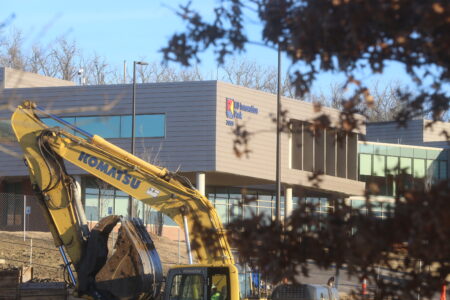
photo by: Chad Lawhorn/Journal-World
The KU Innovation Park headquarters building is pictured in the background on Dec. 31, 2025 as preliminary construction work begins on an addition to the park.
A planned $55 million National Security Innovation Center on KU’s West Campus has signed its first tenant, and it indeed will be keeping an eye on airborne threats.
Think wind, snow, rain and hail.
The National Weather Service has signed an agreement to locate a regional forecasting center in a portion of a yet-to-be-constructed 100,000-square-foot building that is designed to provide space for businesses and agencies that have links to national security research or activities.
The project recently applied for a $3.7 million building permit with the City of Lawrence to finish about 7,500 square feet of office space for the forecasting center. Adam Courtney, CEO of KU Innovation Park, confirmed that the National Weather Service had signed an agreement to locate in the new building, which is being developed by Courtney’s organization. He said he expects about 20 jobs, most of them technical in nature, to be based out of the new NWS facility.
He said the jobs fit well with the type of economic development activity that is being promoted by the not-for-profit KU Innovation Park enterprise.
“We are trying to attract more of those higher-paying science and technology jobs,” Courtney told the Journal-World. “Certainly those play to strengths of the university and what it is creating. Creating more of those jobs can help us retain more of that talent, and I think is important for economic development.”
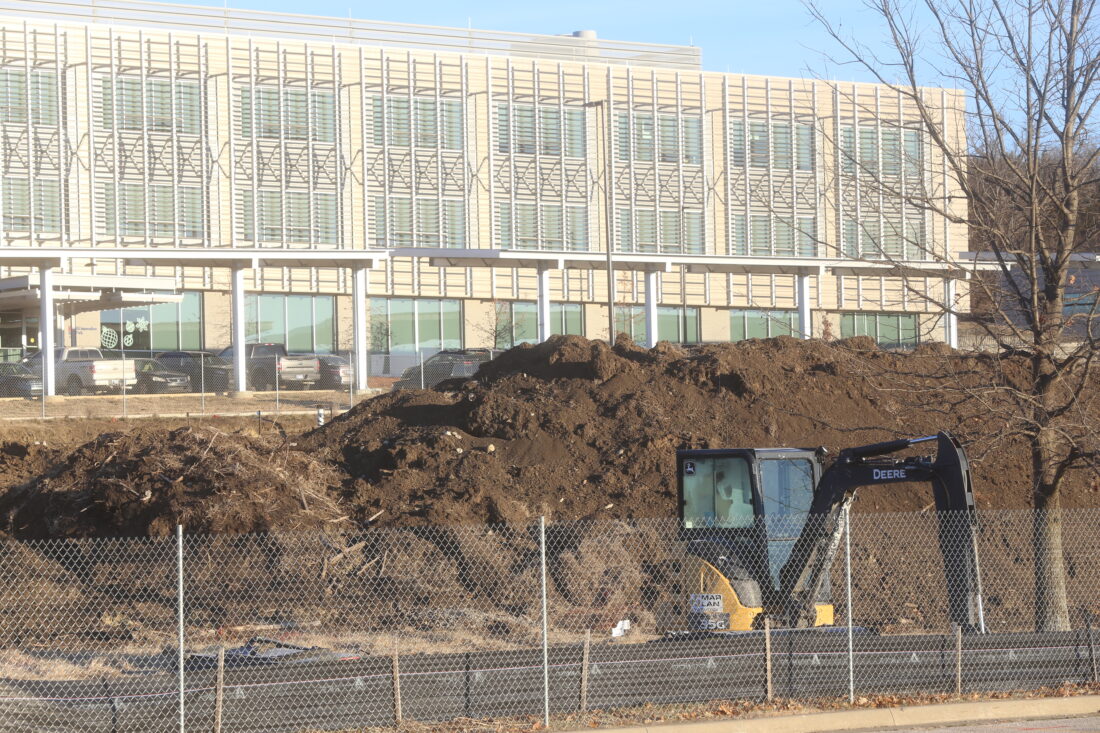
photo by: Chad Lawhorn/Journal-World
The KU Innovation Park’s Phase III office and research building is pictured in the background on Dec. 31, 2025 as preliminary construction work begins on an addition to the park.
At this point, if this news is creating confusion for you like a Kansas Christmas-week forecast — 70 degrees one day and 30 degrees the next — here’s some background information you may have forgotten. As the Journal-World reported in April 2024, KU won $22 million in federal funding to create a new national research and innovation hub on the KU campus.
The hub is slated to be housed in a new 100,000-square-foot building that will be on KU’s West Campus. The easiest way to picture the location might be to look about two to three blocks west of the new Dillons grocery store on West Campus. More precisely, the building will be at 2037 Becker Drive, which is important because it puts it next door to the three general business and technology hub buildings that KU Innovation Park operates. KU Innovation Park is a nonprofit entity that seeks to attract existing businesses or incubate new businesses that want to use KU research or want access to KU researchers and students. KU Innovation Park is the developer of the planned national security hub building.
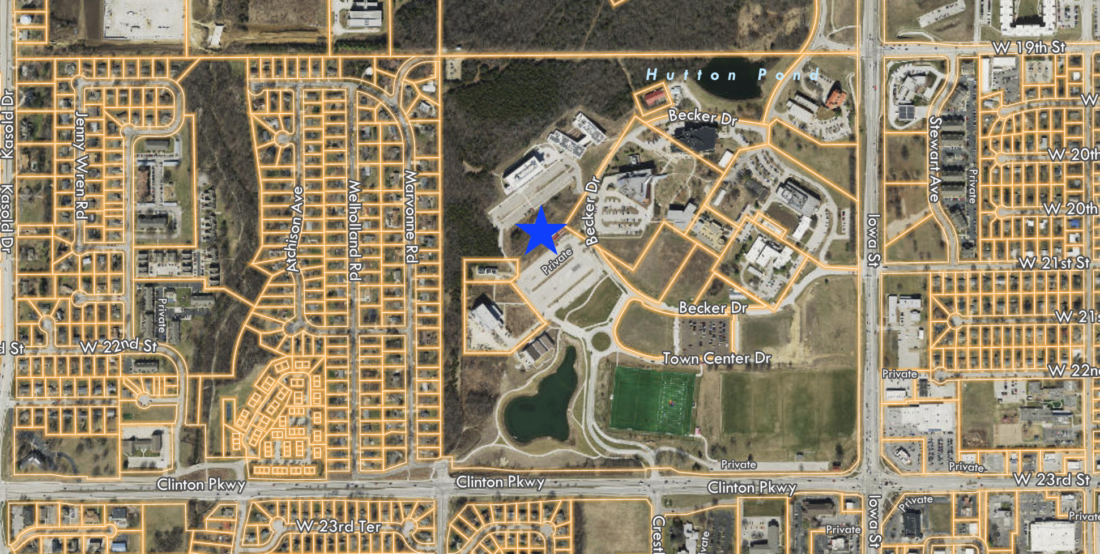
photo by: Douglas County GIS/Journal-World
The blue star marks the site of the planned National Security Innovation center of KU’s West Campus.
That’s all fine, you say, but how does the National Weather Service fall under the umbrella of national security?
Courtney said it does by recognizing that national security goes beyond the top-of-mind topics like the military and terrorism, for example. He said defense contractors often come to mind when you think of the national security industry. He said the center can accommodate those type of businesses, but also will be attractive to businesses in the realm of remote sensing and cybersecurity, a pair of areas that KU has strong research teams for. Another such area where KU does significant research is radar technology. Radar, of course, is a key piece of technology in the weather industry, and plays a key role in helping keep the country prepared for natural disasters.
“We are looking at technologies beyond what you might consider typical national security,” Courtney said. “When you hear that term, a lot of people think defense, but we are thinking national security is a broader term related to protecting the U.S.”
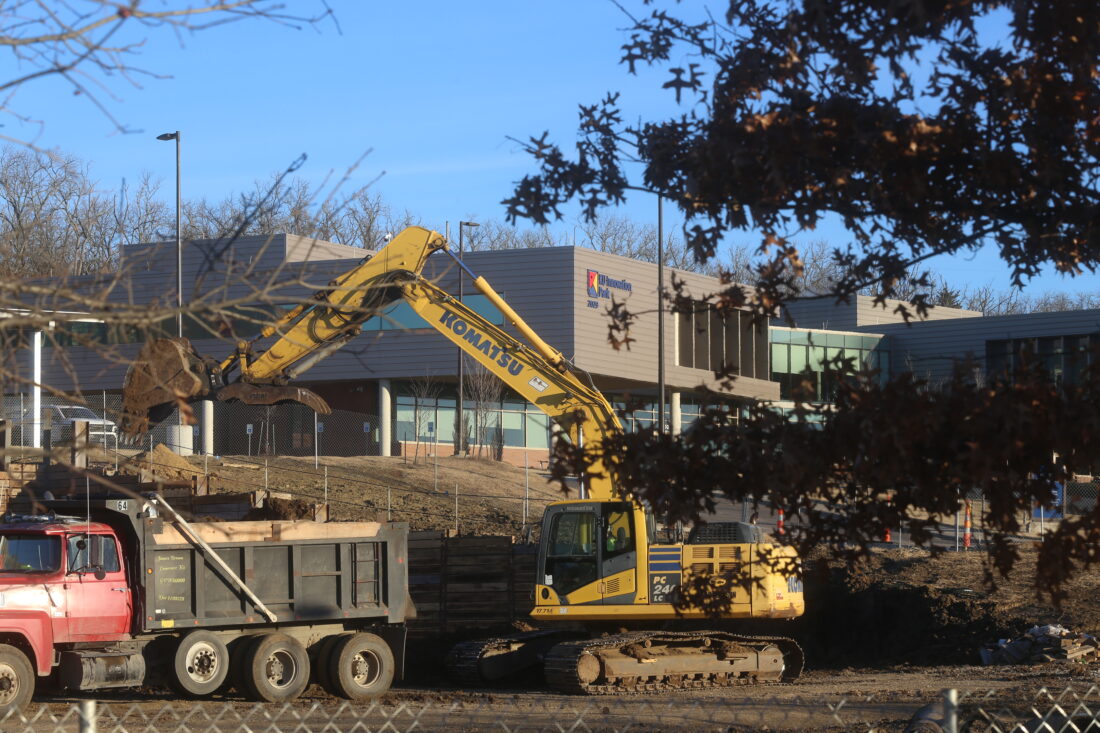
photo by: Chad Lawhorn/Journal-World
The KU Innovation Park headquarters building is pictured in the background on Dec. 31, 2025 as preliminary construction work begins on an addition to the park.
Exactly when the National Weather Service or any other tenant may begin operating out of the new building isn’t yet clear because KU Innovation Park hasn’t yet committed to a formal start date for construction of the building.
Significant site work and utility work is underway at the location, but no building construction has begun yet. Courtney said KU Innovation Park is seeking to finalize a bevy of leases for other tenants before starting actual construction on the building.
Private businesses or outside agencies are expected to be the primary occupants of the new building, although portions of it may include some university-related research space. Courtney said the idea that most of the building would be devoted to private businesses is based on what the private sector has been telling them — there are many businesses or agencies that want to be close to KU researchers and students. Businesses in the tech sector especially want to have those relationships to stay abreast of emerging technologies and to have an inside track at hiring top university students.
Courtney said he anticipates the new building could house 12 to 18 tenants. He said advanced discussions are underway with a multitude of prospective tenants. He said KU Innovation Park is seeking to have 60% of the building leased before it begins construction. He said his team is close to hitting that mark.
“We have one more commitment that would be pretty significant and push us over the edge in terms of really pushing construction forward,” Courtney said.
Courtney didn’t provide information about any of the prospective tenants. However, KU Chancellor Douglas Girod has previously said that KU is in discussions with Panasonic, the Japanese-based company that earlier this year opened a major electric vehicle battery manufacturing plant in nearby De Soto. As a result of that project, KU and Panasonic have signed an agreement to work together on research opportunities, and Girod has said there is some interest in Panasonic having office and research space in the new building.
On Wednesday, Courtney said he didn’t have additional information to share currently, but acknowledged the budding relationship between KU and Panasonic.
“Those are the type of private industry opportunities we are trying to leverage,” Courtney said.
Courtney said he hopes to have enough signed leases in hand to begin construction of the building in the first quarter of 2026, which would put it on track for a mid-2027 opening.
Securing the leases, though, is an important part of the financial plan for the new center. While the project has secured $22 million in federal funding, Courtney said the new three-story building likely will have a total budget of about $55 million, depending on the specific tenant mix. Lease payments made by the building’s tenants will play a large role in filling the gap between the federal funding and the total project budget. Courtney said while KU Innovation Park receives general economic development funding from partners like the City of Lawrence and Douglas County, it is not planned to ask the city or county for additional funding for the new building.
As for the National Weather Service component of the project, one question that remains is whether the new forecasting center will replace the National Weather Service operations located in Topeka or whether the Lawrence facility will be in addition to the Topeka center. I’ve got a question into National Weather Service officials about that, and will report back if new information emerges.
State Government
Senate Republicans move cash from purple North Carolina to red Kansas
TOPEKA, Kansas (AP) — Senate Republicans’ top campaign spending organization is pulling back in North Carolina ...

From half-empty classrooms to canceled factory shifts, southwest Kansas communities feeling impacts of ICE raids
Lobbyist tells court that seeing transgender lawmakers in Statehouse bathroom made her ‘uncomfortable’ and she’s glad that new law banned them

Kobach’s team puts on parents, cops, other witnesses to support Kansas’ anti-trans law SB 244
State’s anti-trans law harms people while not making anything better, experts testify