


Sales tax numbers from World Cup period show Lawrence didn’t fare as well as many Kansas communities
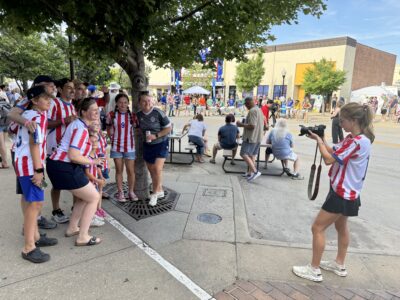
photo by: Chad Lawhorn/Journal-World
Fans decked out in Team USA colors pose for a picture at the Score Lawrence kickoff party on June 12, 2026, in downtown Lawrence.
As many unsuspecting World Cup viewers learned, some soccer games (matches, you American) can end in a tie (a draw, you Ted Lasso-inspired fool.)
A tie, a draw, a wash, may end up being the best way to describe the financial impact Lawrence’s economy received from playing host to a World Cup team, Algeria, this summer. The state of Kansas has released its latest monthly sales tax report, and this one basically covers the period from mid-June to mid-July. That pretty much coincides with the World Cup fever in America.
The state’s sales tax numbers, though, don’t necessarily show that fever, and Lawrence’s numbers in particular aren’t indicating an explosion of economic activity during the period.
Lawrence posted sales tax collections that were up 5.6% from the same period a year ago. That’s a healthy increase, but it is nothing outstanding. I’ve seen monthly increases in Lawrence of 15% or more. I think some people were hoping for that type of increase, or more, given that Lawrence played host to an official World Cup team and was just a short drive from Kansas City, which was a host to actual World Cup matches.
But again, a 5.6% increase is a solid number. However, there is another important point of context: Lawrence’s sales tax collections for the period actually grew less than the statewide average. In other words, there were plenty of Kansas communities that had no real connection to the World Cup that saw increases greater than what Lawrence experienced.
Salina, for instance, had the top growth rate among all major Kansas retail centers for the month. Salina hasn’t been thought of as one of the Kansas communities expected to benefit directly from the World Cup. Here’s a look at how the state’s major retail markets fared during the one-month period:
• Salina: up 15%
• Olathe: up 12.4%
• Lenexa: up 12.1%
• Sedgwick County: up 10.1%
• Overland Park: up 9.7%
• Kansas City: up 7.9%
• Merriam: up 6.7%
• Shawnee: up 6.7%
• Lawrence: up 5.6%
• Manhattan: up 1.0%
• Topeka: up 0.6%
• Statewide: up 9.0%
When you look at Lawrence’s sales tax collections for the entire year-to-date, it currently is very fair to say that the World Cup has not saved the city’s budget. Even after a reasonably strong month, Lawrence still is performing more poorly than any other major retail market in the state. Lawrence is the only major retail market we track that has posted an actual decline in traditional sales tax dollars. (As we have reported, Lawrence has seen an increase in the collections for use taxes, which is a special sales tax charged to online purchases.) Here’s a look at those year-to-date sales tax figures:
• Lenexa: up 5.9%
• Kansas City: up 5.4%
• Manhattan: up 5.0%
• Sedgwick County: up 4.9%
• Salina: up 4.6%
• Overland Park: up 4.0%
• Shawnee: up 3.7%
• Olathe: up 3.1%
• Merriam: up 2.1%
• Topeka: down 0.2%
• Lawrence: down 0.6%
• Statewide: up 2.9%
So, given those numbers, why am I labeling this a draw instead of a loss?
Well, it is hard to say a 5.6% increase for the month should be considered a loss, plus there’s always a chance we’ll see a little more of an increase during next month’s reporting period. The state sales tax reporting system is a little imprecise in the fact that different sizes of businesses have different reporting deadlines, so some World Cup activity may still show up in next month’s report.
But, the main reason I’m declining to label the numbers a loss is because I saw a lot of people enjoying themselves, heard of many connections made with our adopted Algerian team, and know that Lawrence received a good amount of national attention it would not have received otherwise.
All of those have value, and the last one, in particular, could translate to some actual economic value down the line.
Yes, local government did spend some real dollars in planning and preparing for World Cup activities. We should get a fuller accounting of all those costs and also attempt to get a fuller accounting of all the economic benefits the city received from the World Cup. For instance, we haven’t yet looked at the city’s transient guest tax, which the city charges on hotel rooms. The rate for that tax was increased specially for the World Cup.
So, there are more numbers from both a revenue and expense standpoint that are yet to be finalized and reported. In that regard, maybe it is too early to declare a win, loss or draw. Lawrence’s total economic benefit from its World Cup efforts may depend greatly on whether it can do anything to benefit from the exposure and connections it made.
In other words, the true outcome may be yet to come. Let’s play some overtime. (What? What did I say now?)
Town Talk column

After a brief bump during the World Cup, Lawrence is back to collecting less in sales taxes than it did a year ago

To make home construction easier and faster, Lawrence plans to experiment with a menu of pre-approved designs
Affordable apartment project in East Lawrence that escaped funding clawback shows new sign of progress

KC-area dealer Cable Dahmer buys Lawrence’s longtime Dale Willey Chevrolet and GMC dealership
Introducing a new writer for the Journal-World’s Town Talk feature
Bad television was a big part of the creation of Town Talk. While some of these posts made about as much sense as ...