
During the pandemic Lawrence grew tech jobs faster than any other metro; before the pandemic it lost them rapidly
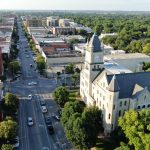
photo by: Jackson Barton
The Douglas County Courthouse and downtown Lawrence are pictured in an aerial photo Saturday, July 13, 2019.
Most of the things that grew during the pandemic in Lawrence didn’t produce much excitement. Frustration, restaurant closings and a greater self-awareness of the importance of breath mints (thank you, masks) were near the top of my list.
But there is a new report out that suggests Lawrence saw growth in one area that could be very exciting — technology workers.
A new study by the Brookings Institution found Lawrence had the highest growth rate of technology-sector jobs of any major metro from 2019 to 2020. In other words, when the pandemic was striking, the number of people working in Lawrence in the technology sector was increasing. Actually, it was increasing at a greater rate than virtually any other metro area. (Small metro areas with fewer than 1,000 technology workers were excluded.)
Lawrence’s No. 1 ranking already is garnering some national attention. An article by online news provider Axios briefly mentioned Lawrence’s top spot placement. Tech workers could involve any number of professions, ranging from software developers to bioscientists to certain types of repair technicians, even. Community leaders generally get excited about technology sector growth because the tech sector generally pays above-average wages.
So, being No. 1 in the country can be a great story for Lawrence as it seeks to keep KU start-up companies, attract new firms from elsewhere and just generally grow the city’s economy. But the report from Brookings also tells another story about Lawrence.
It is a from-worst-to-first story.
While not evident in the brief Axios article, you see another important trend about Lawrence when you look at the full Brookings report. While Lawrence had the fastest technology sector growth rate from 2019 to 2020, Lawrence had the worst tech sector growth rate from 2015 to 2019.
The Brookings numbers show Lawrence averaged a 21.7% decline in technology workers each year between 2015 and 2019. In other words, Lawrence suffered about a 62% decline in tech workers during that time period. In fact, Brookings has exact numbers, listing Lawrence as having 2,513 tech jobs in 2015 and just 943 by 2019.
Talking about the No. 1 ranking obviously is more fun, so let’s start there. The Brookings report didn’t provide a lot of explanation about why Lawrence or other such cities saw big growth numbers. Generally, though, the report theorized that smaller, higher-quality-of-life towns likely benefited from the shift to remote work that many companies adopted during the pandemic. If you don’t have to go into a physical office very often, living in Lawrence or other college town environments might be the choice of many tech workers.
It is certainly an idea that has been floating through certain circles in Lawrence. Several weeks ago — long before this report came out — I talked with Jason Rogers, a Lawrence resident and vice president of software for Matterport, a data company that is big into 3-D mapping, making digital replicas of buildings and other spaces. The publicly traded company is headquartered in Sunnyvale, Calif. — a traditional tech hub — but it has a growing software development branch in Lawrence, although you certainly won’t see a lot of signs for the company.
That’s because many of the company’s Lawrence employees work from home, Rogers said. When I talked to Rogers a couple of months ago, Matterport had 18 employees in Lawrence. That was up from three employees four years ago. Rogers said most of the Lawrence employees are people who came out of the University of Kansas and liked the idea of living in Lawrence.
Before, where moving to Sunnyvale or some other office location might have been a requirement to work for the company, it no longer is today. It is a major change in corporate America that “democratizes where people want to live,” Rogers said.
Communities that understand that change can capitalize off of it. For example, when I talked to Rogers, he said Matterport had 127 open positions advertised on its website, and “all of them would be available for Lawrence.”
Rogers said Lawrence now needs to build upon some of its successes by better promoting its tech advantages, strengthening relationships with KU, and perhaps having a high-profile champion. Several people are pointing to Lawrence resident Brian McClendon for that last role. A Lawrence native, he gained Silicon Valley fame as a creator of Google Earth, and also was a top tech executive at Uber before returning to Lawrence several years ago.
McClendon was one of the first to tweet about Lawrence’s new No. 1 ranking, saying “it’s good to see I wasn’t crazy coming back home,” and then put in a plug that Niantic Labs — a Google-backed augmented reality company that created the Pokémon Go app several years ago — is hiring for positions in Lawrence. The company in November announced that McClendon had joined its board and would serve as Niantic’s senior vice president of engineering, mapping and AR. McClendon will be based in Lawrence, and will be responsible for building out a team of employees, the company said when it announced his hiring.
Perhaps the makings of another hidden Lawrence tech company.
As for why Lawrence’s tech sector fared so poorly in the 2015 to 2019 period, the Brookings report didn’t examine that much at all. That time period does coincide with a period of budget cutbacks at KU, which certainly is a provider of tech jobs in Lawrence.
Some of the other big decliners during that period also are college towns, including Lexington, Kentucky, with an 11% decline; Eugene, Oregon, with an 8% decline; and Champaign-Urbana, Illinois, with a 7% decline. But not all college communities posted a decline, and there were no college communities that also posted big drops. Jackson, Mississippi, dropped 12.1%, which was the highest decline other than Lawrence’s 21.7% drop. Yes, Lawrence really was an outlier during that period, losing a far greater percentage than any other metro.
The drop was so significant that even with the strong growth rate in 2020, Lawrence still has 1,420 fewer tech sector jobs than it did in 2015. But even that can be spun as a positive, if you are looking to do so. Some of those 1,400 people may still be in Lawrence, looking for a new tech opportunity, which in turn might entice new tech companies to focus on Lawrence.
Here’s a look at how several communities from the region, or that are otherwise similar to Lawrence, fared in the Brookings report. A special mention for the Kansas City metro area. It actually was highlighted as a “rising star metro area.” While Lawrence was losing tech jobs from 2015 to 2019, Kansas City was adding them at about 5% per year. During the pandemic year of 2020, it continued to grow tech jobs but a slower rate.
• Tulsa, Oklahoma: up 8.5% for 2015 to 2019; up 0.5% for 2020
• Kansas City: up 4.8% for 2015 to 2019; up 1.4% for 2020
• Fort Collins, Colorado: up 3.9% for 2015 to 2019; up 3.4% for 2020
• Boulder, Colorado: up 3.4% for 2015 to 2019; up 4.4% for 2020
• Lincoln, Nebraska: up 2.7% for 2015 to 2019; up 4.4% for 2020
• Columbia, Missouri: up 1.5% for 2015 to 2019; down 0.1% for 2020
• Colorado Springs, Colorado: up 1.2% for 2015 to 2019; up 1.4% for 2020
• Ames, Iowa: up 0.9% for 2015 to 2019; up 1.2% for 2020
• Omaha, Nebraska: down 1.2% for 2015 to 2019; up 4.5% for 2020
• Wichita: down 2.4% for 2015 to 2019; up 2.1% for 2020
• Oklahoma City: down 2.7% for 2015 to 2019; down 3.5% for 2020
• Topeka: down 4.5% for 2015 to 2019; up 4.7% for 2020
• Lawrence: down 21.7% for 2015 to 2019; up 16.0% for 2020
Town Talk column
Lawrence City Commission to weigh whether Costco should be included in STAR bond district
Thanks to a nonprofit that pairs artists and landlords, the Lawrence Potters’ Guild gets a temporary space of its own

After a brief bump during the World Cup, Lawrence is back to collecting less in sales taxes than it did a year ago

To make home construction easier and faster, Lawrence plans to experiment with a menu of pre-approved designs
Affordable apartment project in East Lawrence that escaped funding clawback shows new sign of progress