What did we learn from KU’s loss to Arizona State?
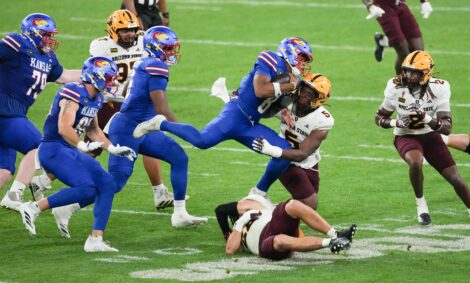
photo by: AP Photo/Dave Shopland
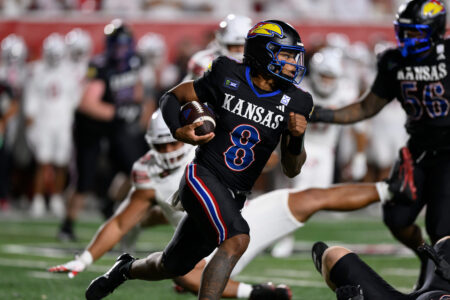
Kansas Jayhawks quarterback Isaiah Marshall (8) during the NCAA college football game between Arizona State Sun Devils and Kansas Jayhawks in London, Saturday, Sept. 19, 2026.
LONDON — Maybe it’s fitting that the first FBS football game played in England featured such a powerful testament to the importance of punting.
The Kansas defense — what thankless work those Jayhawks did on Saturday — had forced Arizona State off the field in the final minute of the first half, thanks in large part to a sack by David Santiago that had pushed the Sun Devils out of field goal range. So in came punter Nick McLarty, who had narrowly missed out on pinning KU back deep at the end of the first quarter.
This time he delivered with a punt that was downed at the 2-yard line. KU, nursing a 7-3 lead, had to run the ball three times, ASU spent its three timeouts in turn and that gave the Sun Devils at least a remote chance to score in the final 30 seconds of the half.
That chance became a lot less remote in a hurry because McLarty’s KU counterpart, Matt Gill, in the highest-leverage situation of his very young career, rolled to his left and delivered a right-footed punt that went a grand total of 17 yards before sailing out of bounds on the left sideline.
Cutter Boley promptly tossed a 25-yard touchdown to Reed Harris and ASU never trailed again.
In the immediate aftermath, the question on social media was whether Gill had intentionally made a directional kick or just messed up the punt.
Head coach Lance Leipold revealed postgame that it was a bit of both: “We were just trying to keep the ball away from the returner,” he said.
KU was wary of the new NFL-style free kick rule that could have allowed ASU to attempt an uncontested field goal if it made a fair catch on the punt.
“They were bringing an edge player off one of those gunners a lot to our right,” Leipold said, “so we couldn’t rugby kick it and roll out, kick it that way, so he was just trying to directionally kick and he mishit it.”
KU has improved dramatically on special teams over the course of Leipold’s tenure, and a pair of field-goal blocks against Missouri and Tate Nagy’s punt-return touchdown against ASU showed concrete evidence of that (and perhaps of the benefits of Taiwo Onatolu’s move to full-time special-teams coordinator).
But then the Jayhawks also allowed a kick-return touchdown to the Sun Devils immediately after halftime and have already missed two field goals early in the year. That’s to say nothing of the punt and its consequences. Among all the grim pre-halftime sequences that KU has experienced in recent years, that might have been the worst.
• In the lead-up to Saturday, defensive coordinator D.K. McDonald quite clearly placed the onus on his defensive backs to play more confidently and aggressively. The way KU handled Austin Alexander in the ASU game suggests that he might have been the intended audience of McDonald’s words. After the Sun Devils targeted him early and he allowed a mid-range reception, he got benched, and his six defensive snaps, according to Pro Football Focus, were the fewest in a game in which he has appeared in his career. Syeed Gibbs stepped in and performed quite well; he broke up a pass and did not allow a reception. Jalen Todd was solid as usual — ASU tried to challenge him early in one-on-one situations and it didn’t work — and nickel back Elijah Cannon seemed more reliable than against Missouri.
Roman Pearson got beaten deep on one play and looked like he might have considered trying to commit a penalty to prevent a catch, but nothing got called in any case and he rotated in effectively otherwise. Ultimately, it was linebacker Quincy Davis who drew the unenviable assignment on Harris on the pivotal touchdown, and that proved to be Boley’s only notable completion in what proved to be one of the best performances by the KU pass defense under Leipold. The pass rush generated 15 pressures, and Boley finished just 11-for-23 for 95 yards.
Still, middle linebacker Trey Lathan was disheartened by the couple of plays his team did concede, even as he praised the defense overall.
“We had two chances to put the fire out, and we gave up two touchdowns,” he said, referencing Harris’ score and a fourth-quarter situation after ASU returned a fumble to the 2-yard line. “It’s kind of upsetting when you work on stuff like that.”
• If KU is going to use more uneven fronts, which it seemed to deploy to a greater extent against ASU than in previous weeks, then it’s a good thing defensive tackle Eamon Smalls is starting to break out.
The UAB transfer, who is KU’s best option as a true nose tackle with Tre’von McAlpine out for the season, threw down Kyson Brown for a 3-yard loss that put the Sun Devils behind the chains early. He was then involved in a second-and-short stop for no gain on Brown on the following drive and clearly presented a challenge to ASU’s interior offensive line.
The Jayhawks have tightened their rotation a bit at defensive tackle. If they’re going to play that way, they need maximum production from everyone involved, and they’re getting it from “Big E.” Considering that he battled injury earlier in the offseason, I would be curious to know if this is the healthiest he’s felt since making the move to Lawrence.
• KU clearly learned from its mistakes against Missouri and was determined to feed both Yasin Willis and Dylan Edwards the ball early. Before ASU could adapt to straightaway runs, associate head coach Andy Kotelnicki switched to getting them the ball via wheel routes and jet sweeps and the like.
It was a strong plan that fell by the wayside when Willis got injured, to the point that he was out of uniform by the time KU returned from halftime.
Needless to say, that is a significant blow at a time when the Jayhawks really need backs to take the burden off of Isaiah Marshall. Edwards handled himself well with one of the biggest workloads of his career — 18 carries, 89 yards — but he also gave away a late fumble (after Willis had done so early on).
With Kory Amachree out long-term and Jalen Dupree currently limited, the situation at running back is looking a bit grim, which is remarkable for what might have opened fall camp as the Jayhawks’ strongest position.
• After KU’s loss to Missouri, one in which it also struggled to convert promising drives into points, I essentially declared Kotelnicki innocent, noting that he put his players in positions to succeed on many occasions. I’m not quite ready to do that after the ASU game.
He deserves his share of the blame for the Jayhawks’ struggles on third and fourth downs (they opened 0-for-7 and 0-for-2, respectively). The third-and-2 reverse to Edwards to open the second half, which went for an 8-yard loss, felt like too dramatic of a response to the absence of a usual short-yardage option in Willis, as did the third-and-1 deep shot on the next drive. Those sorts of plays had a lot to do with KU finishing the game with one offensive touchdown, even as it repeatedly reached ASU territory.
In a bit of a departure from the Missouri game, Marshall and Kotelnicki both seemed to be at their best when they were playing from further behind, with a sense of greater urgency and a higher tempo. Maybe KU can find a way to channel that into other game states going forward.
• The chemistry hasn’t quite been there between Marshall and center Kasen Carpenter this season, whether it’s been Marshall bobbling a snap or Carpenter overshooting him completely. Who knows if it has to do with Marshall splitting reps with Cole Ballard in August or Carpenter missing a few days of camp or what, but it has not been ideal and has forced Marshall to throw the ball away on a number of occasions.
Leipold said the light rain on Saturday didn’t have much to do with the snapping issues: “Sometimes, when the center’s trying to make a block … he’s moving and snapping instead of getting the snap first, and that. And unfortunately, uncharacteristic that those things get away when they’re trying to do too much too quickly.”
Marshall said he has a plan to fix it, in any case.
“I feel like just during third downs when the defense is out there, just doing snaps on third downs more, like every single drive, go to the sideline, get about five to 10 snaps right before we go back out,” Marshall said. “So just doing that more, I feel like is huge, because we didn’t do that as we should have.”
• The Union Jack Classic may not exactly have met its lofty ticketing aims in its first go-round. Back in March its co-founder told The Athletic “We’re very confident” of selling out the 90,000-seat Wembley Stadium. ESPN and the BBC had reported in recent days an expectation of 60,000 fans, so it’s not exactly clear how the event ended up with an announced attendance of 46,523.
No one seems deterred, in any case. The organizers managed to get the game done, which is more than anyone can say about an N.C. State-Virginia game that was supposed to be in Brazil this year or a Michigan-Western Michigan game that might have been played in Germany.
“We have the right promoter, we have the right schools, the right team,” Big 12 Commissioner Brett Yormark said on Wednesday. “We really leaned into this event, partnered with our promoter every step of the way.”
The Union Jack Classic is supposed to continue at Wembley through at least 2030. But other Big 12 schools will have to deal with that. More to the point for KU, athletic director Travis Goff said the Jayhawks are now “thirsting for more of these kinds of opportunities.”
“I would say that every aspect of this has emphasized that future opportunities, whether be it football, whether be it other sports, certainly on the basketball side, you want to take full advantage of it,” he said.
KU was once supposed to be part of men’s and women’s basketball games against Houston in Mexico City, but that never came to fruition.
• To close on a somewhat uneasy note: I agree with Leipold when he says this team has shown flashes that demonstrate it has a chance to be successful. I guess I just wonder if the results will create an environment that allows that to happen.
KU will have a chance to rebound after its bye week against a Group of Six foe in Middle Tennessee. But it’s likely to be a steep underdog in extremely difficult road games against Utah and rival Kansas State. If it doesn’t show significant progress in those games, how will it retain fans’ attention ahead of homecoming on Oct. 24 against Baylor? More importantly, how will the players keep their morale high enough to regroup for the second half of the schedule — one that by any metric seems quite a bit easier?
Leipold has kept teams together through tough times before, notably in 2024 when the Jayhawks rattled off three straight wins against ranked opponents. But even that late-season charge with a vastly more experienced team didn’t quite yield a bowl berth.
In short, having come up empty against Missouri and ASU, KU is going to need to get its act together quickly under adverse circumstances.
KU Football
Leipold updates status of pair of receivers after loss to Utah
What did we learn from KU’s loss to Utah?
Jayhawks’ ‘biggest problem’ put them in early hole in loss to Utah
Quick recap: Jayhawks fall 41-24 in road battle with No. 12 Utah

KU-Utah kickoff time moved earlier due to weather