
What we learned from KU’s loss to BYU
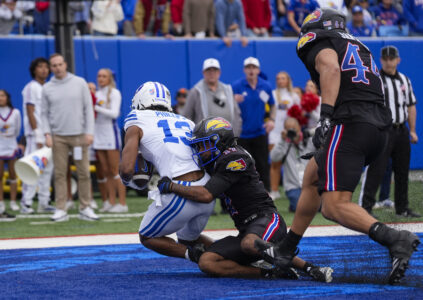
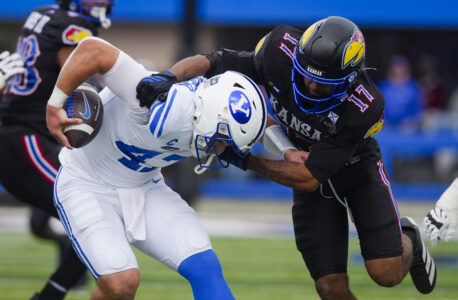
BYU wide receiver Jojo Phillips (13) falls into the end zone with Kansas cornerback Lennie Brown III (17) for a two-point conversion during the third overtime. The Jayhawks lost to the Cougars 31-29 on Saturday, Nov. 21, 2026 at David Booth Kansas Memorial Stadium. Nick Krug/Special to the Journal-World
Kansas defensive end David Santiago said he was at “a loss for words” after Saturday’s triple-overtime loss to No. 10 BYU, and it’s hard to blame him.
“I went and spoke to my family, and I was like, I told them, ‘I don’t know what emotions to feel at this point,'” he said.
What else is there to say, really?
Both KU’s offense and defense had chances to win this game for the Jayhawks. The offense was on the field at the end of the second overtime with a chance at a walk-off two-point conversion (more on that later). But the defense — the one its coordinator D.K. McDonald keeps saying is playing some of the best defense that’s been played at KU — had several opportunities to change the game where it just needed to play approximately as well as it had for the first 56 minutes.
When BYU running backs LJ Martin and Preston Rex ran for 23 and 12 yards to open the Cougars’ drive at the end of regulation, they were two of the team’s three longest runs of the day, and they made it essentially trivial for BYU to get into position for a game-winning field goal.
Matthias Dunn missed, of course, giving KU a reprieve, but the defense also didn’t stop the Cougars in the first overtime after KU went up 23-16, nor in the second. It did enough to prevent one two-point conversion pass from quarterback Bear Bachmeier, but not a second that gave BYU a 31-29 win.
Making a final stop — the thing McDonald has said separates a good unit from a great one — eluded the Jayhawks again, just like it had in other losses to TCU and UCF.
Head coach Lance Leipold said of BYU postgame, “They’re going to use game and play clock and wear you down, and they probably wore us down a little bit there late as the game kept going.”
Two interceptions by Isaiah Marshall in the third quarter had KU’s defense on the field for about 10 of 15 minutes in that period. Santiago said he felt the difference. But he also said firmly that he didn’t think that the Jayhawks were worn down by the end of the game.
“It was just small, little detail things,” he said. “It was loud, so we couldn’t entirely get the communication we wanted.”
Whatever the case, the way the game ended, both in regulation and in overtime, didn’t flatter a unit that had three first-half sacks against a team that had allowed six total sacks all year, forced and recovered two fumbles and limited Bachmeier to 173 passing yards.
“You battle yourself back into it, you think that you tied the thing up and then you think it’s starting to slip away a little bit and you get new life,” Leipold said. “I really felt that once we got it into the second overtime that we were going to find a way to do it.”
Here are some more of the biggest takeaways from the loss, which dropped KU to 4-7 and all but eliminated it from postseason contention.
• Marshall continues to show that he shines in the biggest moments. His two clutch passing touchdowns on fourth downs — one in regulation and one in overtime, both on plays when he sensed the Cougars were bringing a blitz and still got a well-placed pass away — were as impressive as anything KU has done on offense this year.
The problem is that he continues to dig himself into situations where these sorts of heroics are required by making mistakes earlier in games. This was the third time this season that Marshall has turned the ball over on the first play of the second half. Then he threw another pick on the fourth play of KU’s second drive.
In the process, he gave BYU two short fields that it converted into 10 points after KU had led 6-3 at halftime.
“Just coming from a QB, throwing two turnovers like that that resulted in scores, it hurts a lot knowing I’m the reason they had got those points,” he said postgame.
The first pick occurred when BYU safety Raider Damuni correctly sniffed out KU’s wheel route on a fake screen: “He made a great play, but I got to see that,” Marshall said. The second, on an awkward third-down throw without any great options, occurred, he said, because two defenders were stacked on top of each other.
“The sideline never let down on me,” Marshall added. “They always kept my head up, still telling me I’m the best player on the field, just little things like that definitely helps a lot from my team.”
The redshirt sophomore certainly appeared undaunted. The drives that followed took on a familiar character, evoking previous games against Arizona State, Utah and UCF, as the KU offense started humming only once it had dug itself a hole. In the fourth quarter and overtime, Marshall went 9-for-11 for 86 yards and two touchdowns. He also ran for a score on third-and-7 in the first overtime.
Unfortunately for KU, it was always going to need Marshall to play at that level for something closer to a full game in order to take down a top-10 team.
• It had been quite some time since the Jayhawks last played in an overtime game, the 2022 Liberty Bowl. Like that game, this one eventually made it to a two-point conversion shootout in the third overtime period.
But KU could have ended the game in the second overtime after Marshall’s brilliant fourth-down touchdown pass to Nahzae Cox.
The Jayhawks came out with a very similar play to one they had run for a touchdown on a fourth-and-3 from the 34-yard line against Baylor on Oct. 24. The alignment of the offensive line was different and there was a jet-motion element with Dylan Edwards, but the fundamentals were the same: an unbalanced look in which tight end Carson Bruhn would snap the ball to Marshall and run a route to the right flat, while one wide receiver would head for the corner.
Like Baylor, BYU covered up Bruhn immediately. Unlike against Baylor, Marshall didn’t have the time or space to wait for Nik McMillan to run 28 yards down the field. He basically had to throw the ball out the back of the end zone.
“We had kind of like a little snag concept,” Marshall said. “We had a flat, a corner and like a little hitch. I rolled right, and they had covered the flat. The corner bailed off on the corner (route). I tried. My thing was maybe throw it high, give Nik a chance to jump, it was (the) same thing, not trying to give them no pick where they turn it back and win the game.”
That’s a valid point, and the possibility of a defensive conversion also came up on KU’s next ill-fated play.
The Jayhawks brought out a shotgun look with offensive lineman DeAndre Harper in motion as a tight end across the formation from left to right. As Marshall noted postgame, they had a mesh concept over the middle.
Keaton Kubecka might have been open. The problem was that BYU safety Faletau Satuala zoomed around left tackle Calvin Clements, flushed Marshall out to his right and eventually knocked the ball away for a fumble. (The Cougars probably should have attempted to scoop and score rather than just diving on it.) He never really had a chance, other than the possibility of an immediate checkdown to Yasin Willis.
“Looking back, I feel like maybe I could have threw it fast to my running back and he could have got in, which sucks,” Marshall said. “I wish we could have that back, of course.”
Bachmeier stood in against a hit from Corey Gordon and found Jojo Phillips moments later to win the game.
• One of the strangest elements of a strange game: neither team was called for any penalties.
It is the first such game at this level since Iowa-Minnesota on Nov. 19, 2022, and is the first for KU since at least 1996. Leipold said he had never experienced such a thing before: “I asked the guy right before the last field goal, ‘Did you bring them?'”
He did say he felt it was a generally clean game.
“I’m not saying there was a bunch of blatant holding calls or anything,” Leipold said. “There weren’t a lot of contested throws that were questionable in pass interference, so I think it was a clean job, I think they did a really good job today. I just think it was very odd. I know we didn’t play a perfect game, so it was there, but that was just how they decided to officiate it. The biggest thing was it was consistent and that’s what you want.”
• Another unforeseen factor that ended up playing a significant role in the game was the return of Willis.
The junior running back, a Syracuse transfer, had suffered an injury against Arizona State in London on Sept. 19 that required surgery. At the time, Leipold said a return this season was doubtful, and when Willis showed up as out on one week’s worth of Big 12 availability reports ahead of the Utah game before vanishing from successive reports in the weeks that followed, it seemed to suggest — in accordance with the apparent league policy — that he might be out for the year.
In fact, he not only came back on Saturday but carried the ball 18 times for 63 yards.
“I thought his performance was very good,” Leipold said.
A source close to the conference told the Journal-World that the “exempt list” for availability reports is actually for long-term injuries, not just season-ending ones, and that Willis’ case was one of the first, if not the first, in which a player was removed from the list. The source also said that KU went through the appropriate channels both to add Willis to the list in the first place and then to remove him.
The source suggested it might be worthwhile for the league to make the list public at some point to create greater awareness of the players contained within.
“Just to give you the timeline so there’s not any question, is when we meet here on Mondays, we give you a depth chart, he had a late-afternoon appointment and scan to be cleared,” Leipold said. “He got that late afternoon on Monday. We were able to rep him some on Tuesday and Wednesday and decide from there how much he would play, and he just continued to progress in doing that (so) that he earned the starting role.”
KU ended up needing him a great deal because Dylan Edwards, who did not have an injury designation this week after getting hurt at West Virginia, played very little. Willis, in fact, was the only running back to receive a carry on the day, although Chase Belcher and Khijohnn Cummings-Coleman also cameoed.
• McDonald’s corner and safety blitzes in this game were on point. Elijah Cannon perfectly executed one for a sack on BYU’s opening drive. Trey Brown helped force a turnover when he got to Bachmeier to create a sack by David Santiago. And Gordon’s blitz on BYU’s decisive conversion was nearly enough to disrupt the game-winning play — Bachmeier just showed impressive accuracy to get the ball over Santiago and past Brown to Phillips in the corner.
• Along those same lines, it shouldn’t be forgotten that KU’s defense nearly prevented BYU from getting any points at all off of one of Marshall’s interceptions, but Bachmeier made an incredible play. Blake Herold had him dead to rights on a fourth-and-6 almost 15 yards behind the line of scrimmage and he managed to get his bearings, throw on the run and hit Phillips some 30 yards down the field.
That play saved what became the Cougars’ only touchdown drive in regulation, creating the two-possession hole that Marshall had to dig KU out of later in the game.
KU Football
What we learned from KU’s loss to BYU
Leipold, Jayhawks remain confident team will continue to play hard without bowl eligibility in play
Photo Gallery: Kansas loses 31-29, triple-OT heartbreaker to BYU
Quick recap: KU loses 31-29 to No. 10 BYU in triple overtime
Defensive players-only meeting precedes improved performance for KU football