A look into the future of the KU men’s basketball roster
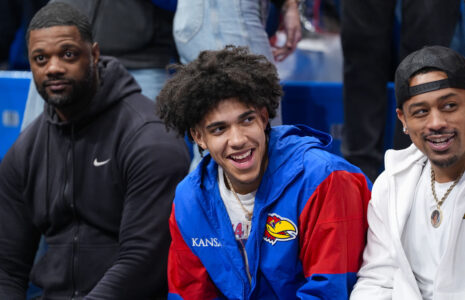
Kansas signee Taylen Kinney smiles from behind the Kansas bench on Saturday, Jan. 31, 2026 at Allen Fieldhouse. Photo by Nick Krug
SAN DIEGO — What happened on the dais in the media tent just outside Viejas Arena on Sunday afternoon ensured that any assessment of the upcoming Kansas men’s basketball offseason must come with a very big asterisk.
In stating after KU’s loss to St. John’s that he hasn’t decided yet whether he will return for the 2026-27 season, Bill Self left room for the possibility that the program could potentially have a new head coach this spring and summer.
That in turn means anything that might seem like a given with KU’s current roster, in terms of projected returnees and incoming recruits, could dramatically change. Trying to guess how many of them would still want to come if Self were to retire is a fool’s errand.
So, in the meantime, this early look ahead to the offseason will have to operate as if the Hall of Famer will return for a 24th year helming the program. If his health is in fact the determining factor, and he feels, as he said on Sunday, “as good as I’ve felt in a long time,” it’s easy to envision a world in which he chooses to come back.
If he does, he’ll be busy very quickly. He said on Sunday that KU needs to excel at evaluating and recruiting if it is to get past the second round (it has not done so since 2022).
“You’re going to have to figure out who’s staying, who’s not staying, portal,” he said. “I just think in today’s time, the next four to six weeks will be indicative, to the question that was asked earlier, (which was) ‘How can you improve yourself moving forward?’ The next four to six weeks will be the most important time to do that.”
The window for players to enter the transfer portal opens on April 7, the day after the national title game in Indianapolis, and closes on April 21, a shift to a shorter and later period as compared to last season.
That could make for a somewhat greater frenzy of activity for many teams, although of course they can still acquire players well after the window to specifically enter the portal has closed. In any case, barring the head coach’s potential retirement, one would expect a quieter offseason than in 2025 for Kansas given that at one point last spring the Jayhawks had no scholarship players who had spent a minute on the court the prior year on their roster.
Unless there’s a veritable transfer-portal calamity this time around, that’s not going to happen. But there still remains plenty of uncertainty.
Darryn Peterson said the right things after Sunday’s loss about wanting to talk to his family before making a decision about whether to turn pro. But he is surely headed for the NBA, where he will immediately become a franchise centerpiece as one of the top two or three picks in June’s draft. However, Self has acknowledged that sophomore forward Flory Bidunga, the Big 12 defensive player of the year and also an increasingly developed offensive talent, will have a stay-or-go decision. It wouldn’t be a surprise at all if he chose to test the professional waters.
Elsewhere on the roster are several players who arrived last offseason but didn’t obtain roles as large as they might have expected. How many will stick around and how many could choose to look elsewhere in the transfer portal?
One factor that could wield a great deal of influence over the remainder of KU’s roster construction — both from a financial and player-acquisition standpoint — is how the Jayhawks’ high school recruiting turns out. KU has four players signed to what already ranks as one of the top classes in the country, but Self has frequently spoken of needing one more to make it elite. The Jayhawks’ pursuit of 2026 No. 1 prospect Tyran Stokes is no secret, but can they lock him down? Will Javon Bardwell reclassify from 2027? Will there be late-summer additions like Kohl Rosario, Paul Mbiya and Nginyu Ngala last year?
It should be quite a different sort of offseason with much more focus on the draft than the last two years, but one with plenty of intrigue all the same.
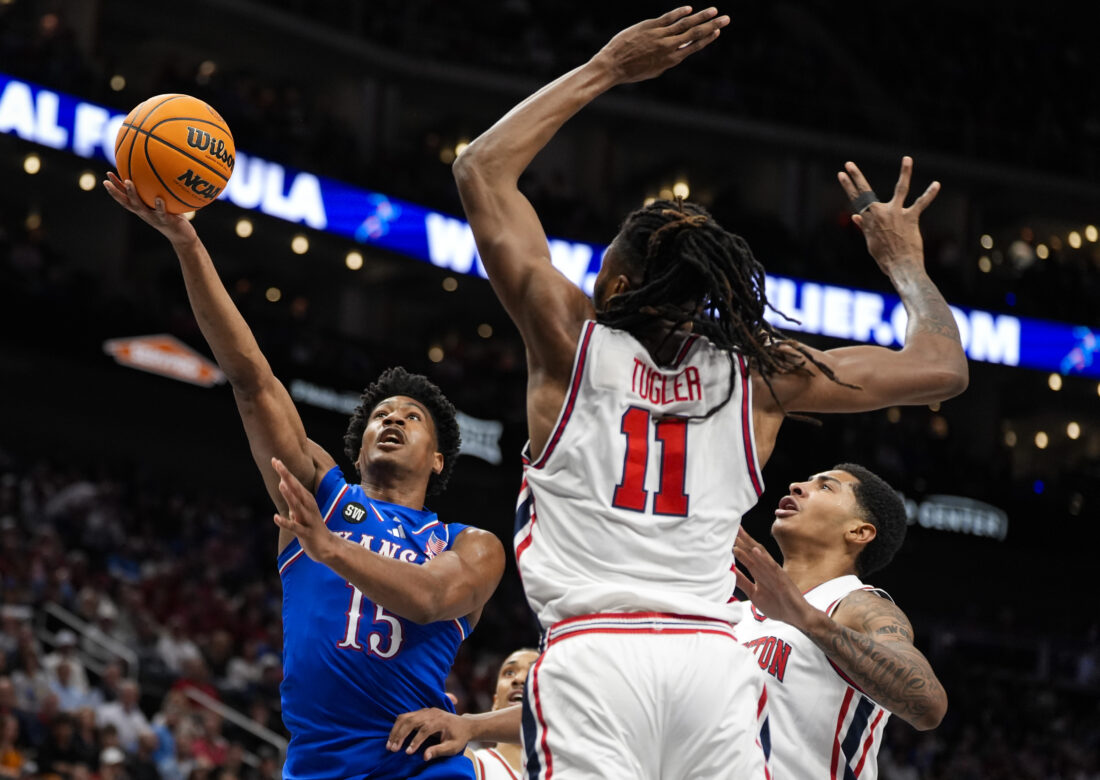
Kansas forward Bryson Tiller (15) puts up a shot as Houston forward Joseph Tugler (11) comes in for a block during the first half, Friday, March 13, 2026, at T-Mobile Center in Kansas City. Photo by Nick Krug
THE ROSTER AS IT STANDS
Guard Melvin Council Jr. and forward Tre White have exhausted their eligibility, and KU fans will likely remember them fondly as two of Self’s best transfer-portal fits, even if they didn’t cap things off with a lengthy postseason run. Jayden Dawson never made significant in-game contributions when he had seemed like a starting-caliber addition upon arriving from Loyola-Chicago, and Ngala mostly served as a well-regarded practice player.
With Peterson surely on his way to the draft, that would leave KU with Corbin Allen, Bidunga, Samis Calderon, Elmarko Jackson, Mbiya, Jamari McDowell, Rosario and Bryson Tiller — eight scholarship players who can potentially return.
Bidunga and Tiller will likely receive the greatest scrutiny this offseason. They both seem on track for professional opportunities in the NBA, albeit with different strengths and weaknesses, and are at somewhat different stages of their development. Amid his highly accomplished sophomore season, Bidunga has popped up as a potential second-round pick in mock drafts from the likes of Bleacher Report and ESPN. Would that be enough to sway him to make the jump, instead of shooting for a potential All-American-caliber (and highly lucrative) junior year in college?
Tiller was ahead of schedule as a redshirt freshman this season and showed off his technical gifts and inside-outside skill set in a 6-foot-11 body. He struggled at times to provide the post defense and rebounding required of his power-forward position, but on the whole showed immense promise and could undoubtedly be a primary focus of the 2026-27 campaign.
Jackson and McDowell each returned after missing a season — in Jackson’s case due to a torn patellar tendon, in McDowell’s due to a mid-career redshirt — and took on roles off the bench. Jackson looked more confident than in his freshman campaign and earned plenty of playing time through high-level defense but showed he still has work to do, especially on the offensive end. McDowell managed to fend off multiple offseason additions for consistent playing time, sometimes as KU’s first guard off the bench, and hit 3-pointers at a higher rate than perhaps anyone anticipated, but was not nearly as productive outside of Allen Fieldhouse.
The rest of the roster is full of question marks. Rosario was so impressive in the offseason after reclassifying as to earn a starting role but lost it rather quickly and, though he always demonstrated his athleticism, hustle and work ethic, didn’t make many 3-point shots when called upon — then suddenly showed his skills in KU’s ill-fated rally in the season-ending loss to St. John’s.
The emergence of Tiller diminished the need for either Calderon or Mbiya to see significant minutes. In Mbiya’s case, he too showed flashes toward the end of the year, and he clearly has the physical tools at 7-foot with a 7-foot-8 wingspan, but will he be able to carve out a role going forward?
Calderon, meanwhile, played so sparingly with 67 minutes in 16 appearances that Self called him, addressing the crowd on senior night, “a guy that really, you didn’t get a chance to see play this year, and you know, looking back on it, I wish we would (maybe) have made a different decision” — possibly an allusion to redshirting — “because he’s got a chance to be an NBA player.”
Corbin Allen, a 6-foot-5 guard from Kansas City, Missouri, who did in fact end up redshirting, is another enigma in his own right.
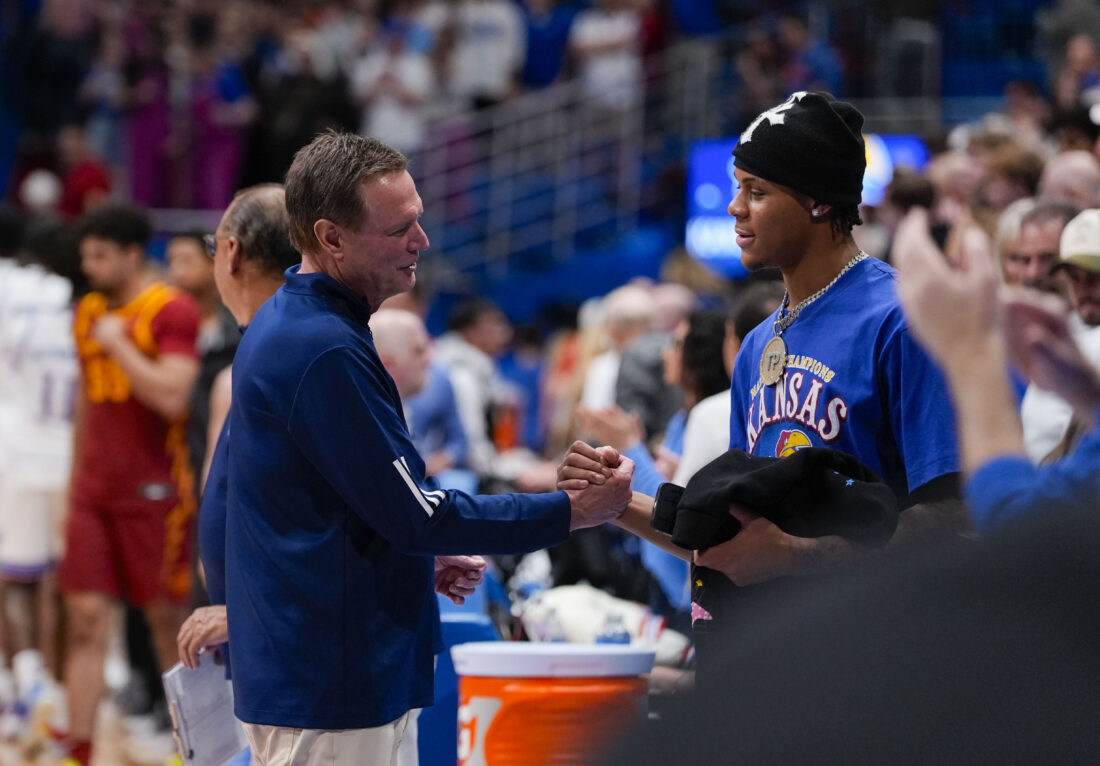
Kansas head coach Bill Self greets recruit Trent Perry following the Jayhawks’ 84-63 win over Iowa State on Tuesday, Jan. 13, 2026 at Allen Fieldhouse. Photo by Nick Krug
SIGNEES
Under the new rules implemented by the House v. NCAA settlement — and with NCAA penalties for KU at last in the rearview mirror — the Jayhawks will have 15 roster spots at their disposal (not including walk-on Will Thengvall, who is expected to be grandfathered in under the Designated Student-Athlete rule from last summer).
That means that in the unlikely event that if everyone above chooses to return, KU will have 12 slots occupied because of its four incoming freshman signees: Davion Adkins, Luke Barnett, Taylen Kinney and Trent Perry.
Kinney, from Newport, Kentucky, is the headliner, a top-15 national recruit and a scoring point guard who has spoken of Self giving him the keys to the Jayhawks’ offense. The rest are four-stars: an athletic post player in Adkins (Arlington, Texas), a long and strong wing in Perry (Frisco, Texas) and a shooter in Barnett (Laguna Niguel, California). Adkins and Perry, by the way, will be in action in Chipotle Nationals beginning April 1 in Fishers, Indiana.
Bardwell, a five-star wing from Harlem, New York, who plays with Kinney at Overtime Elite, is already committed for 2027 and has been since October. Long viewed as a reclassification candidate, he could move up to 2026, but would he be more valuable to the Jayhawks where he already is?
The recruitment of Stokes, the consensus top prospect in the 2026 class, continues to drag on. A powerful 6-foot-7 wing from Louisville, Kentucky, he recently won a state championship at Rainier Beach High School in Seattle. Stokes has told 247Sports and On3 that his sponsorship deal with Nike won’t impact his ultimate choice of college. That would seem to be good news for Adidas-backed KU, which has been in his top three for quite some time.
Stokes visited Lawrence on Jan. 31 for the battle between the top 2025 freshmen Peterson and AJ Dybantsa, with Kinney and Bardwell also in attendance, but nearly two months have passed since without a decision. Earlier in March, ESPN reported, citing Stokes’ high school coach, that he was planning on setting up an official visit to Kentucky. He and Kinney will be in the McDonald’s All-American Game in Glendale, Arizona, on March 31.
KU has been linked to other 2026 prospects, especially international centers, but not in any substantive fashion of late. Serbian center Lazar Stojkovic was supposed to visit in February but did not due to scheduling conflicts and it wasn’t clear if it would be rescheduled, his agency told the Journal-World at the time.
SALIENT NEEDS
Obviously, KU’s greatest personnel needs are heavily dependent on many of the stay-or-go decisions mentioned above, both for NBA candidates like Bidunga or the various players who could potentially choose to enter the transfer portal.
It does seem like the Jayhawks need to get more physical inside, whether that’s through developing the likes of Tiller and Mbiya or adding a bruiser in the offseason. Their lack of post depth meant a number of situations against teams running two-big lineups in which either Bidunga or Tiller would pick up a second foul, White would have to function as a power forward and foes would take advantage.
If KU doesn’t get Stokes, it will probably need a starting-caliber wing, even if it is able to retain the off-ball guards already on its roster. That may be its clearest-cut position of need. The Jayhawks didn’t have a lot of true wings during the 2025-26 season and will lose their most experienced one, White, to graduation.
And then there’s some question as to who might accompany Kinney in the backcourt. There will likely be returning options from the 2025-26 roster, but there’s some merit to the idea of accompanying him with a defensively inclined secondary ball handler, a wily veteran, sort of in the vein of partnering Council with Peterson.
KU Men's Basketball
Bidunga reportedly headed to Louisville
Utah transfer guard Brown likely to visit KU
Former K-State guard Ames, most recently of Cal, set to visit; KU one of top schools for Utah transfer Brown
Why Jayden Dawson entered the portal without remaining eligibility
Report: Calderon latest Jayhawk to enter portal