Returning players who will need to improve to secure roles on this year’s KU football team
photo by: Mike Gunnoe/Special to the Journal-World
Kansas sophomore Keaton Kubecka celebrates scoring a touchdown against Fresno State at David Booth Kansas Memorial Stadium Saturday, Aug. 23, 2025 in Lawrence.
With Big 12 media days about to get underway on Tuesday and Kansas representatives speaking on Wednesday, we’ll soon hear plenty about the Jayhawks’ quarterback competition and the various star players who will have the greatest direct impact on how the 2026 campaign unfolds.
But scattered throughout the transfer-heavy roster that will take the field this fall are some unheralded returning players who will nonetheless help determine whether the Jayhawks are able to grow beyond their 5-7 record from the 2025 season.
Here are four of the players who need to take the biggest steps forward if they want to earn their roles on this year’s team.
Keaton Kubecka: For the second season in a row, the arrival of high-quality, proven transfer talent at wide receiver has pushed Kubecka — a high school recruit from the class of 2023 — down the perceived pecking order.
Last year KU reeled in Bryson Canty from Columbia, Cam Pickett from Ball State, Emmanuel Henderson Jr. from Alabama and Levi Wentz from Albany in the winter portal to redo its receiving corps. All but the late-arriving, injury-affected Canty ended up earning more snaps than Kubecka, according to Pro Football Focus. The 6-foot-2 Kubecka did show some potential as a red-zone target and scored his first career touchdown in the 2025 opener, but finished the year with 17 catches for 157 yards and just the one score.
This season, Pickett is back and has the slot locked down, and Kubecka, now a redshirt junior, will have to compete with two new acquisitions for playing time on the outside. Buffalo transfer Nik McMillan is coming off a distinguished season with the Bulls in which he caught 62 passes for 981 yards. Nahzae Cox led all wideouts at Middle Tennessee with 562 snaps and recorded 40 catches for 473 yards.
Kubecka has the dual advantages of being both a returning player and the only member of the receiver group who has previously played in Andy Kotelnicki’s offense. Kotelnicki, who loves to deploy wide-ranging personnel, will surely use Kubecka in some form no matter how prominent his role is. But getting something like a starting job — he started two games in 2025 — will demand more from Kubecka.
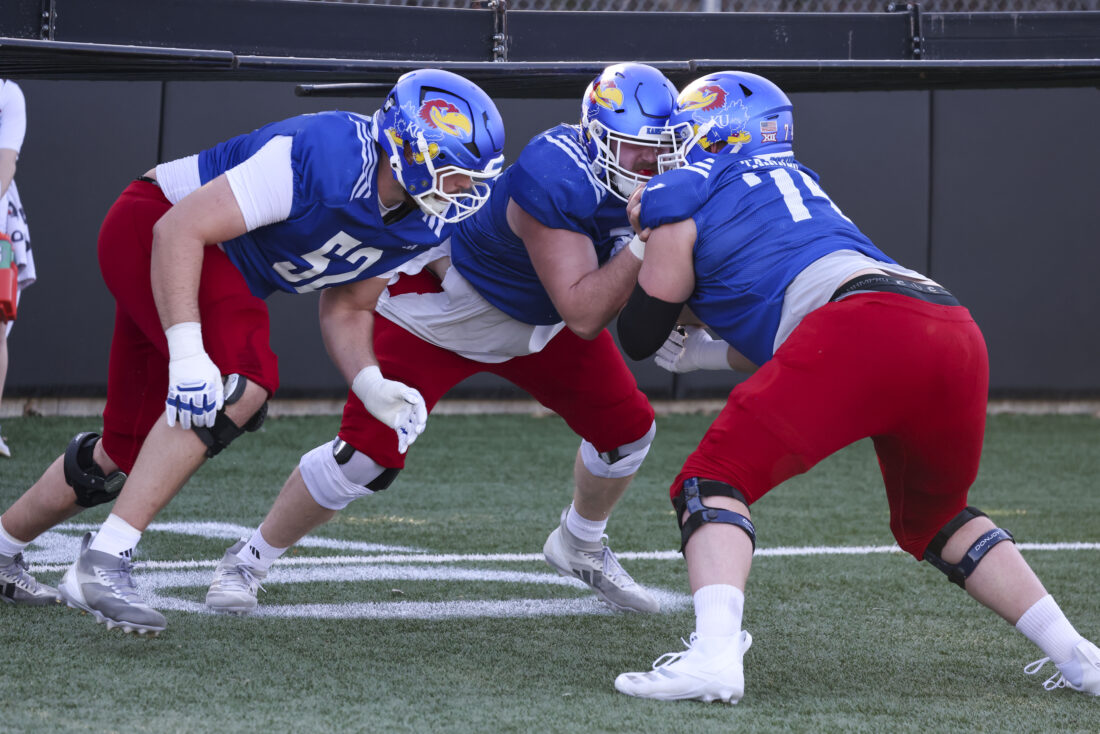
photo by: Kahner Sampson/Special to the Journal-World
Kansas offensive linemen Nick Morrow, James Livingston, and Jack Tanner (left to right) participate in Kansas football’s spring practice on Thursday, March 26, 2026, in Lawrence.
Jack Tanner: Calvin Clements and Amir Herring are safe bets at left tackle and left guard, and Kasen Carpenter seems likely to stave off the younger Anderson Kopp at center. Texas transfer Connor Stroh and returning reserve Tavake Tuikolovatu will surely battle for the starting spot at right guard — and it’s quite possible, given KU’s history of rotation at the guard spots, that each player will find his way onto the field somehow during the 2026 season.
The outlook is murkier for Tanner, a former Tulsa transfer who was part of a group of young linemen KU added in the portal in the winter of 2025 who had all accrued some sort of playing experience as freshmen at lower-level programs. They then redshirted in their first season in the Big 12; Tanner went from starting at left tackle as a freshman with the Golden Hurricane to playing 17 snaps in two games on offense for KU in 2025.
Now Tanner faces potential challenges on two fronts. He might be the underdog as compared to veteran Cal transfer Nick Morrow when it comes to the starting spot at right tackle; if he misses out on that position, he might also be the favorite over Missouri transfer Brandon Solis, a bit of an enigma who never played in three years with the Tigers, to serve as the swing tackle. Either way, it should be a competitive summer and fall for Tanner.
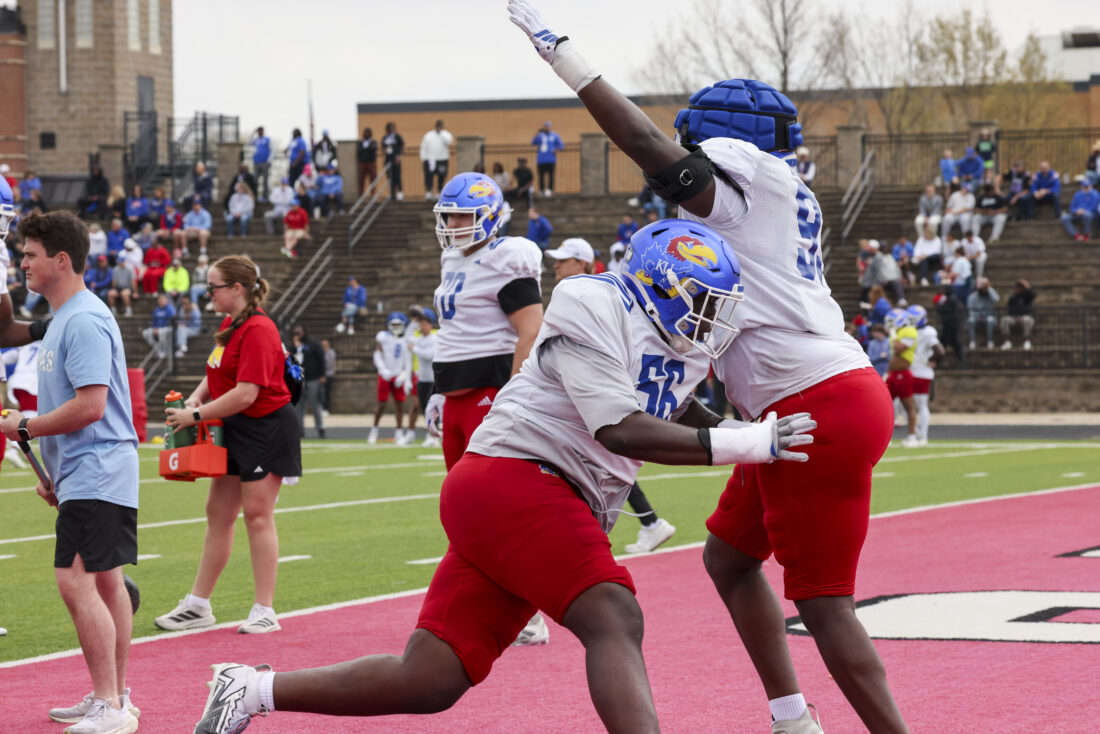
photo by: Kahner Sampson/Special to the Journal-World
Kansas defensive lineman Marcus Calvin (left) and Josiah Hammond participate in drills during KU Football’s spring practice at Lawrence High School on Saturday, April 11, 2026 in Lawrence.
Marcus Calvin: Even in the earliest stages of the offseason, it was clear this would be a pivotal year for Calvin, still experienced in the Jayhawks’ system but less firmly ensconced in a marquee role than his classmate Blake Herold, who started to receive greater playing time earlier in his career than Calvin did.
Then KU loaded up at defensive tackle in the offseason by adding Jibriel Conde (Grand Valley State), Tre’von McAlpine (Tulane), Kevin Oatis (Arkansas) and Eamon Smalls (UAB), providing plenty of competition from players with different body types and levels of experience. Last season Calvin ranked fifth in snaps on the interior defensive line, and the influx of talent could have potentially pushed him down to a similar ranking, or at least one not much higher, in the 2026 group.
The late-spring injury to McAlpine — the severity and details of which are still unknown — might end up making room for Calvin to take on a slightly larger responsibility as a redshirt junior, depending how long McAlpine proves to be out. But considering that McAlpine looked poised to be one of KU’s top transfers regardless of position, the injury could also create an even greater sense of urgency for Calvin to grow and develop if the Jayhawks are to maintain the high level of play at tackle that they have displayed in recent years.
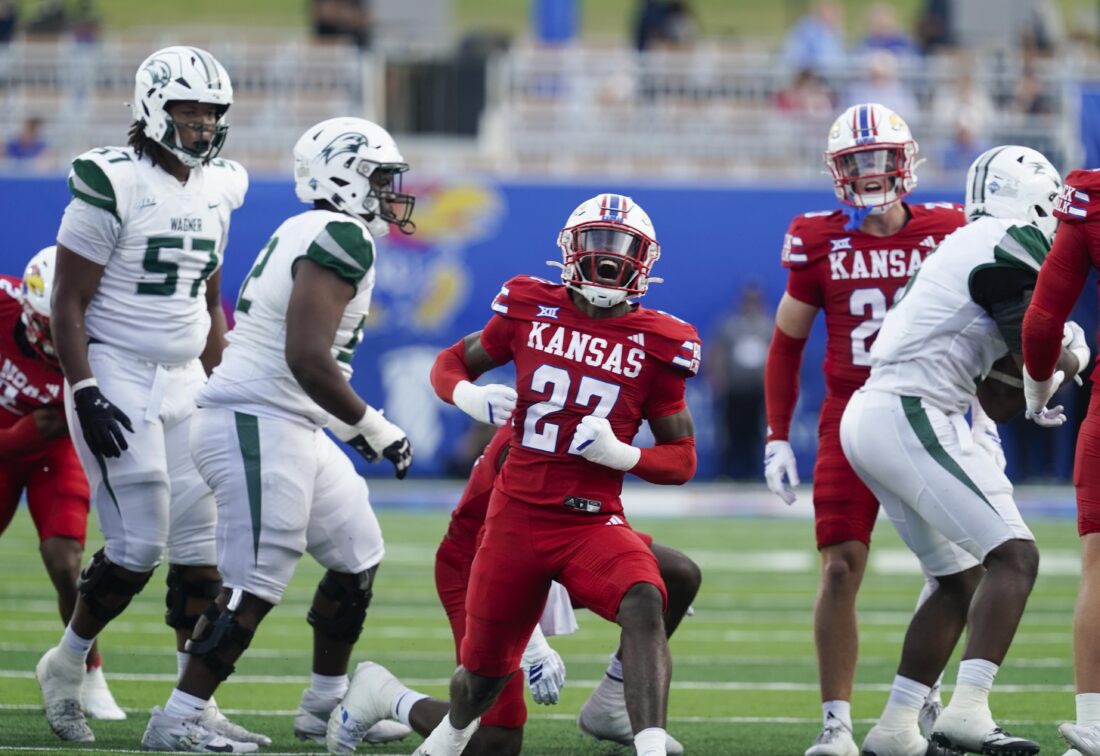
Kansas safety Taylor Davis (27) celebrates a stop against Wagner during the first quarter on Friday, Aug. 29, 2025 at David Booth Kansas Memorial Stadium. Photo by Nick Krug
Taylor Davis: Davis was ahead of schedule when he got thrust into action as a redshirt freshman in 2024, and the impressive work he did late in that season as an unlikely starter at safety put him in position to start once again in 2025.
He was able to do so in 11 of KU’s 12 games, but the results were not stellar. As one of the core members of a secondary that struggled for much of the season, Davis recorded 41 tackles and was one of precious few Jayhawks to intercept a pass, but he also went down as PFF’s lowest-graded player on the defensive side of the ball among any of KU’s regular contributors.
As others have suggested, Davis might benefit this year from playing more frequently as a boundary safety, a role somewhat more focused on run support and less on coverage, and one that was often occupied by Lyrik Rawls last season before he transferred to Arizona State. The versatility of being able to play both positions can’t possibly hurt Davis this year, in any case.
But he is also contending with a whole new array of athletes vying for opportunities in a revamped safety room. Perhaps the most prominent competitor is Jaden Harris, who has experience at some of the top programs in the nation in Georgia and Miami and was once a full-time starter for the Hurricanes. His presence alone will ensure that Davis grows beyond what he was in 2025 or risks losing playing time, and indeed head coach Lance Leipold has already mentioned that Harris has helped push Davis quite a bit.
KU Football
KU reserve linebacker Willis out for season
What did we learn from KU’s loss to Kansas State?
KU run defense regresses in Sunflower Showdown loss
Photo Gallery: Crucial mistakes doom Jayhawks against Wildcats
Quick recap: KU loses 18th straight to K-State, 35-24