New eligibility rules could mean extended special-teams action for young Jayhawks
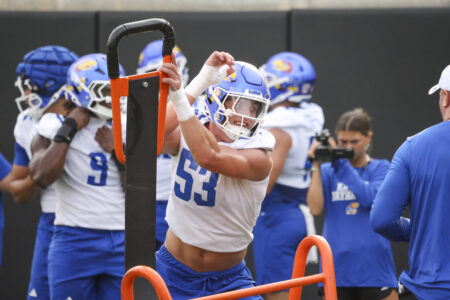
photo by: Kahner Sampson/Special to the Journal-World
Kansas defensive end Draeden Punt pushes aside the sled during the first day of KU Football's fall camp on Tuesday, Aug. 4, 2026, in Lawrence.
Twelve snaps on special teams were a valuable part of Kansas linebacker Malachi Curvey’s first year of college football.
“It was good to get a feel for the game speed,” the redshirt freshman said.
Like so many other freshmen in recent years, however, Curvey was limited to four games — the maximum in which he was allowed to play to preserve his redshirt, meaning he could still play in four full seasons beyond 2025.
But now such restrictions have evaporated. With the NCAA’s move to a five-seasons-in-five-years eligibility model, redshirts and most waivers are things of the past, and there is no incentive to have a player sit out the majority of a season.
That means KU’s coaches don’t have to hesitate in terms of how frequently they integrate a promising young talent.
“Now you don’t have to sit there and go, ‘Well, maybe this guy in the first four games, this guy in the middle four, whatever,'” head coach Lance Leipold said. “Now you can play a guy.”
KU’s special teams coordinator Taiwo Onatolu said that when the rule passed, several freshmen came to him and were “fired up.”
“You’re starting to see those freshmen knowing that there’s no redshirt, that they’re competing, and know, ‘Hey, I can get on the bus right away,'” Onatolu said.
The travel element does provide a bit of an impediment, in that Big 12 teams are limited in terms of how many players they can bring to road games. They have their full complement of deep reserves when they play at home.
“We have grown the travel squad,” Leipold said. “I know the Big Ten just expanded theirs even more (from 74 players to 80). We haven’t heard anything if we are looking into that. Hope we do. But it gives you a chance to get guys on the field and keep them engaged and help things in their development process.”
Onatolu said that Leipold and chief of staff Michael Painter generally work through assembling the travel squad: “We always think it’s a big deal but it never really is that much,” Onatolu said.
From a broader perspective, it helps the team to have fresh bodies available as the season draws on and as injuries and fatigue accumulate. (That may be particularly useful for KU this year given that it plays its final nine games in a row after its lone bye week.)
“It’s a long season and you can plan on those guys showing up then,” Onatolu said. “They may not run down game one. If they’re good enough, great. But game three, game four, game five, they might be available then and that’s what’s great about it for sure.”
Who might make it onto the field this year from the class of 2026? Onatolu had good things to say about cornerback Trey Brown, who “keeps flashing in my eyes”; defensive end Draeden Punt, who received a team award for his performance on the scout team; running back Kory Amachree; and wide receiver Corbin Glasco, one of the Jayhawks’ fastest players.
Of course, KU also needs to ensure it has the best possible groups of 11 players out there for kicks and punts, not just the youngest and most willing. The Jayhawks reliably trotted their out No. 1 wide receiver Emmanuel Henderson Jr. as its kick returner and gunner in 2025, and it paid off in spades as he was all-conference as a return man and “literally made every tackle” on coverage, as Onatolu put it.
“He was one of our most dynamic players,” Onatolu said. “We try to show guys, ‘Hey, the best players got to play.'”
If some of those players do prove to be freshmen this time around, though, there will be nothing preventing them from appearing early and often.
KU Football
KU reserve linebacker Willis out for season
What did we learn from KU’s loss to Kansas State?
KU run defense regresses in Sunflower Showdown loss
Photo Gallery: Crucial mistakes doom Jayhawks against Wildcats
Quick recap: KU loses 18th straight to K-State, 35-24