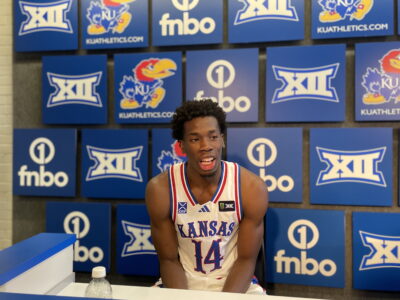
Evaluating most likely lineups for KU men’s basketball
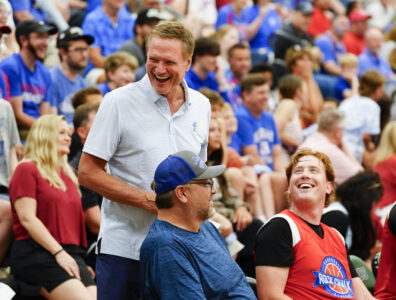
Kansas head coach Bill Self laughs with Red Team guard Chris Teahan (12) and David Johanning as he passes by the Red Team bench during the 18th-annual Rock Chalk Roundball Classic on Thursday, June 4, 2026 at Free State High School. Photo by Nick Krug
The process of projecting a starting lineup for the Kansas men’s basketball team usually brings with it plenty of intrigue and uncertainty, with numerous combinations and endless debates in the lead-up to the fall.
But the way KU has constructed its roster this season, along with recent comments by head coach Bill Self and associate head coach Jeremy Case in the days and weeks since the Jayhawks arrived on campus for the summer, make it pretty clear how the Jayhawks could play this season, or at least how they might initially intend to.
From where I’m sitting, it would be a bit of a surprise if the Jayhawks took James Naismith Court on Nov. 2 to open the season against Fordham with a lineup that does not include Taylen Kinney, Leroy Blyden Jr., Tyran Stokes, Keanu Dawes and either Paul Mbiya or Christian Reeves.
I’ll evaluate some potential variations on that starting five, or more accurately six, in a moment, but first should explain how I arrived at this particular conclusion.
The main quibble that many will likely have with this projection is the inclusion of two small guards. Indeed, with the recent release of its official roster, KU is listing Kinney and Blyden at 6-foot-2 and 6-foot-1, respectively, and it’s easy to see how this could inhibit the Jayhawks’ offense against teams with more length (provided the foes have some level of lateral quickness at least) and make them less switchable on defense, certainly as compared to last season.
But Self has already said that KU will play with this particular backcourt “a lot.” I think what he finds most appealing is the idea of deploying two combo guards. (He even added, “I’ve usually done my best when I have combo guards.”) Both Blyden and Kinney have advanced inside-out offensive skill sets for relatively young players, but they can also play on or off the ball, allowing the Jayhawks to initiate the offense in different ways. When you throw in the much-discussed passing acumen of Stokes, uncommon for a player of his size at his position, KU should really be able to keep defenses guessing.
On a recent episode of “Hawk Talk,” Case emphasized that Blyden’s primary value to the Jayhawks is his shooting ability, of which he provided ample evidence by shooting 77-for-189 (40.7%) beyond the arc in his freshman year at Toledo. That makes it difficult for KU to take him off the court. If the Jayhawks were to go bigger, he’d have to be the one on the chopping block, in all likelihood, and how would that work from an outside shooting perspective?
Kinney can shoot reasonably well — 33.9% from deep between the regular season and playoffs in Overtime Elite last year, though his percentages in each phase of the year were dramatically different — but this would be a lineup in which his ball-handling responsibilities would increase even further and he would be expected to create for others. Stokes is a developing shooter with solid form whose full potential in that realm is not yet known. Dawes, the projected power forward, is a career 31.1% 3-point shooter. Case complimented his shooting and said he might be able to get up toward 38%; we’ll see. The center spot won’t give KU anything in this area.
If Blyden were to come off the bench, the Jayhawks’ shooting guard would need to be one of a pair of 6-foot-6 wings between sophomore Kohl Rosario and senior transfer Dennis Parker Jr. Rosario’s potential is clearly incredibly high, but he hasn’t shot with consistency yet to this point in his career. Parker went 60-for-159 (37.7%) on 3s last year at Radford, though it’s worth questioning whether he could translate that efficiency to a situation in which he isn’t anywhere near the primary offensive option and is facing a higher level of competition, considering that he was just 21-for-75 (28%) across his prior two years at N.C. State.
Between increased defensive length and rebounding prowess, there’s plenty to like about a Kinney/Parker or Kinney/Rosario backcourt, but it’s much harder to say no to the proven on-ball production Blyden provides. All three players will figure prominently into this year’s rotation, there’s no doubt, but I expect Blyden to get the first crack at starting.
Dawes at power forward is a no-brainer considering his experience at the position and the potential ways in which he can complement Stokes and either Mbiya or Reeves with his athleticism and versatility. (Davion Adkins will likely be Dawes’ primary backup.) Considering the relative uncertainty at center — more on that in a moment — there’s at least some merit to putting Dawes in the middle and going for a small-ball five that includes both combo guards and either Parker or Rosario on the wing with Stokes at power forward. That will surely come to the forefront at some point during the season. But Self has said he’d rather not play that way.
So there will likely be a 7-footer anchoring the middle, and the center spot should continue to provide enough intrigue to sustain offseason starting-lineup debates on its own. KU did not bring in a marquee player at this position. Staying out of the fray might have been wise given some of the reported price tags for top-level post threats. Instead KU seemed at least reasonably content to head into next season with Paul Mbiya and Christian Reeves vying for playing time.
Compared to Mbiya, who wasn’t even really part of KU’s rotation until the 2026 NCAA Tournament, Reeves is vastly more experienced, with four years of college basketball under his belt, albeit having spent the first three years playing 4.5 minutes per game. He’s also two inches taller and 10 pounds heavier. On the other hand, he has a brutal medical history that now includes both ankle surgery that ended his sophomore year and a shoulder injury that hampered him as a redshirt junior and required its own offseason surgery.
Because of the recovery process, he won’t be a full-contact participant in practice until October, which gives Mbiya months and months to gain traction. Given the extent to which Reeves will have to get reacclimated, Mbiya should have the edge to start at the beginning of the year — and if he plays like he did in those tournament cameos against Cal Baptist and St. John’s, he might not let his spot go at all.
Now, it is worth noting that KU’s roster may not be done. In fact, Self has quite straightforwardly said it is not. The Jayhawks could add up to two more players and have rumored interest in former Arkansas forward Malique Ewin, who is not currently eligible and would presumably need to undertake some sort of legal action. JayhawkSlant also reported on Wednesday that KU was involved with Serbian big man Mihailo Mušikić.
Either would be a noteworthy acquisition if it somehow comes to fruition. It is quite possible, though, that whomever KU might acquire could have trouble cracking the top five.
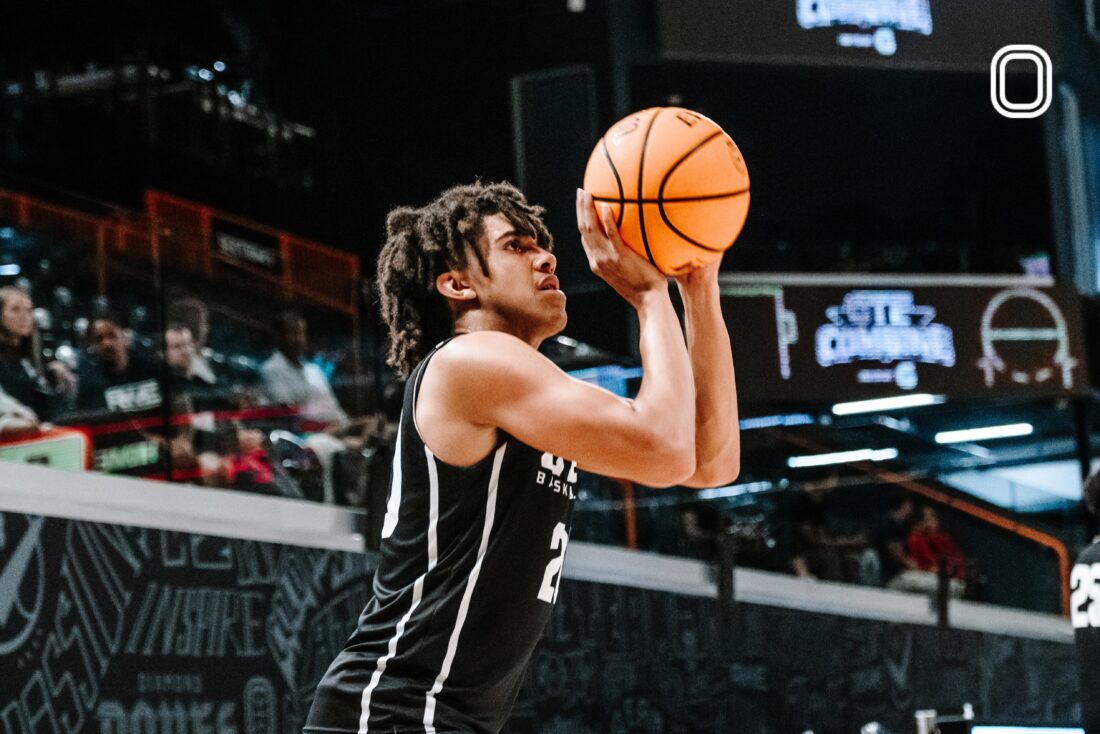
photo by: Overtime Elite
Taylen Kinney lines up a shot at the Overtime Elite combine on Tuesday, Sept. 24, 2024, in Atlanta.
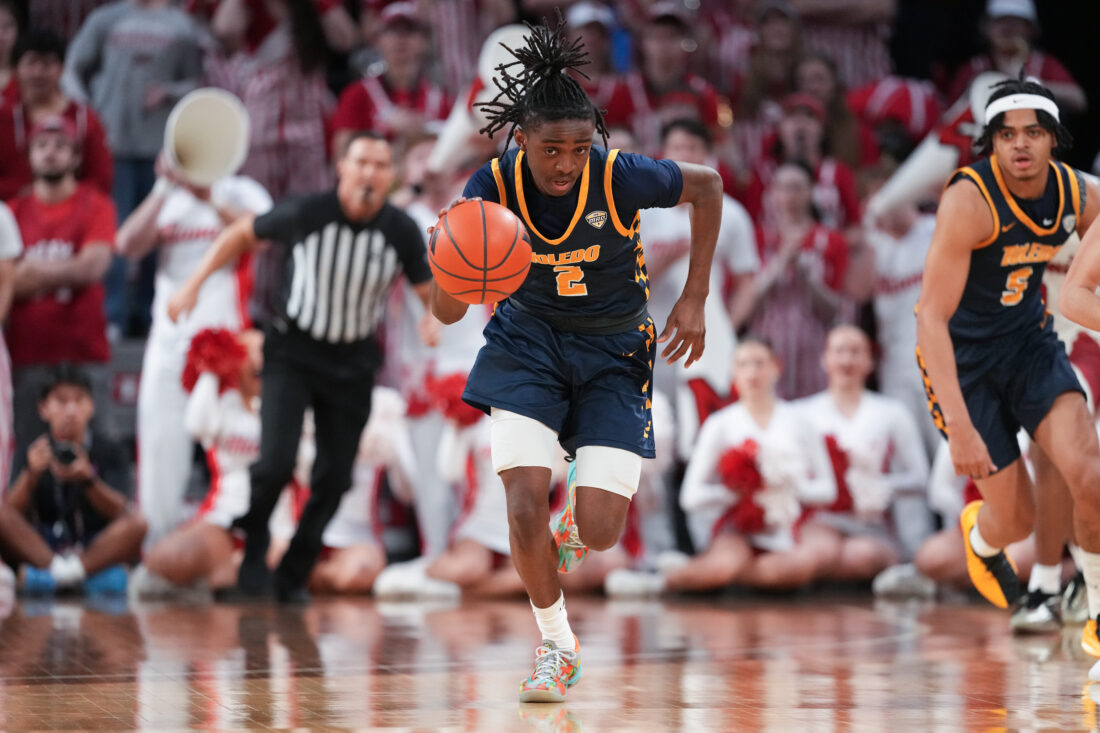
photo by: AP Photo/Kareem Elgazzar
Toledo guard Leroy Blyden Jr. dribbles on a fast break during the first half of an NCAA college basketball game against Miami (OH), Tuesday, March 3, 2026, in Oxford, Ohio.
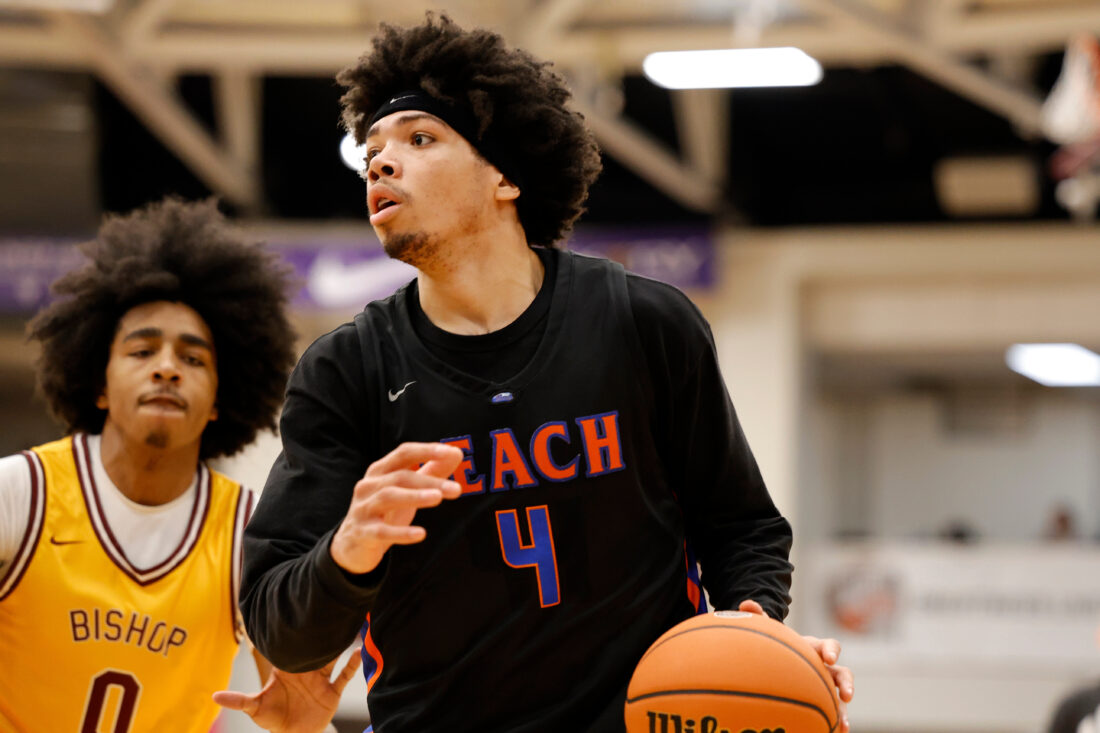
photo by: AP Photo/Gregory Payan
Rainier Beach’s Tyran Stokes (4) in action against Bishop McNamara during a high school basketball game at the Hoophall Classic, Sunday, January 18, 2026, in Springfield, Mass.
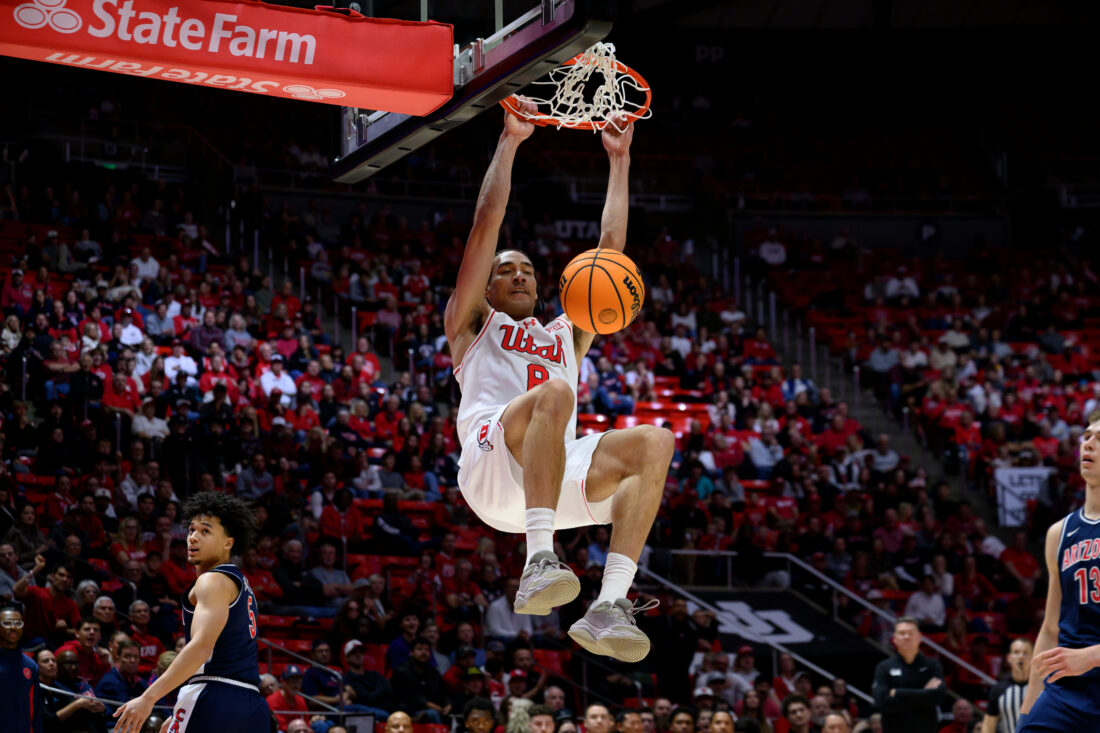
photo by: AP Photo/Tyler Tate
Utah forward Keanu Dawes dunks during the first half of an NCAA college basketball game against Arizona, Saturday, Jan. 3, 2026, in Salt Lake City.
KU Men's Basketball
Reeves makes early impression at Late Night
Photo Gallery: Kansas handles Pitt State with an 80-62 exhibition win
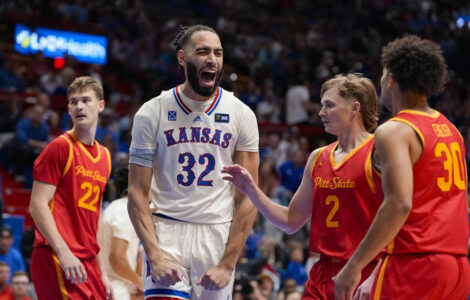
Jayhawks top Pitt State 80-62 in Late Night exhibition
Indiana court keeps injunction in place, maintaining eligibility for several KU athletes
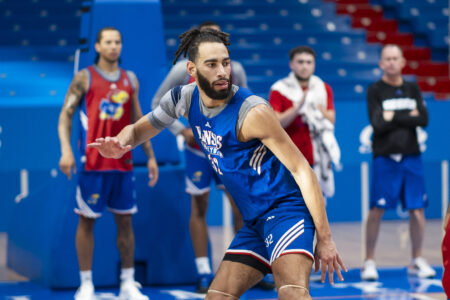
Reeves ready to go after lengthy recovery from shoulder injury