How latest eligibility bombshell could affect various KU sports

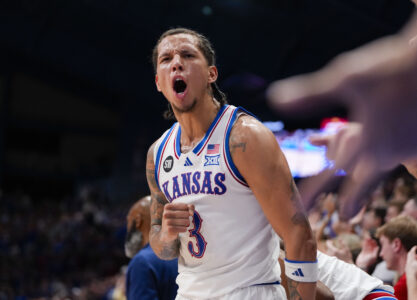
A sea of blue Kansas fans sing the Alma Mater, Monday, Feb. 9, 2026, at Allen Fieldhouse. Photo by Nick Krug
It certainly seems like quite a few college athletes are about to get more eligibility, whether they were actively looking for it or not.
Amid a barrage of increasingly successful lawsuits by members of the high school class of 2022 who played four straight seasons in college, then graduated this past year — so too early to take advantage of the NCAA’s new five-year eligibility rules — a judge in Denver on Friday night declared that the NCAA must instead render all such athletes eligible for a fifth year.
U.S. District Judge Charlotte Sweeney’s ruling in Wisne v. NCAA is for a preliminary injunction and will surely be subject to appeal, not to mention that it’s not exactly clear how this might work for players who have already signed professional contracts. That’ll be a pretty sizable number of them considering that it is now August and this decree spans all sports; some athletes might have finished their senior seasons as many as nine months ago.
Attorney Darren Heitner, who has been in the thick of many of these five-year lawsuits, wrote in a post on X on Saturday morning, “The NCAA will likely take a firm position that an athlete loses eligibility if he signs a contract or commitment of any kind to play professionally in that sport … The biggest problem for athletes and their agents is that the decision is silent on these issues.”
In any case, the result is that the possibility of a fifth collegiate season is, if nothing else, now on the table not just for those who were actively suing the NCAA, like former Kansas guard Jayden Dawson, but for anyone who was sitting around wondering what they might do this coming year.
From a KU perspective, if this injunction stands, not only will it potentially return a bunch of recently departed Jayhawks to the collegiate ranks — some of whom could be quite useful if KU wanted to try to retain them — but it will create a flood of bizarre late-summer transfer-portal action in every sport by which the Jayhawks might be able to obtain new talent if they have roster space and cap space available. In fact, attorney Mit Winter suggested those two prohibitive factors might not even come into play, based on a provision in the Wisne case in which plaintiffs asked the court to prevent the NCAA from enforcing them.
It’s far too early to tell which external prospects KU might be interested in, but one can at least consider the Jayhawks’ potential needs. It’s also probably worth noting that the compulsion to return to college will be a lot greater for those who play in sports where the largest amount of money is available.
(By the way, this doesn’t really affect the potential legal outcomes for Melvin Council Jr., who is older than the class of 2022 athletes and is challenging a different element of NCAA rules.)
What follows is a survey of how some KU athletes and sports might be impacted by this ruling, if it stands. It does not encompass every possible person or team.
Baseball: The KU baseball program might be the one for which the immediate impact is most readily apparent. Prominent players like relief pitchers Kannon Carr and Toby Scheidt and regular starters Josh Dykhoff (first base) and Dariel Osoria (designated hitter/second base) were members of the class of 2022 who played four straight years in college (they all transferred to KU from elsewhere). None of them has signed any publicly announced professional contract after they all went unselected in the MLB Draft.
As for what Dan Fitzgerald and company might seek to acquire from the new player pool, they don’t have many notable needs after a strong offseason, especially with the recent addition of a potential replacement for shortstop Jake Berkland (a transfer acquisition who signed with the White Sox) in the form of Weatherford College’s Walt Jones. They now have good depth throughout both the infield and outfield. The best place to look might be for greater bullpen depth.
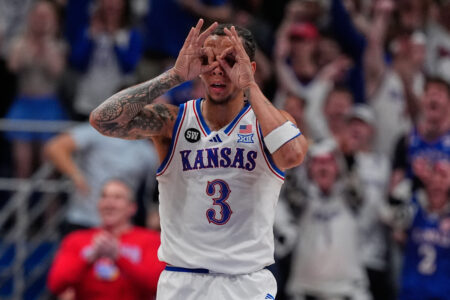
Basketball (men’s): Jayden Dawson can now play a fifth season, notwithstanding his previous attempt at a medical waiver and his pending lawsuit in the state of North Carolina. He has expressed his desire for a fresh start after his lone year at KU didn’t go the way he had hoped. Tre White will also be eligible under the terms of the preliminary injunction, which is interesting considering that he is coming off a strong showing for the Miami Heat at the NBA Summer League.
From the KU perspective, the biggest need is quite apparent: center. Even if roster limits come into play, the Jayhawks have still preserved two open spots, and the infamously slow international eligibility process has not provided any recent clarity on Serbian 7-footer Mihailo Mušikić. The Wisne ruling creates another avenue by which KU might obtain a big man to supplement the inexperienced Paul Mbiya and the injured Christian Reeves. Malique Ewin, formerly of Ole Miss, South Plains College, Florida State and Arkansas, was a rumored KU target earlier in the offseason and is rendered tentatively eligible by this ruling.
Basketball (women’s): Defensive specialist guard Sania Copeland, hot-shooting wing Elle Evans and starting center Lilly Meister all graduated in the spring and are part of the class enacted by this ruling. Evans was statistically one of KU’s best-ever 3-point shooters but fell out of favor in the rotation during her senior year. She is slated to begin her pro career in Italy this fall.
The KU women’s basketball team did well to strengthen its backcourt through the transfer portal, but it might be a bit thin at center, especially during the portion of the year when incoming freshman Cydnee Bryant is playing volleyball.
Football: KU redshirts players so frequently — another practice that will soon go extinct — that basically no one on its 2025 roster had played four straight years after entering college as part of the class of 2022. Wide receiver Emmanuel Henderson Jr. was drafted by the Seattle Seahawks, who are currently in training camp. The only player to whom this legal action would really apply is Justice Finkley, a Texas transfer who had a quiet season as a team captain starting on the strong side for the Jayhawks. And indeed, 247Sports reported on Saturday morning that he is exploring a return to college.
KU could look in a few different directions if it wanted to add to its 2026 roster. Defensive tackle, especially nose tackle in KU’s odd fronts, looks somewhat more suspect with the uncertain injury situation of Tulane transfer Tre’von McAlpine, though the Jayhawks did already add a body there over the summer in Jalen Atkins from the JUCO ranks. They are also a bit thin at wide receiver beyond their top four options of Nahzae Cox, Keaton Kubecka, Nik McMillan and Cam Pickett. The defensive backfield should be fine as long as the various players who were injured in the spring are progressing well ahead of fall camp.
Soccer: First-team all-conference striker Lexi Watts played four seasons straight through at KU, two under Mark Francis and two under Nate Lie, and recorded 28 goals and 14 assists. She would regain eligibility from this injunction, as would reserve defenders Emily Minard and Brooke Otto.
KU soccer is drawing so close to the start of its season — Aug. 12 — as to make the late-stage incorporation of any new players rather impractical. But in a perfect world the Jayhawks could use more goal-scoring firepower or a quality center back to replace the departed Olivia Page, who transferred to Florida State in the spring.
Softball: A sizable and influential senior class helped the Jayhawks return to the postseason in 2026. Players like second baseman Campbell Bagshaw, shortstop Hailey Cripe, center fielder Presley Limbaugh, right fielder Aynslee Linduff and pitcher Lizzy Ludwig, among others, came from the high school class of 2022 and could go back to school if they so chose under the terms of the injunction. Cripe, the Big 12’s co-defensive player of the year, is playing professionally this summer for the new KC Diamonds team.
KU was more active than usual in the transfer portal and brought in four infielders to help replace what it lost. The Jayhawks could look to center field or stock up on pitching to supplement their young core in the circle.
Volleyball: In Matt Ulmer’s first year, the Jayhawks did not have a lot of players who fit the description of this injunction. Libero Ryan White was a senior but started her career in 2021; setter Katie Dalton was listed as one but got a redshirt for a previous season and transferred to Creighton. The main player fitting the bill was outside hitter Rhian Swanson, a second-team all-league pick.
The KU volleyball team is another that has already made it to campus to prepare for the upcoming season. This year’s squad is very young and at some positions doesn’t have a huge amount of depth; at middle blocker and outside hitter, it will depend largely on how quickly freshmen get acclimated. In any case, a third setter behind Reese Messer and Cristin Cline might be valuable regardless.
KU Men's Basketball
Council rejoining Jayhawks for 2026-27 season
Self not keen on in-season international games

KU faces complex situation with final roster spot
Council receives injunction against NCAA in New York court
How White’s return could impact KU