A deep dive into the season’s strangest KU basketball stat
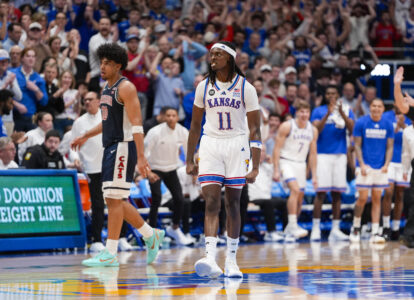
Kansas guard Jamari McDowell (11) grits his teeth after a three against Arizona during the first half, Monday, Feb. 9, 2026, at Allen Fieldhouse. Photo by Nick Krug
Jamari McDowell has by any metric exceeded expectations this season.
The offseason acquisitions of players like reclassifying freshman wing Kohl Rosario and Loyola-Chicago transfer guard Jayden Dawson seemed poised to push McDowell far down the rotation, especially because both those players came to Lawrence with reputations as reliable 3-point shooters.
Instead, McDowell’s development during his redshirt season shone through. The sophomore from Houston has staked his claim for a significant spot with 36% shooting from beyond the arc and consistent effort on defense. He has reliably served as KU’s sixth or seventh man throughout the season and even heard his name called in the starting lineup at Allen Fieldhouse on a few occasions as a replacement for the periodically absent Darryn Peterson.
In his 18.8 minutes per game, compared to 7.2 as a true freshman, he is averaging 3.9 points, 1.7 rebounds and 1.3 assists per game.
Do those numbers seem oddly low to you? Especially considering how many timely, significant shots McDowell has knocked down of late — a dagger to put away Monday’s win over Houston that Bill Self suggested was the biggest shot of the game, a couple of tough buckets in an impressive first half to sustain the Jayhawks against Arizona on Feb. 9 and so on?
If you think about McDowell’s significant moments this season, you may soon realize that nearly all of them — with the major exception of his first career start against Syracuse at the Players Era — have taken place, indeed, at Allen Fieldhouse.
In 15 home games, the sophomore is averaging 5.4 points and 2.1 rebounds on 20-for-42 (47.6%) shooting from deep. In nine road games, he has six total points — in 139 minutes — and 10 rebounds and is 2-for-21 (9.5%) from beyond the arc.
Even tossing in four neutral-site games, one for the Champions Classic and three at the Players Era, his averages away from Lawrence are still 2.1 points and 1.3 rebounds on 7-for-33 (21.2%) shooting.
Of course, McDowell is not the first player in world history to have dramatic home-road splits. As recently as last season, Lawrence native Zeke Mayo’s lack of production away from his hometown became a minor late-season storyline for KU. He finished the year with 17.6 points per game at home and 9.7 on the road, largely driven, like McDowell’s, by his 3-point shooting percentage disparity.
But then the 2024-25 Jayhawks were quite poor away from home as a team and went 4-8 in true road games. This year’s team is a more respectable 5-4 heading into Saturday’s date with Arizona. And some players, like Melvin Council Jr. (16.2 points per game on the road compared to 11.6 at home) and Elmarko Jackson (7.1 as opposed to 3.2) are actually scoring better beyond the friendly confines of Allen Fieldhouse.
That alone should be enough to cast doubt on one potential confounding factor in McDowell’s home-away splits: the idea that KU plays much tougher opponents on the road than at home. Maybe so, especially in nonconference when teams like Green Bay and Texas A&M-Corpus Christi come to town. But a close look at McDowell’s game log reveals that that aspect has little to do with his production. He didn’t solidify himself as a major contributor until the Players Era anyway and hit two total 3s in 30 combined minutes across the Jayhawks’ first three buy games of the year.
A career-high 10 points against Davidson in the nonconference finale got him on track, yes, but similarly strong showings have come since then against highly regarded foes like Iowa State, BYU, Arizona and Houston in the games since. Those are better teams than the likes of Oklahoma State and Kansas State, part of a four-game road stretch in which McDowell has not scored a point away from Lawrence since Jan. 20.
As the rebounding numbers demonstrate, it’s not limited to offensive contributions, either, to be clear. But shooting is McDowell’s primary utility off the bench for this team, aside from generally jelling well and not looking especially out of place alongside KU’s starters. (As Self recently said, “I’ve never accused Mari of being elite defensively” — granted, he said that in the context of McDowell having in fact been elite defensively against Houston.)
So why might the dramatic splits exist? Well, I should note that McDowell is playing about five minutes more per game at home. That provides more opportunities to get on the stat sheet. However, that shouldn’t affect his percentage-based stats — except for the fact that, even dating back to his freshman year against Tennessee in Honolulu, McDowell really seems to play better with a longer leash, which he has had at home when starting in place of Peterson (when KU has a shorter bench).
Self also said in the same post-Houston radio interview about McDowell that the sophomore “played his heart out” and showed “personality.” Indeed, as much as any Jayhawk other than Council and maybe Tre White, McDowell seems to feed off the crowd and the energy of playing before 15,300 at Allen Fieldhouse in order to build his confidence. That energy still exists on the road, though oppositional rather than supportive, but perhaps he just hasn’t found a way to channel it to his benefit.
Ultimately, McDowell’s production is not by any stretch the most important difference maker for KU as it looks to mount a postseason run. But if he could drop in one or two of those well-timed shots in a building other than Allen Fieldhouse or the MGM Grand Garden Arena, it might go a long way for the Jayhawks if they’re trying to grind out a second-round matchup in Greenville, South Carolina, or Oklahoma City. Every point matters for a team that ranks 350th out of 361 nationally in bench scoring.
That’s one piece of good news: He only has to play two more games in an opponent’s home arena, so perhaps he can bring some of that Las Vegas production forward into the Big 12 and NCAA tournaments. Mayo, for what it’s worth, ended up playing even better in his three postseason games — 20.7 points per game on a red-hot 14-for-24 (58.3%) shooting beyond the arc — than he had at any point all season.
KU Men's Basketball
A deep dive into the season’s strangest KU basketball stat
Bracketology update: Where do KU men’s, women’s basketball teams stand after big wins?
White stays consistent, shines on offense against Houston
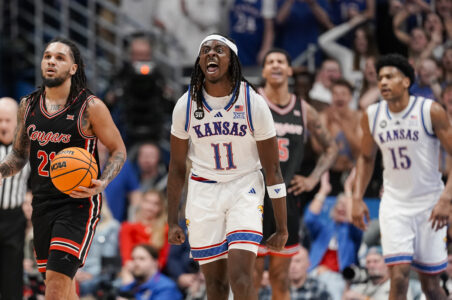
Photo Gallery: Kansas puts a beating on Houston, wins 69-56
KU stifles No. 5 Houston for 69-56 bounce-back victory