Just catching up with KU baseball? Here’s what you need to know
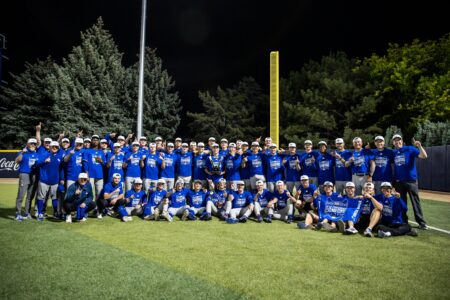
photo by: Kansas Athletics
The Kansas baseball team poses for a photo celebrating its Big 12 Conference title on Friday, May 15, 2026, in Provo, Utah.
To those Kansas fans who may just now be tuning in to witness the baseball program’s sudden and unprecedented success: Welcome!
Maybe you turn away from the crimson and blue completely when the buzzer sounds on KU men’s basketball’s final NCAA Tournament game and go into a sort of estivation until football starts. Maybe you were vaguely aware the Jayhawks had managed some sort of success on the diamond but it didn’t totally register for you until the regular-season title in Utah or tournament title in Arizona. Whatever the case, now is as good of a time as any to start paying attention, especially if you’re local and have a chance to experience firsthand the first-ever Lawrence Regional.
Yes, after KU won that regular-season conference title for the first time since 1949 and tournament title for the first time since 2006, it accomplished something that has never been done by any iteration of the Jayhawks’ baseball program by earning a top-16 national seed and home-field advantage for the postseason weekend ahead.
You might have some questions.
HOW DID WE GET HERE?
As head coach Dan Fitzgerald would tell you, this season is built on a foundation laid by his previous three KU teams — even if that’s not eminently apparent given that just a few contributors returned from 2025 and this year’s team is garnering all these accomplishments with an almost entirely new roster.
Fitzgerald, a former assistant at Dallas Baptist and LSU, took over in the summer of 2022 after the retirement of Ritch Price. KU had gone 20-35 and 4-20 in Big 12 play in Price’s final season. With a new roster that balanced the transfer portal, a handful of returners and the JUCO recruiting that would become his hallmark, Fitzgerald led the Jayhawks to incremental improvements in each of his first two years.
The Jayhawks came in eighth of nine teams in the league at 8-16 in 2023 with a big upset win over Texas in the conference tournament. Big 12 Freshman of the Year Kodey Shojinaga and standout pitcher Collin Baumgartner were the headliners that season. Then came 2024, when KU moved up to sixth in the Big 12 at 15-15 and sent eight players to the pros, with third-round pick Hunter Cranton as the second-highest-drafted Jayhawk ever.
The breakthrough season was 2025, when KU galvanized the fans with an unbeaten start to draw unprecedented student crowds at Hoglund Ballpark. (You might have seen some of the videos.) The Jayhawks developed a flair for the dramatic, with some early walk-off wins, and also made national news with a sequence of five consecutive home runs in a 29-1 win at Minnesota.
Conference play included sweeps of Oklahoma State, UCF, Kansas State, Utah and most infamously West Virginia, which won the league title over KU on win percentage because it had played fewer overall games. Even so, the Jayhawks, led by previously anonymous breakout stars Brady Ballinger and Jackson Hauge, reached their first NCAA Tournament in 11 seasons. (They didn’t do much of note once they got there, losing immediately to Creighton and North Dakota State in Fayetteville, Arkansas, but it was a milestone all the same.)
WHAT ABOUT THIS YEAR?
KU retained Ballinger, along with Dariel Osoria, right-handed pitcher Dominic Voegele and a handful of others, but it’s not like the Jayhawks were supposed to take the Big 12 by storm in 2026. They were picked in a tie for fifth in the preseason poll and entered the year with plenty of unknowns as Fitzgerald and his staff had to reconstitute essentially seven spots of the batting lineup outside of Ballinger and Osoria. Plus, Voegele had an inconsistent sophomore year and it wasn’t clear how he might perform as a junior.
The Jayhawks did not look early on like a force to be reckoned with. They lost their season opener at UTRGV and a midweek date at Lamar. At one point, they were 10-8 after dropping their first two games at Texas Tech, the first in particularly bleak fashion. But that series later on became the retrospective turning point for the Jayhawks, who won the series finale by run rule and proceeded to win 27 of 30 and at one point 21 of 22 games.
That stretch featured no shortage of highlights. KU earned regional supremacy by beating Missouri home and away, Nebraska home and away, and Kansas State in a three-game sweep in Manhattan for the first time since 1963. The Jayhawks won three against Utah in which the teams scored a combined 71 runs and then three against then-first-place UCF in which they totaled 20, demonstrating their versatility. After another sweep against Arizona, they were riding high with a four-game lead in the Big 12 and talk of a top-eight national seed.
Then came the first notable adversity since Texas Tech. First was an odd extra-innings loss at Creighton that began as a shootout before the Bluejays’ lesser-used relievers locked KU down. That could have been an aberration, but then in the Jayhawks’ most significant series in their recent history, with second-place WVU coming to town, they got swept 4-1, 5-2 and 13-2 at Hoglund Ballpark as their four-game lead dwindled to one.
They were undeterred, however, and took two of three on the road at BYU, not without some late-inning drama, to clinch the outright league title.
They lost leads in each of those three games, as they did in the Big 12 opener against No. 8 seed Baylor when 7-1 became 7-7 in the span of two innings, but reserve outfielder Savion Flowers hit a walk-off home run to essentially save KU’s chances of hosting a regional.
The Jayhawks then pulled away from No. 5 Oklahoma State and No. 2 West Virginia in deceptively close 9-2 and 9-0 wins to cement their Big 12 glory with a tournament title.
WHO ARE THE PLAYERS TO KNOW?
One defining characteristic of this year’s team is that it has gotten contributions up and down its lineup. Center fielder Tyson Owens exploded for eight RBIs, with two home runs and a walk-off single, in a memorable 9-8 win over Houston. Second baseman Cade Baldridge had a big three-run homer to seal the sweep of Utah. Catcher Augusto Mungarrieta was key against Nebraska. Ballinger, the left fielder this season, rescued the Jayhawks in Manhattan.
Max Soliz Jr. recorded a walk-off hit against UCF, Osoria hit a go-ahead grand slam at OSU, Flowers had his big moment in Arizona, and so on.
But the Jayhawks’ closest thing to a star hitter is shortstop Tyson LeBlanc. The shortstop from Maurice, Louisiana, a JUCO transfer from LSU Eunice, earned national recognition in April when he went 9-for-17 with three doubles, three home runs and 10 RBIs in the span of a week, and he has stayed hot for much of the year since, to the point that he is now tied for KU’s single-season home run record with 21. After a pair of three-hit games in Arizona, he was named the Big 12 tournament’s most outstanding player.
Voegele has grown into a true ace for the Jayhawks on the mound. One of the few players KU has recruited out of high school, the junior has a modest 6.01 ERA on the year, but it has improved from 8.84 since the Utah series. He has only allowed more than three earned runs in a start once since and had games with 10, 15, 15 and 10 strikeouts, including a complete game against Arizona.
Mason Cook and Mathis Nayral join Voegele in the increasingly steady weekend rotation, while the Jayhawks’ top reliever is first-team all-league closer Boede Rahe, a fiery right-hander out of Kirkwood Community College with a 3.96 ERA, nine saves and 65 strikeouts to 16 walks. Transfers Riane Ritter and Toby Scheidt have worked KU out of a host of high-leverage situations this season.
HOW DOES THE REGIONAL WORK?
The intricacies of NCAA postseason formats can be so difficult to grasp because many of them are vaguely similar across sports but with small and highly meaningful differences. In the NCAA baseball tournament, 64 teams are grouped into 16 four-team regionals at various host sites across the country — hence why it was so important for KU to be one of the top 16 teams in the country this season.
Once the teams are split into groups of four and seeded one through four, they take part in a double-elimination bracket. KU will open against No. 4 seed Northeastern on Friday at 12 p.m. on ESPN+, then No. 2 Arkansas and No. 3 Missouri State will face off at 5 p.m.
The losers of each matchup will do battle in an elimination game on Saturday at 12 p.m. The winners of those first two matchups will then play on Saturday at 5 p.m. with a spot in the regional final on the line.
At this point three teams will remain in contention. The two that are each 1-1 in the regional will play an elimination game on Sunday at 12 p.m. for the other place in the regional final, which in turn takes place Sunday at 5 p.m.
Where things get complicated is that one team in the final enters at 2-0 and the other is 2-1. That means that if the 2-1 team wins, the regional isn’t over and there will be a rematch on Monday for all the marbles at a time yet to be determined. If the 2-0 team wins, it becomes the regional champion on Sunday with no seventh game necessary.
THEN WHAT?
The NCAA baseball tournament likes to alternate between four-team double-elimination brackets and two-team best-of-three series.
As the No. 15 overall seed, KU had its regional paired with that of No. 2 overall seed Georgia Tech. That means that the winners of those two regionals will face off in a best-of-three super regional series the following weekend (either June 5-7 or June 6-8). KU has never taken part in a super regional because the one time it advanced past a regional in 1993, the format was different and it went directly to the College World Series.
If both KU and Tech advance the super regional will be at Tech in Atlanta. KU could theoretically host a super regional if one of the teams in the Yellow Jackets’ regional pulls off an upset.
Sixteen teams will compete in eight super regionals. The remaining eight will go to the College World Series in Omaha, Nebraska.
At that point, they again split into four-team double-elimination brackets. The winners of those brackets contest a best-of-three series for the national title.
KU Sports
KU soccer tops K-State 2-0 in Manhattan
KU women’s golf wins Marilynn Smith Sunflower Invitational
KU women’s golf ready to host Marilynn Smith Sunflower Invitational
KU baseball enters fall schedule with uncommon amount of returning experience
Will KU baseball add to its roster? ‘We’ve got time’