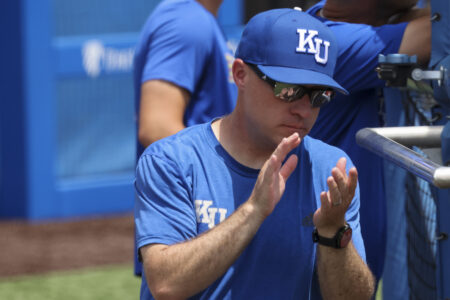
How KU is preparing for a potential baseball regional and the broader future of the program
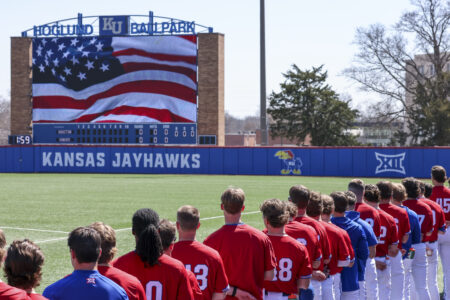
photo by: Kahner Sampson/Special to the Journal-World
The Kansas baseball team lines up for the national anthem prior to the Jayhawks' game against Houston on Saturday, March 21, 2026, at Hoglund Ballpark in Lawrence.
The success of the Kansas baseball program this season has been in many ways unprecedented.
The most tangible evidence of that fact is the very real possibility that the Jayhawks, who until last year had not even appeared in an NCAA regional for more than a decade, may get the chance to host one later this month beginning on May 29.
There are no guarantees, as KU (37-12, 20-4 Big 12) will need to maintain its place among the top 16 national seeds. Prior to Tuesday’s road loss at Creighton, Baseball America and D1Baseball had each projected the Jayhawks at No. 7, a ranking that would actually allow KU to host a super regional as well if it advances.
In any case, solid showings in KU’s final two series — at home against West Virginia beginning on Friday at 6 p.m., then at BYU the following week — and a respectable Big 12 tournament should be enough to lock up not only the regular-season conference title but a first-round hosting bid.
“Hosting is a really, really big deal for a couple reasons,” head coach Dan Fitzgerald said on Wednesday. “One, it’s the playing at home, and the teams that host are statistically the most likely to move on. I think there’s another piece to it, and we felt this at (Dallas Baptist) in 2015 when we hosted: It does elevate the program, and it does bring you into a new light of, OK, we’ve done the regional thing, now we’re hosting one.”
In order to elevate the program, KU will have to elevate Hoglund Ballpark itself as much as possible. The venue has become home to a fervent student section over the last two seasons; it is also 38 years old with a capacity of 2,500. (It’s not exactly comparable to Arkansas’ Baum-Walker Stadium, the site of last year’s regional appearance for the Jayhawks, which seats over 11,000.)
KU is in the process of preparing to host a regional; it must submit its hosting bid by May 18 before the bracket is announced on May 25. In an interview with the Journal-World, KU athletic director Travis Goff said that the department will be “doing everything possible to make Hoglund a world-class regional venue.”
“I think it’s in environment,” he said. “It’s in crowd impact. It’s certainly in the experience for the student-athletes, both in our case, we hope” — he knocked on wood — “as the host team and our team, but also for those visiting student-athletes.”
That means creating a “really energized environment” through whatever means possible.
How much of that energy might come from additional capacity is not exactly clear. KU was able to cram in 2,674 fans for a midweek win over Nebraska on April 21, which at the time was the fourth-ever sellout at Hoglund. Goff said that the layout of the site places limits on potential expanded capacity.
“I mean, we could talk about outfield and all those things,” he said. “Well, you can’t cut down a bunch of trees, and you can’t just prop up a berm, but we’re looking at every square foot, quite honestly, of it. So I think in terms of capacity, there will be limitations, that’s inevitable, and there’s only so much we can do to attack that (during) this particular opportunity.”
That’s with an emphasis on the present hosting opportunity in particular, Goff stressed, as he noted that “we will continue to find ways to grow the experience at Hoglund and certainly grow capacity” moving forward.
“It’s not as if we’ve had multiple years of a full house over there,” he added. “And so we’re learning through, hey, how do we even make this a first-class experience for the aspects we currently have, for the assets we have, for the size and scope that we have. So we’re still working through that before we think about any kind of major, you know, either short-term or longer-term expansion.”
THE GREAT INDOORS
So those are the parameters of the conversation about expanding Hoglund Ballpark. But what about other baseball improvements?
On a recent episode of his “Hawk Talk” radio show, Fitzgerald responded to an audience question about facility upgrades by declaring an indoor practice venue “our next step” and “critical for our future.”
The Lawrence weather inevitably limits the scope of KU’s practices in the winter; an indoor facility would alleviate those limitations somewhat.
“I mean, as beautiful as it is today and has been for much of the spring,” the fourth-year head coach said on a pleasant April 13 evening at 23rd Street Brewery, “being able to scrimmage on Jan. 8 when those guys get back is really important. So that’ll be the next step and something we’re working hard on, and yeah, looking forward to being in there.”
Just how hard KU might be able to work on such a project, of course, is a salient question. The athletic department is already operating at a deficit while trying to fund the ongoing Gateway district project that when all is said and done will exceed $800 million, not to mention direct revenue sharing with athletes.
Goff confirmed that there have been discussions about an indoor facility that are “intentional and certainly, I think, serious in nature” regarding how, where and in partnership with which firms it might come to fruition.
But there remain a lot of external factors to consider.
“We are, and it’s not completely a new variable, but we are in an environment where we have to weigh every single expense, and certainly new expense line,” he said, “against the dynamic of revenue-driving programs, revenue-share growth as it relates to student-athlete compensation, commercial NIL opportunities.”
He did take care to note that KU is highly and increasingly invested in baseball as a sport more broadly, and not only via the contract extension that Fitzgerald signed last June or the additional scholarship allotment the program has received since the implementation of the House v. NCAA settlement: “We’re now into a new cycle of growth in scholarship and growth in NIL opportunities for that program.”
SECURITY
Fitzgerald has brought the Jayhawks dramatic improvement since he took over, particularly during the past two seasons.
“Certainly I couldn’t have sat there and projected it to go to this level this fast,” Goff said, “but we had indicators on Fitz’s approach and on the staff that he would put around him that gave us great confidence he’d established an identity and an approach and a culture that could be pretty unique.”
Fitzgerald is under contract through 2031 and may well be in position to add another year by the end of the 2026 season, given that he gets an automatic one-year extension for winning a Big 12 regular-season or tournament title as well as another one for reaching a super regional. (If these happen in the same year, the deal is only extended by one season.) Not to mention that he’ll be in line for plenty of incentives along the way.
If another school were to come calling for Fitzgerald in the wake of his recent success, his buyout is 50% of the remaining annual compensation. Excluding any added years that might get tacked on, that number at the conclusion of the 2026 season will equate to about $1.9 million.
Goff, for his part, said he’s confident in retaining Fitzgerald for two reasons: KU’s investment in him, his staff and the program, including the extension — “All of us would agree that’s unequivocal,” he said — and his and his family’s attachment to the community.
“When we hired Fitz, he’s as strong and convicted a family human that we have in the place,” Goff said. “And I don’t know if anybody would argue there — some are in the same realm, but Dan Fitzgerald’s at the forefront. And so as I then assess where do I get my confidence from there, I’m like, gosh darn, it’s a special place for him and his family.”
Goff acknowledged that neither of those factors means anything is set in stone.
“But those are the two realms I look at,” he said, “and I feel good on both fronts at this juncture.”
KU Sports
KU soccer, volleyball teams win road matches
Jayhawks, Hawkeyes battle in first Division I baseball game at Field of Dreams
KU soccer tops K-State 2-0 in Manhattan
KU women’s golf wins Marilynn Smith Sunflower Invitational

KU women’s golf ready to host Marilynn Smith Sunflower Invitational