NCAA will argue against Council’s eligibility on Sept. 23; judge does not immediately grant temporary restraining order
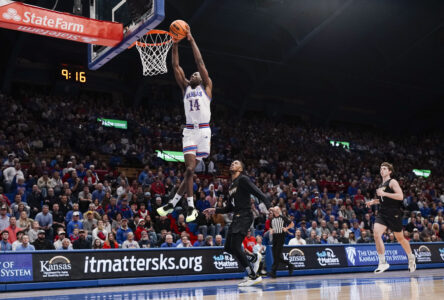
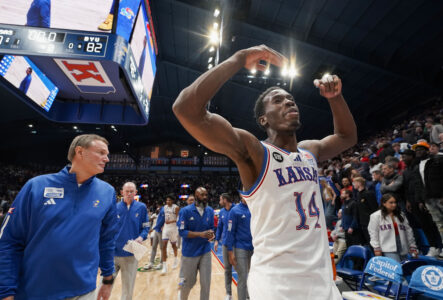
Kansas guard Melvin Council Jr. (14) gets in for a bucket on a breakaway dunk against Towson during the second half on Tuesday, Dec. 16, 2025 at Allen Fieldhouse. Photo by Nick Krug
The latest turn in the Melvin Council Jr. saga will give the recent Kansas guard an opportunity to potentially become eligible, but he hasn’t gotten there quite yet.
Judge Daniel J. Doyle of the Monroe County Supreme Court on Thursday signed an order to show cause, which will require the NCAA, on Sept. 23 at 2 p.m. Eastern time, to explain before his New York court why Council should not receive an injunction to become eligible.
But Doyle also crossed out the entire portion of the proposed order that would have made Council eligible “until such time as a final determination has been made on (his) application.” So he did not receive a temporary restraining order on Thursday.
Council is seeking to play a sixth overall season of college basketball based on the premise that his two years at a junior college should not count against his four years of NCAA eligibility.
Council, who dismissed his initial lawsuit against the NCAA in Douglas County on Aug. 28 and refiled on Tuesday in Monroe County, is represented in this matter by Trevor A. Prince Jr., among other lawyers from Archer & Greiner. The NCAA is represented by Duvol M. Thompson and Noah W.S. Parson from Holland & Knight, among others.
On Wednesday evening, Thompson had filed a memorandum of law in opposition to Council’s application for a temporary restraining order in which he argued that allowing the NCAA to make its case in an injunction hearing held on a prompt schedule would make more sense than immediately issuing a restraining order. Among other arguments, Thompson wrote that Council “manufactured his own purported emergency” by waiting several months after the denial of his NCAA waiver before filing suit in Douglas County, then voluntarily dismissing that action in favor of the Monroe County lawsuit.
With Doyle eschewing the temporary restraining order portion of the order to show cause, the NCAA appears to have gotten its way for the moment.
The question now becomes whether, given the delay until Sept. 23, Council will still potentially be able to play for the KU men’s basketball team if Doyle rules in his favor.
The KU academic calendar lists Sept. 21 as the final day to petition for late enrollment. However, it’s possible that Council, who played for the Jayhawks during the 2025-26 season after one year at Wagner and one at St. Bonaventure, may already be enrolled at the university even though he is not currently on the team. The Journal-World has learned that he is, as of Thursday, listed as a student in the KU student directory. The Journal-World has also inquired with KU asking for confirmation of his enrollment status.
All that said, Council’s filings in New York have cast some doubt on whether he actually intends to go to KU specifically, at least compared to what his lawyers were saying when he was suing in Douglas County. His complaint against the NCAA in Monroe County suggests that in the wake of the Big 12’s policy prohibiting former professional players from joining its roster, “it was unclear whether KU would continue to offer an NIL contract to Mr. Council for the 2026-2027 season,” and that Council has also heard from other schools who would be interested in signing him.
Whatever the case, the clock is ticking. KU men’s basketball’s annual conditioning boot camp is underway and Late Night in the Phog is on Oct. 16.
KU Men's Basketball
What’s it like welcoming back Council and White? Jayhawks explain
Evaluating Council’s return and its potential impact on the KU roster
Council rejoining Jayhawks for 2026-27 season
Self not keen on in-season international games
KU faces complex situation with final roster spot