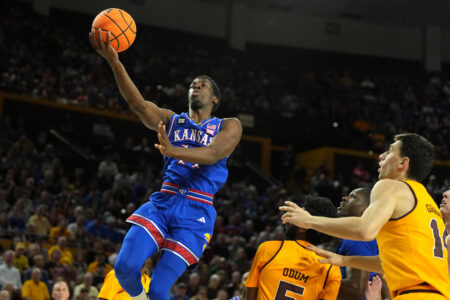
Council sues NCAA again, this time in New York; complaint reveals other teams besides KU have expressed interest
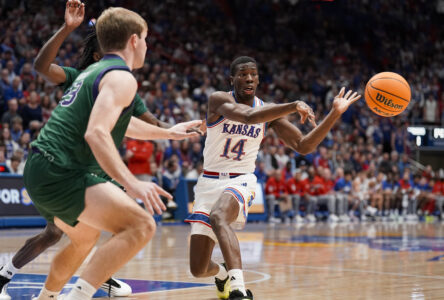
Kansas guard Melvin Council Jr. (14) throws a pass to the wing against Green Bay during the first half on Monday, Nov. 3, 2025 at Allen Fieldhouse. Photo by Nick Krug
Recent Kansas guard Melvin Council Jr. refiled his lawsuit against the NCAA in Monroe County, New York, court on Tuesday.
The new filing makes it clear that Council, who is seeking to play another year of college basketball, is at least entertaining options besides specifically returning to KU.
Council voluntarily dismissed his previous claim against the NCAA in Douglas County court on Aug. 28. Now, a footnote on the ninth page of his new complaint, filed by Trevor A. Prince Jr. of Council’s law firm Archer & Greiner, says that Council “previously commenced an action in the District Court of Douglas County, Kansas because he intended at that time to return to KU if the court affirmed his eligibility,” but ever since the Big 12 Conference adopted a new policy banning professional athletes from returning to college, “it was unclear whether KU would continue to offer an NIL contract to Mr. Council for the 2026-2027 season.”
Accordingly, the complaint reads, Council refiled in his home state of New York (he is from Rochester, located in Monroe County) “rather than confine his claims and his athletic opportunities solely to the Big 12 Conference and KU.” Elsewhere in the complaint, it also says that within the past week, other NCAA institutions have expressed interest in signing Council.
Council is seeking a temporary restraining order that would make him eligible for the upcoming season. According to an exhibit in the case, Prince will appear in court on Wednesday at noon Eastern time “seeking to enjoin (the NCAA) from enforcing its bylaws, denial directive, and the rule of restitution so as to bar Mr. Council from practicing with, being listed on the roster of, or competing for a NCAA member institution during the 2026-2027 basketball season.”
The complaint follows much the same script as his initial Kansas-based lawsuit. To review, Council is seeking another year based on the premise that his two seasons spent at the junior-college level should not count toward his overall NCAA eligibility. At the Division I level, he has played three years: one at Wagner, one at St. Bonaventure and most recently one at KU.
The year at KU was only possible in the first place because of the so-called Pavia waiver, which allowed all former JUCO athletes whose eligibility would otherwise have ended following the 2024-25 season to play another year. But that was limited to just one year, regardless of how much time they had spent in JUCO.
Council’s lawyers have contended that he had no choice but to attend junior college because he was facing rape and sexual abuse charges dating back to his time in high school, which were later dismissed. In the refiled lawsuit, his complaint includes more details of those circumstances.
According to the complaint, attorney Jon Getz of the Innocence Project took on Council’s case pro bono and moved “to vacate Mr. Council’s youthful offender adjudication and guilty plea entered on January 15, 2020. Through the efforts of Attorney Getz, the government eventually joined in the motion. On April 23, 2024, the court granted the motion vacating Mr. Council’s youthful offender adjudication and guilty plea and restored him to his pre-plea status.” It was at that point, according to the complaint, that NCAA teams became willing to include Council on their rosters.
Council’s lawsuit also includes some points contradicting various arguments the NCAA had made in Douglas County, including one in which the NCAA suggested that Council should be considered a professional athlete.
Council’s lawyers state that NCAA bylaws permit participation in the NBA Summer League (where he played for the New Orleans Pelicans) and that he “did not receive any money for his participation beyond permissible expenses.” The complaint denies that Council ever signed an Exhibit 10 contract, which multiple outlets reported over the summer. (The Journal-World, for its part, reported simply that Council “signed as a free agent” with the Pelicans based on social media posts from his agency Seros Partners that congratulated him on “officially signing” with the team.)
The two causes of action on which Council is suing the NCAA, and Charlie Baker in his capacity as president, are breach of the implied covenant of good faith and fair dealing and tortious interference with a business relationship.
KU Athletics had no comment. Archer & Greiner and the NCAA did not respond to requests for comment
This story has been updated to correct the date on which Council dismissed his initial lawsuit in Douglas County.
KU Men's Basketball
What’s it like welcoming back Council and White? Jayhawks explain
Evaluating Council’s return and its potential impact on the KU roster
Council rejoining Jayhawks for 2026-27 season
Self not keen on in-season international games
KU faces complex situation with final roster spot