Preview: KU will look to build on positives, mitigate negatives as it takes on WVU
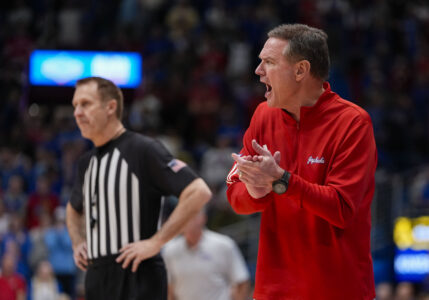
Kansas head coach Bill Self implores his players during the end of regulation on Tuesday, Jan. 6, 2026 at Allen Fieldhouse. The Jayhawked defeated the Horned Frogs, 104-100. Photo by Nick Krug
There were so many things not to like about how Kansas played on Tuesday night against TCU.
Head coach Bill Self can, and will, list them: The Jayhawks didn’t guard, didn’t rebound, didn’t maintain good body language, didn’t display consistent energy, didn’t create activity and so on.
But they did dispel all those numerous and variegated issues in the final few minutes to win 104-100 in overtime and complete one of the best comebacks in Self’s 23 years as head coach.
“Hopefully it is a game in which even though there was a lot of not-good that took place, the good that did should give us confidence moving forward that we can play at a pretty high level together,” Self said.
Now KU is looking to attain a vastly higher level of play, particularly on defense, than it put forth in those grim first 35 minutes against the Horned Frogs or in much of its earlier road loss against UCF.
“I’d say the difference is just energy and effort,” said guard Elmarko Jackson, who had five steals against TCU. “I feel like that’s just the main two things. I feel like that’s just a choice that you can make when you’re on the floor, is just playing with intensity and effort.”
The Jayhawks will have to bring those qualities forth in a place where their program has not historically had a lot of success: the newly renamed Hope Coliseum in Morgantown, West Virginia, home of the Mountaineers, where the Big 12 foes will face off at 11 a.m. Central Time on Saturday.
Jackson said success on the road, where KU is 1-2 this year (and 8-17 over the last two-plus seasons), depends on “being able to withstand powerful hits from the opponent.”
“We’re a team where teams circle us on their calendar, so they’re going to play their best,” he said. “So (it’s about) understanding the gravity that we have and just being the team that punches first, not waiting until the team deals their first three blows to really lock in, hunker down and really respect their game. Just, I’d say, utilizing the fear that we put into other teams … and using that as an offensive weapon.”
West Virginia is a perfect 10-0 at home this year and 0-5 everywhere else. The Mountaineers have for all intents and purposes their fourth head coach in four years in Ross Hodge, previously of North Texas, and have played what is according to KenPom the easiest schedule for a power-conference team. Their best wins to this point are a blowout over rival Pittsburgh on Nov. 13 and, more recently, their first league victory, 62-60 against Cincinnati on Tuesday night.
That game remained close throughout, and the Bearcats had a chance to take control after using an 11-0 run to go ahead by five with less than five minutes remaining. But they extended that lead no further, and WVU brought an end to a scoring drought of five minutes and 48 seconds with a 3-pointer by Honor Huff. Then Treysen Eaglestaff hit another to put them up a point with 1:12 to go. UC didn’t make another field goal until three seconds remained, and then almost won anyway because WVU threw away an inbounds pass in the final moments, but the Mountaineers escaped with the victory.
The 5-foot-10 guard Huff’s name is undoubtedly at the top of the scouting report, in large part because he shoots a ridiculous amount of 3-pointers. He makes four per game, which is second in the nation, and attempts 9.7, which is fifth. That’s good for 41.4% shooting and nearly all the shot attempts that account for his 17.1 points per game.
Joining him in the backcourt are Jasper Floyd, who came with Hodge from North Texas, and wing Treysen Eaglestaff, a North Dakota transfer who had 18.9 points per game for the Fighting Hawks last year, including 40- and 51-point showings, and garnered plenty of buzz in the portal but is scoring just 9.1 on 39.2% shooting for the Mountaineers. WVU’s second-leading scorer, Chance Moore, comes off the bench for 13.0 points per game, though he isn’t as much of a shooter.
“We’re excited to match up with their guys,” Jackson said, “They’ve got an elite shooter in Honor Huff and then Eaglestaff as well, so we’re going have to focus in, hone in on those two guys along with their supporting cast. We’re just going to focus on those guys, make sure we can limit their 3-point attempts.”
The frontcourt includes Brenen Lorient (10.1 points, 5.5 rebounds), also from North Texas and before that the Florida Atlantic team that reached the 2023 Final Four, as well as Harlan Obioha, a 7-foot Hoxie native whom KU saw last year when he was at UNCW.
WVU averages just 74.1 points per game on offense, but the Mountaineers hold opponents to 61.5 on defense, which ranks sixth in the country. Floyd is one of the league’s steal leaders with 2.1 per game, and Lorient averages 1.6 blocks.
“(They’re) really sound defensively,” Self said. “Can play fast but can also get deep into the shot clock on both ends. Very, very good defensively. And then they let their shooters shoot it, and they got three guys that can, but two of them really can and will shoot a lot of them.”
To limit those tendencies, KU will need to reclaim the form it displayed earlier in the season, not all that long ago, when it was defending the arc as well as anyone in the country.
WEST VIRGINIA MOUNTAINEERS (10-5, 1-1 BIG 12) VS. NO. 22 KANSAS JAYHAWKS (11-4, 1-1 BIG 12)
• Hope Coliseum, Morgantown, West Virginia, 11 a.m. Central time
• Broadcast: Fox
• Radio: Jayhawk Radio Network (in Lawrence, KLWN AM 1320 / K269GB FM 101.7 / KKSW FM 105.9 / KMXN FM 92.9)
KEEP AN EYE OUT
Switching gears: KU’s previously solid defense has been picked apart in each of the Jayhawks’ first two Big 12 games. The Jayhawks have been switching on every ball screen, which has occasionally exposed mismatches for opposing teams, especially when a guard draws someone like Bryson Tiller on the perimeter or a center achieves strong positioning in the post against someone like Melvin Council Jr. Self said KU could potentially choose to switch less, but that a lot of the issues of late stem from poor communication.
Batman and Robin: Council and Darryn Peterson spent much of the offseason looking forward to playing together in the backcourt, but of late they have been arguably better when playing separately. Of course, it’s all part of the process of reincorporating the increasingly healthy Peterson into the lineup, and of Peterson getting accustomed to his teammates. As Self put it, Council and Peterson won’t be like Devonte’ Graham and Frank Mason III in the backcourt, or Darius Garland and Donovan Mitchell on the Cleveland Cavaliers. Each of Council and Peterson will have to use his aggressiveness and the defenders he draws to help set up fellow Jayhawks — including his backcourt running mate — for opportunities on offense.
Bucking the trend: This has little to do with this year’s specific team, to be sure, especially with so few returning players on the roster from previous seasons. But WVU’s arena has generally been a brutal place for the Jayhawks to play, especially compared to other Big 12 venues. A victory there on Saturday would be just KU’s fifth in a dozen tries.
OFF-KILTER OBSERVATION
WVU’s Moore and KU’s Council were the top two scorers at St. Bonaventure last season.
KU Men's Basketball
Reeves ready to go after lengthy recovery from shoulder injury
‘The dog back in the house’: Council explains return to KU, goals for 2026-27 season
Stokes named Big 12’s top freshman; KU picked 3rd
KU to host Pitt State for exhibition in new version of Late Night
Dawes could help space KU’s frontcourt