NCAA files response to Council’s request for injunction
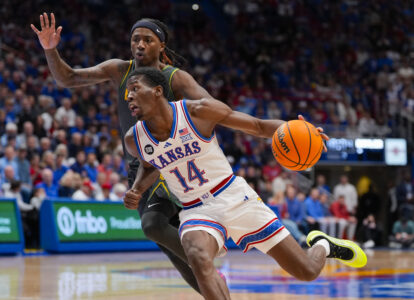
Kansas guard Melvin Council Jr. (14) drives past Baylor guard Obi Agbim (5) during the second half on Friday, Jan. 16, 2026 at Allen Fieldhouse. Photo by Nick Krug
The NCAA on Friday afternoon filed its official response to Melvin Council Jr.’s request for a temporary injunction in Douglas County court, arguing that Council should not receive the opportunity to play a sixth season of college basketball after having already benefited from two previous waivers.
The response — submitted by attorneys Lynn D. Preheim of Wichita’s Stinson LLP and Taylor J. Askew of Holland & Knight from Nashville, Tennessee, on behalf of the NCAA and its Division I Cabinet chairman Josh Whitman — requests a denial of Council’s motion and states that Council “petitions this Court for an additional opportunity to compete that is not warranted by law, the Manual, or common sense.”
The next move for the case has not yet appeared on the court docket, but Chief Judge Mark Simpson will ultimately have the opportunity to determine whether Council should receive a temporary injunction. The NCAA will then have to respond to Council’s formal petition within 30 days after Simpson rules on the injunction.
Council filed his lawsuit on July 23, arguing that his years spent at a junior college should not count toward his NCAA eligibility. He played two seasons at Monroe College, the JUCO in question, followed by three at various NCAA Division I schools, including most recently Kansas during the 2025-26 campaign. He was able to play his fifth in the first place due to a blanket waiver issued to former JUCO athletes.
The NCAA’s response asserts that Council, who graduated from high school in 2020, has made use of both his JUCO waiver and his COVID year and now “asks the Court to compel the NCAA to grant him a third waiver so he may participate in collegiate athletics for a total of seven years and six seasons. The request has no basis in law or the bylaws contained in the NCAA DI Manual.”
The NCAA contends that regardless of whether the court wants to count JUCO years, it should not render Council eligible because he has hired an agent, signed a contract with the New Orleans Pelicans (reportedly an Exhibit 10 deal) and played for them in the NBA Summer League: “Plaintiff has not challenged the legality of other rules that render him ineligible to return to collegiate competition,” the response reads.
Those central points, laid out in the introduction to the response, are supplemented by a number of other formal and jurisprudential objections to Council’s motion for an injunction, including but not limited to the following:
• The NCAA argues it simply cannot be sued under Kansas law and that it could only be sued alongside members of its association.
• One of Council’s claims is that the NCAA is committing breach of contract, based on his status as a third-party beneficiary of its contract with its member institutions. The NCAA states that student-athletes are not beneficiaries of its bylaws and “the omission of a role for students was a deliberate drafting decision that should not be undone.”
• The NCAA not only argues that its eligibility rules should be shielded from judicial review, but also attempts to preempt a potential claim under Indiana law (which apparently oversees Council’s contract claim) that the “abuse of … property rights” would allow a judge to get involved in Council’s situation, since he is an athlete who can get paid. The NCAA cites several rebuttals to this idea, including that courts have decided that “participation in intercollegiate athletics is a privilege, not a right.”
But if Council were to have a property interest, the NCAA’s lawyers write, then none of its eligibility rules would be enforceable.
“If those rules are subject to judicial review merely because they exclude a student from participation,” the document reads, “then the NCAA would never be able to self-govern because any judge anywhere in the country who disagrees with any rule would have the power to invalidate said rule by judicial fiat. That would turn Indiana law governing private associations on its head.”
The NCAA later characterizes Council’s argument as follows: “Plaintiff does not dispute that his competition at Monroe counts toward his four seasons of eligibility under the Bylaws contained in the Manual. Instead, he disputes whether they should count, which is a policy judgment the law leaves to voluntary associations–not the courts.”
• Council had a request for an NCAA waiver rejected in May. His initial filings were heavily critical of the waiver process and specifically of a so-called “denial directive” from a committee meeting that “recommended that staff deny cases requesting … additional seasons of competition.” The NCAA says that guidance was based on the fact that those cases should instead have gone to a different committee, and does not have to do with their merits.
• Besides breach of contract, Council also accuses the NCAA of tortious interference with a business relationship, in large part because he alleges it is preventing him from earning money as a KU athlete.
The NCAA responds by calling it “facially absurd insofar as, taken to its logical conclusion, the claim would not permit the NCAA to have any time-limits on eligibility.”
“Under Plaintiff’s theory, the NCAA cannot render him ineligible because Kansas may be willing to compensate him for the use of his NIL rights if he is eligible to compete in NCAA athletics,” the response reads. “So long as Plaintiff remains a skilled athlete, that will presumably always be the case–and his theory would require the NCAA permit him to compete in a seventh, eighth, ninth, or tenth season of competition.”
Those are some of the many arguments contained in the NCAA’s 20-page response. Preheim and Askew had no additional comment, and Council’s law firm Archer & Greiner provided its same statement from July in which it said Council’s petition speaks for itself. The Journal-World has also reached out to the NCAA for comment.
In the weeks since Council’s initial filing, the NCAA has been besieged by eligibility lawsuits, but those have been primarily on the five-year-eligibility front from members of the high school class of 2022 who are not included in the association’s new five-season policy. Council does not fall into that category, as someone who has entered college earlier and has already played more years of college basketball.
The result of these lawsuits has been to enact a flurry of late-summer transfers among college athletes at various levels. KU men’s basketball, for its part, did not necessarily plan on getting Council back, according to head coach Bill Self, who called the guard’s prospective return “a bonus, but it’s not something that anybody is expecting, nor has it been part of our plans whatsoever.”
The Jayhawks do have two roster spots open, and a potential way to fill one of them evaporated recently when class of 2027 wing Javon Bardwell announced he was in fact reclassifying but also decommitting from KU.
KU Men's Basketball
KU men’s basketball ranked No. 17 in AP preseason poll
KU men’s basketball adds former Purdue forward Kaufman-Renn for upcoming season
The KU freshmen who surrendered their jersey numbers to Council and White
Reeves makes early impression at Late Night
Photo Gallery: Kansas handles Pitt State with an 80-62 exhibition win