How much high school baseball is enough? Big schools say the season needs to be longer, but smaller schools not so sure
KSHSAA narrowly rejects plan to extend season by six games

Lawrence High junior Austin Crawford celebrates with his teammates after crossing home plate during a 7-5 win over Southern Boone on Thursday, April 27, 2023, at Hoglund Ballpark in Lawrence.
Without question, there was a lot of baseball in Lawrence last month.
More than 30 baseball teams – some coming from as far away as Arkansas City – were in town to compete in the River City Baseball Festival, a late season highlight for both Lawrence High and Free State’s teams.
But there is a question floating through Kansas high school baseball circles: How much baseball is enough baseball?
Some of the state’s largest high schools – like LHS or Free State – are arguing more baseball is not only better, but is necessary.
Getting everyone to agree to that, though, won’t be easy. The Kansas State High School Activities Association Board of Directors last week voted down a proposal to add six more games to the Kansas high school regular season.
The proposal failed by one vote – with 13 board members not voting at all. That may give the idea a chance in future years, and supporters believe a look across state lines might help persuade some about the need for a longer season. Currently allotted just 20 scheduled games, Kansas finds itself behind every state along its borders: Oklahoma (37 games), Missouri (36 games), Nebraska (24 games) and Colorado (23 games).
When the Free State baseball team met Platte County for the final day of a long baseball weekend, the visitors from Missouri entered the contest having already played 10 more games than the Firebirds.
Mike Hill has coached Free State baseball for 26 years, spending 10 of them as the school’s athletic director. Hill played the current regular season cap of 20 games at Lawrence High back in 1986.
“We’re not giving our kids the opportunities that other states get,” Hill said. “I think we’re demonstrating a lack of understanding for what our game is supposed to be like. At the big league level, they tell you you’re going to win 54, you’re going lose 54. It’s what you do with the other 54 that matters.”
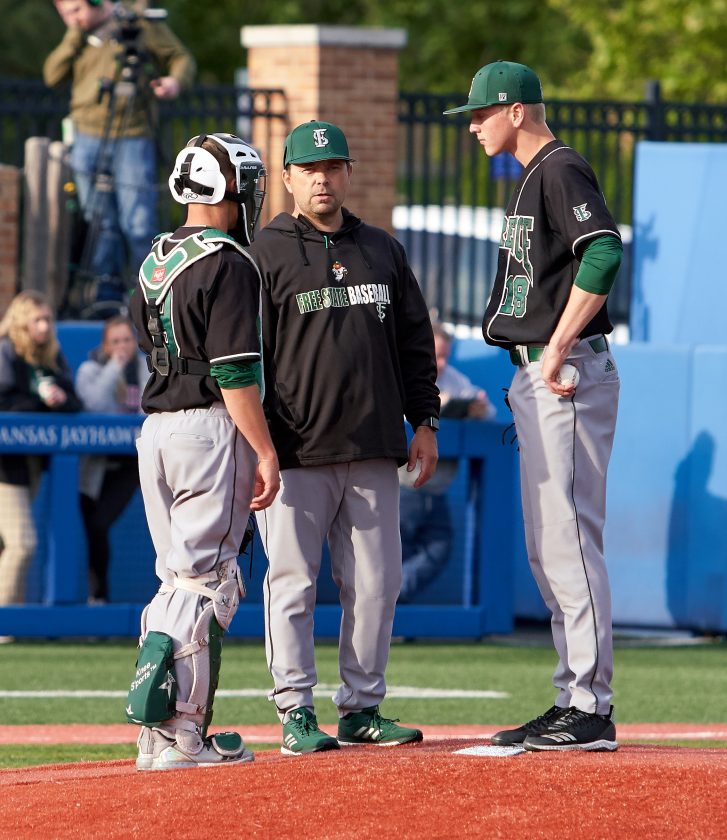
photo by: Carter Gaskins
Free State coach Mike Hill talks to Ethan Bradford and catcher Camden Karlin in this May 10, 2019 file photo
While the regular season schedule extension failed at last week’s board meeting, another measure passed. Pitchers, across all Class levels, are now allowed to report twice a week, four weeks before practices can begin during the final week of February by KSHSAA regulations.
Similar arm-care policies had already been passed by the board in 2017, limiting pitchers to just 12 innings pitched over 48 hours. Walking into last week’s meeting, coaches from the northeast were seeking a practical next step – extending the number of games a pitcher can develop.
“Do the math, it’s less than three weeks you have to play and all we’re asking for is an extension that places us at just a little over three games a week to get our season in,” Hill said. “And that’s nothing compared to what normal baseball is.”
Understanding the debate involves recognizing another spring sport – softball.
Jeremy Holaday, assistant executive director at KSHSAA, said the primary discussion among members was whether excluding softball from this particular six-game extension was a violation of Title IX, the federal civil rights law prohibiting discrimination based on sex in education programs and activities.
However, getting Kansas softball programs up to 26 total games might be easier said than done.
Organizing a special event similar to Lawrence’s annual festival becomes quite tricky, considering every state Kansas touches – Missouri, Nebraska, Oklahoma and Colorado – all play softball during the fall. Additionally, the declining number of available umpires and unpredictable spring weather makes the job even tougher.
“If you look at all the Olathe and Shawnee Mission, you can travel to the east and have the ability to play a bunch of schools,” Holaday said of baseball teams in the Kansas City area. “That’s something that just wouldn’t be able to take place when you’re talking about softball.”
Aside from softball, concerns stem from just how much time a student spends on a particular sport. Sport specialization, a growing trend of students immersing themselves in club and travel teams, becomes a problematic piece of the puzzle when applied at smaller levels of competition.
Currently, KSHSAA combats sport specialization by limiting coaches from working with players during the school year and outside the season of sport.
KSHSAA’s ultimate fear of sport specialization, as listed on its website, is “overly demanding or aggressive coaches could dominate student athletes’ time in the offseason and summer months by demanding they play on certain teams or by controlling who plays with whom on non-school rosters.”
Toby VanCleave, principal at Galena High School in southeast Kansas, wasn’t hearing that discussion during last week’s meeting and, ultimately, voted against the six-game extension for baseball in Kansas.
VanCleave, whose district competes at the Class 3A level, raised the argument that extending baseball or softball schedules to 26 games takes away from the opportunity for students to immerse themselves in the activities offered within each school district.
“We’ve found that, at least in our small school, colleges encourage kids in high school to have multiple sports,” VanCleave said. “They’re getting a more rounded athlete. That’s what we’re hearing from coaches that come to recruit our kids. And as an administrator, I advocate that as well.”
High school baseball in Kansas is currently allotted 8 and 1/2 weeks for its regular-season schedule – just 36% of a typical D-I college baseball schedule (56 games) – making enough time for two games each week.
Even if Kansas ballplayers were gifted plenty of time to play each sport they wished, not every school district can provide the same opportunities and resources. Lawrence High softball coach Mike Byrn, holding 17 years of coaching experience, feels the concerns limiting softball’s ability to fill out a 26-game schedule shouldn’t be the same variables holding baseball back.
“I think it’s crazy that these (administrators) still fight this,” Byrn said. “To me, it’s a no-brainer with the arm care and all the things going on. They’re not overusing these kids.”
Byrn hopes to one day see softball providing extra-game opportunities, such as the River City Baseball Festival, to fill a potential six-game extension for softball matching baseball’s wishes. In the meantime, Kansas coaches like Free State’s Hill and Lawrence High’s Brad Stoll will be waiting on KSHSAA to make the call.
“A lot of these rules are just archaic and they’re afraid to part with them,” Byrn said. “It’s a chance for us to be better. It’s going to start with communication. We’ve got to know when these things are going on, and can we attend? If it’s really about the kids. Let’s be like every other state.”
Free State
Preview: Free State football staying motivated ahead of City Showdown
Baldwin finishes as runner-up in 4A state golf tournament; other local teams compete in state golf
Local golfers competed in state golf tournaments on Monday and Tuesday, with Lawrence and Free State having golfers ...
Journal-World Athletes of the Week: Grayson Masterson and Eli Ward
Seasons came to an end this weekend while others got deeper in the postseason, and in both cases, local athletes ...
Free State’s Ward wins second 6A tennis singles title in as many years
Free State rushes for over 300 yards to snap losing streak, take down Shawnee Mission South on senior night
Free State football’s four-game losing streak came to a screeching halt on Friday, as the Firebirds rushed for ...