Opinion: The three projects everyone rooting for Jayhawk success should be watching

photo by: University of Kansas
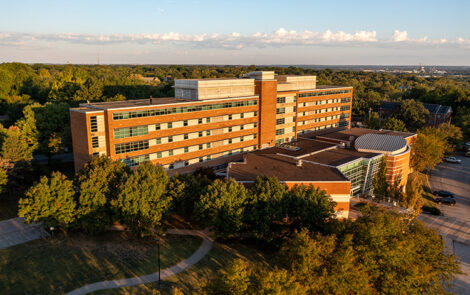
The skyline of the University of Kansas is pictured.
The migratory pattern of the Jayhawk has officially broadened. After last week’s sighting in London, I believe the species notes in a birdwatching field guide may read like this: Brilliant plumage, pronounced beak, tepid offense, special teams inconsistently special.
Yes, the actual football game in Wembley Stadium left something to be desired for KU fans. I’ll still argue that it was a good sight nonetheless. While the score was wrong, I think the symbolism was right.
First, I think the timing was right for the University of Kansas to play its first real athletic contest overseas. While KU basketball has played several overseas exhibition games, Saturday’s football game was the first time a Jayhawk team ever competed on foreign soil in a game that counts. Higher education, and KU, need to broaden their horizons. In one sense, they did so last week.
Opinion
Chad Lawhorn
Editor & Publisher
Have your own take? Send 250 words or less to letters@ljworld.com.
Have a column idea or a tip for Chad to investigate?
Send a message to clawhorn@ljworld.com.
Second, I think the game featured the right teams. Arizona State, with its pioneering ways in online learning, is widely regarded as the most innovative university in higher education. US News & World Report routinely gives that award to the university, and the school has an eye-popping statistic to share with doubters. In the last 20 years — during a time period where the public has really begun to question the value of a college education — Arizona State’s enrollment has grown from about 63,000 students to more than 200,000 students.
But why was KU right for the game? Because it’s on the chase. In fairness, there are a handful of universities trying to catch and surpass Arizona State in the realm of innovation. I think KU is now one of them. I’m not sure many would have said that a decade ago. Some, especially locally, may not say it today. As the behemoth in Lawrence, KU is an easy target to strike when it missteps. I suspect it will take a couple of blows in future columns here. But, KU has been on a pretty good run recently. Enrollment levels have set new records, its finances have improved, and its chancellor is a national leader in the industry.
Of course, how successful KU becomes is yet to be determined. I think there are three KU projects currently underway that are worth watching for anyone who cares about the outcome. Here’s my running scorecard on them.
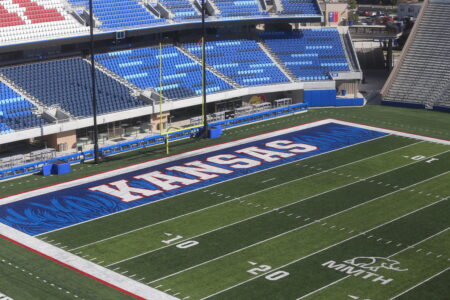
• Most innovative: The Gateway District at KU’s football stadium. College football stadiums have existed for a long time in America. Most of them have been highly inefficient. They sit empty most days of the year. I’ve heard KU Chancellor Doug Girod mention that many times. KU is trying to change that equation by placing a conference/convention center in the north end of the stadium.
There are some innovative synergies with that project. For instance, a stadium needs kitchens to fuel its concession stands. Now, they can also fuel the food service needs of a year-round convention center. Convention centers need plenty of places for mingling with an intoxicating beverage in hand (agenda item No. 1 on any good convention). If you build those mingling areas with a view of the field, they can now also serve as premium viewing areas for athletic contests.
But the innovation Lawrence residents should most appreciate is the check that Girod and his team wrangled from the state of Kansas for the project. Between a special state economic development grant and STAR bond financing, Lawrence is essentially getting a convention center paid for by state funds. That’s not usually the way it works. Often, it is city or county governments that are on the hook for that large upfront expense.
There’s still much to be determined about the impact the overall Gateway District will have on KU. Donors and debt — both from KU’s athletic department — are pumping large sums of money into the other aspects of the stadium renovation and its surroundings. The stakes are high and evolving for KU. For Lawrence itself, though, the risks are much lower but the opportunities are still significant. A bit of innovative thinking has put Lawrence in that enviable position.
• Most interesting: The Crossing. That’s the development on KU’s West Campus property that includes a new Dillons grocery store, a new Olive Garden restaurant, and soon will include new high-end apartments.
More importantly, it also is home to KU Innovation Park, which houses everything from tech startups to well-established companies that simply want to be close to KU researchers and talent. Given that “innovation” is in its name, you might think I would rank this project as the most innovative. However, I think honest observers would concede that KU is playing some catch-up in this arena. Universities across the country have embraced the idea of having high-tech business parks on their campuses. KU, arguably, is behind a fellow Kansas university in this regard. What Wichita State is doing with its on-campus business activities is pretty phenomenal.
KU, more than some others, may be leaning into the live, work, play concept of creating a complete development. That’s one aspect that makes the development interesting. But the No. 1 reason I rank it as most interesting is because of the potential impact on the Lawrence economy. If Lawrence is to ever land a new business that employs 500-plus people at wages well above average, I think odds are good that KU Innovation Park will have helped grow the business or attract it.
It will take more than a nice Dillons and all-you-can-eat breadsticks to accomplish it. Creating an environment where start-ups that begin on the KU campus want to stay in Lawrence will take a strong partnership between KU, the business community and local governments. In recent years, there has been sign of strain in that partnership, particularly with some of the comments coming out of Douglas County government, and even some comments from local developers who don’t like the competition. That partnership adds another layer of interest.
• Most important: Jayhawk Global. This is KU’s most direct effort to emulate and exceed Arizona State. KU has increased its focus on offering multiple degrees that can be obtained fully online. That is a model that ASU has used to add more than 100,000 students to its ranks.
KU, however, is not simply copying ASU’s playbook. Instead, KU seems to be a leader in writing a new one. KU is leaning heavily into a concept known as “competency-based education.” It is a system that dramatically changes the structure of education. Traditional classes last a certain number of weeks, with each week bringing a new lesson, which leads to a definite end date where a student is judged to have passed or failed. Competency-based education takes a different approach. It says: Here are the topics you are going to learn in this class. The class will be over when you learn all of them.
For someone who has been a bookkeeper for their entire career and now wants an accounting degree, the system may be great. The bookkeeper likely knows a lot of the material and can take a test to prove it on day one, rather than spending an entire semester proving it week by week. The system promotes different pricing plans too. Instead of charging by the credit hour, KU can charge a flat rate for a semester, for instance, and the student can pass as many classes as possible, since the online classes are continuously starting and ending throughout the term.
Non-traditional universities like Southern New Hampshire — which you likely see frequently advertising on television — have been the leaders thus far in competency-based education. KU, however, arguably is the pioneer among major research universities trying the idea. An article in the Chronicle of Higher Education earlier this month reported how many in the higher education industry are closely watching KU’s efforts.
It is easy to see how the concept could be a game-changer for higher education. Go back to the bookkeeper example: If people who have had careers can somehow quickly get credit for what they already know, they may become much more interested in getting a degree to advance their careers. Such nontraditional students will become more important to a university’s health as high school graduating classes become smaller due to years of lower birth rates in the U.S.
It also should be easy to see how this new type of system could be a major boon for KU and the Lawrence economy. True, these students wouldn’t necessarily be spending time in Lawrence patronizing bars and restaurants and renting apartments. But they would be sending thousands of dollars to Lawrence in tuition payments that largely would stay in the Lawrence community to pay faculty and staff who would run the programs. More dollars coming in, but fewer services required from the local community. That potentially could be a very positive economic development arrangement.
Dare to imagine for a moment: What if KU saw the same type of enrollment growth as ASU? What if KU went from 30,000 students to 130,000 students? Say at $5,000 per semester. Let me do the math: 100,000 students at $5,000 each is $500 million per semester.
It is a tall number that I argue should produce a short response: Game on.
KU
Hilltop childcare center has been losing money for at least two years, records show

Turnstile rocks KU campus as Day on the Hill returns after two-decade absence
UPDATE: Closure of Hilltop childcare center is final, but the building seems likely to stay
KU to lead national effort to address special education needs and tackle industry’s pressing concerns
Opinion: KU faculty, staff should be nervous about the new spending rules proposed for college athletics