
Lawrence sales tax collections grew by 8% in 2022, nearly setting a record; City Hall collects about $6M more than budgeted
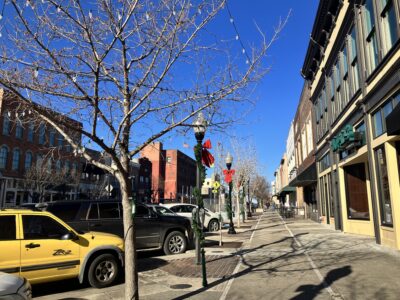
photo by: Kim Callahan/Journal-World
Downtown Lawrence is pictured Thursday, Jan. 5, 2023.
You can’t quite call it a record-breaking year, but you can certainly say that Lawrence shoppers broke out their wallets in a big way in 2022.
Now, the question is whether those shoppers are just plain broke heading into 2023.
The city’s retail sales tax collections in 2022 were up 8% compared with a year ago, which is the second-best growth rate in recent memory. It trailed only 2021, when the city posted a 9.1% increase.
For a good part of the year, it looked like Lawrence was going to best its 2021 record, but then the city’s 12th and final sales tax check of the year came with a surprise: The citywide sales tax collections for that month were down about 13% from a year ago.
It is always dangerous to read too much into one month’s worth of sales tax collections, but the end-of-year downturn — which occurred in cities across the state — will raise some questions about whether shoppers have started to slow down their spending in the face of high inflation. While this latest check came in December, due to normal lag times in the state’s process, the numbers largely reflect sales made in October. So, think back to October to gauge your mood. (Mine was angry, largely because I got no trick-or-treat candy despite multiple people confusing my face for a Halloween mask.)
Reports for the next few months will provide us more information on whether shoppers indeed slowed down or whether this was just a one-month blip. But that is a worry for another day. The City of Lawrence has about 6 million reasons to not worry too much right now.
When you add up all the various sales taxes the city collects — a citywide sales tax, its share of the countywide sales tax, the citywide use tax on internet purchases and the city’s share of countywide use tax — Lawrence coffers were filled with nearly $50 million in sales tax collections. That is about $6 million more than what the city budgeted to collect in 2022.
That should help ease the sting of inflation a bit at Lawrence City Hall, although I haven’t yet seen an accounting of whether the city’s expenses also came in quite a bit higher than budgeted.
Douglas County, which relies less on sales tax collections than the city, also received more sales tax money than it budgeted to collect, but I haven’t yet done the math on how much.
All of those numbers should spark a couple of thoughts. One is how much Lawrence government relies on the retail industry. The nearly $50 million collected in sales taxes pays a lot of bills at Lawrence City Hall. For some perspective, the city was budgeted to collect about $38 million in property taxes in 2022. The Lawrence community historically struggles with how much new retail development it should allow. As it struggles with that question, it probably would be wise to remember how important retail sales are to Lawrence’s government. If we mess the local retail industry up, we likely all will feel the consequences either through higher property taxes, reduced services or a combination thereof.
The second thought that comes to mind: My, how far we have come. Remember when the pandemic began? (It was that period when you were twice as happy to see me because half my face was covered.) The Lawrence economy took a big hit, as students never returned from spring break. Sales tax collections in 2020 showed the results. They were down nearly 4% from 2019 totals. There were legitimate questions about how long it would take to rebound from those losses. The answer ended up being not very long.
Lawrence indeed has more retail sales happening now than it did in 2019, the year before the pandemic began. Citywide sales tax collections are up 13% from 2019 totals.
The bounce-back is not unique to Lawrence. In fact, if anything, Lawrence has bounced back a little less vigorously than several other communities. Statewide, local sales tax collections were up 9.1% compared with Lawrence’s 8% growth rate.
When compared with the other major retail markets in the state, Lawrence performed a little better. Its growth rate was in the top half of the 10 markets I track. Here’s a look at 2022 growth rates for those markets:
• Lenexa: up 14.5%
• Overland Park: up 10.8%
• Olathe: up 9.3%
• Sedgwick County: up 9.0%
• Lawrence: up 8.0%
• Kansas City: up 7.8%
• Shawnee: up 7.8%
• Manhattan: up 7.2%
• Salina: up 7.1%
• Topeka: up 6.4%
Lawrence also continued to see strong increases in the amount of use taxes it collects on internet purchases. A use tax basically is the sales tax Lawrence consumers pay when they buy something online from a retailer that isn’t located in Lawrence. Those tax collections grew by 25%, which was the third highest increase among the 10 big retail markets. Olathe was tops with a 35% growth rate, while Salina was next at 26%. While use tax collections are growing, the city still receives far more revenue from its local sales tax. The citywide use tax generated about $5.8 million compared with the more than $29 million generated by local retailers through the citywide sales tax. The gap, though, is narrowing each year, and that will have big consequences at some point, as the online shopping dollars don’t do as much to support local jobs.
Finally, I couldn’t write an article about 2022 sales taxes without acknowledging that not all of the increases posted in the year have been healthy. Part of the increase comes simply from inflation. Lawrence shoppers did not buy 8% more goods in 2022. They simply paid 8% more for the goods they got. How much of the increase was due to inflation? I’m not sure, but I’m confident some of that 8% increase does represent an actual increase in demand. More important, though, is whether increasing demand will continue or wane. As I mentioned at the top of the article, Lawrence’s December collections were down 13% from a year ago. Communities across the state didn’t fare much better. Local collections statewide were down 8.5%.
Since this is the end of the year, some of you may be interested in how some of the smaller communities in our area fared in 2022. Here’s a look at their sales tax collections for the year:
• Tonganoxie: up 13.9%
• Overbrook: up 11.6%
• Ottawa: up 8.2%
• Lecompton: up 8.2%
• Oskaloosa: up 4.6%
• Eudora: up 6.3%
• Basehor: up 4.3%
• Leavenworth: up 3.8%
• Baldwin City: up 2.5%
A couple of local cities, including De Soto and Perry, had changes in their tax rates that didn’t allow for year-over-year comparisons.
Town Talk column
Lawrence City Commission to weigh whether Costco should be included in STAR bond district

Thanks to a nonprofit that pairs artists and landlords, the Lawrence Potters’ Guild gets a temporary space of its own

After a brief bump during the World Cup, Lawrence is back to collecting less in sales taxes than it did a year ago

To make home construction easier and faster, Lawrence plans to experiment with a menu of pre-approved designs
Affordable apartment project in East Lawrence that escaped funding clawback shows new sign of progress