

Panasonic officially opens De Soto battery plant; leader says facility still on track to employ 4,000 people
Plant currently employing 1,100 as first of 8 production lines open

photo by: Mike Yoder
Participating in a traditional Japanese ceremony — Kagami Biraki, or a sake barrel opening — dignitaries and representatives of Panasonic and Kansas conclude grand opening celebrations for Panasonic’s electric vehicle battery plant in De Soto, Monday, July 14, 2025. In the group at left, from left, are Yuki Kusumi, representative director, president and group CEO of Panasonic Holdings Corp.; Kansas U.S. Rep. Sharice Davids; Allan Swan, president & chief operating officer, Panasonic Energy North America; Kansas Lt. Gov. David Toland; and U.S. Sen Jerry Moran.
UPDATE 4:15 P.M. JULY 14
The first phase of Panasonic Energy’s nearly 5-million-square-foot electric vehicle battery factory is officially open in De Soto and marching toward an impressive production goal: Churning out 70 batteries per second.
But as dignitaries from both Japan and Congress gathered Monday morning for a grand opening celebration, there was a different type of production question that hung over the event: Will the Panasonic plant end up producing the 4,000 jobs it promised when receiving financial incentives from the state?
Yes, a top Panasonic official said. And he thinks it still will happen in about 18 months, despite some U.S. political headwinds for electric vehicles and a downturn in sales for its key customer, Tesla.
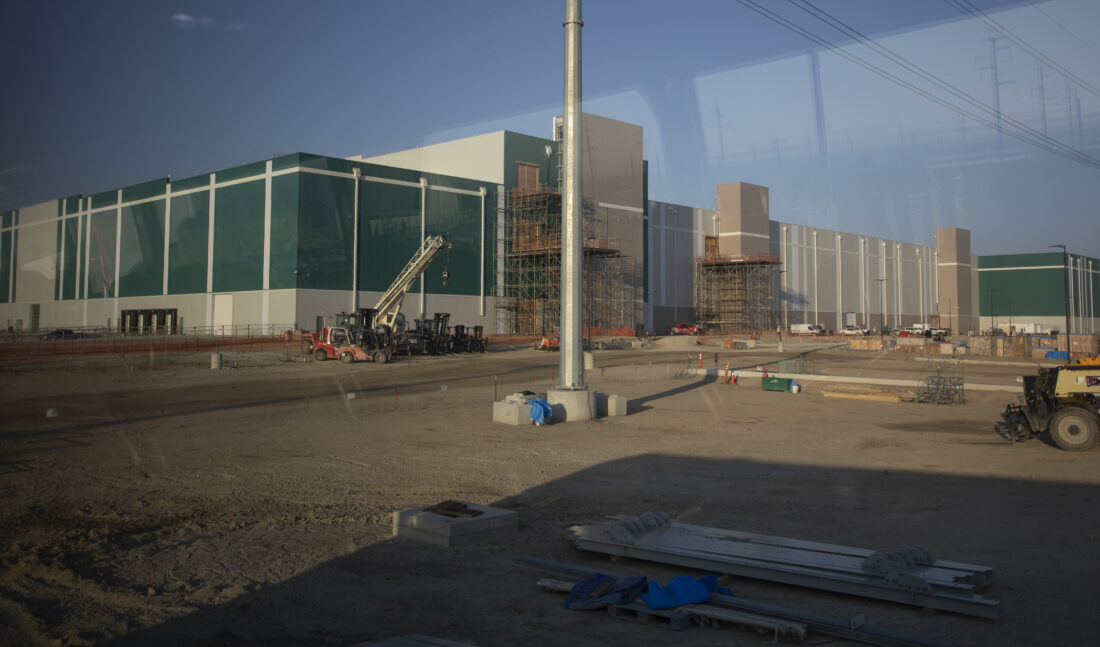
photo by: Mike Yoder
Panasonic’s electric vehicle battery manufacturing plant in De Soto, is a 4.7-million-square-foot plant, roughly the size of 225 football fields and marks a major expansion of Panasonic’s U.S. manufacturing footprint.
The plant, about 20 minutes east of Lawrence on Kansas Highway 10, has about 1,100 employees currently, and that is with only one of its eight production lines in operation, Allan Swan, president and chief operating officer for Panasonic’s North American battery company said.
“Line one is open, and we will open the next three lines to have four lines in wing one,” Swan said of the building that is being constructed in two wings. “That should be through the end of this year, into early next year. Then the next four lines will be in wing two, which is still under construction. They start in 2026 and should be finished by the end of 2026.
“So, basically, from now to 18 months will get us up to 4,000.”
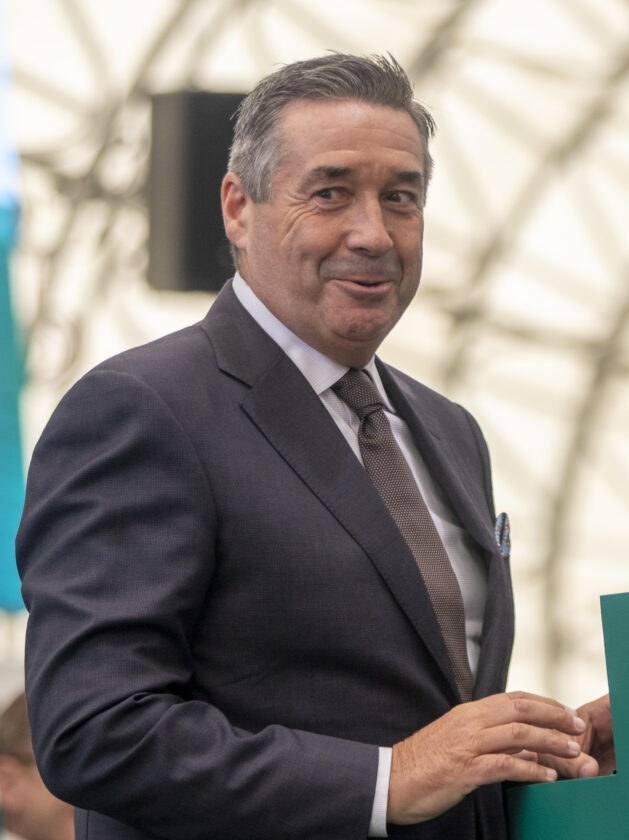
photo by: Mike Yoder
Allan Swan president and chief operating officer of Panasonic Energy North America, speaks during ceremonies for the grand opening of Panasonic’s electric vehicle battery manufacturing plant in De Soto, Monday, July 14, 2025.
A recent report from a Japanese media company that closely covers Panasonic in its home country has created questions about when the company would be running at full capacity in De Soto. The publication Nikkei Asia last week reported that Panasonic had originally planned to have the De Soto plant operating at full capacity by March 2027, but now had pushed that date back by an indefinite time period due to weakness in the electric vehicle market.
When asked directly about that report, Swan did not back away from his 18-month estimate for when the De Soto plant would reach its 4,000-employee mark. Rather, he said Panasonic still believes the electric vehicle market will have strong growth, but acknowledged it may be uneven for a time period.
“We’re in a brand new industry,” Swan said. “That industry will ebb and flow a little bit as she grows, and she will grow. We’re clearly going in one direction. It’s not going to change. So we will ebb and flow a little bit. But the beauty of Kansas is we can build those lines out. We have customers who want them, so we should be in a good place.”
The plant — dubbed as the largest, private economic development project in Kansas’ history — received millions in financial incentives from the State of Kansas to entice the project to De Soto rather any number of other states that sought the facility. A bipartisan coalition of state legislators and Gov. Laura Kelly were supportive of the incentives in large part because Panasonic promised $4 billion in private investment and 4,000 jobs at the De Soto plant.
On Monday, Kansas and De Soto leaders said what Panasonic has accomplished thus far is a strong indicator that Panasonic will deliver on those promises. The plant went from an announcement to production in a little more than two years. Top Kansas officials said the payoffs from the plant will be evident for decades to come.
“We are grateful and we are honored by the trust you have placed in us,” Lt. Gov. David Toland, the state’s chief negotiator on the deal said to the numerous Panasonic leaders who travelled from Japan. “We will always work to be worthy of that trust because we recognize this is an investment in the Kansans of today and in the Kansans of tomorrow.”
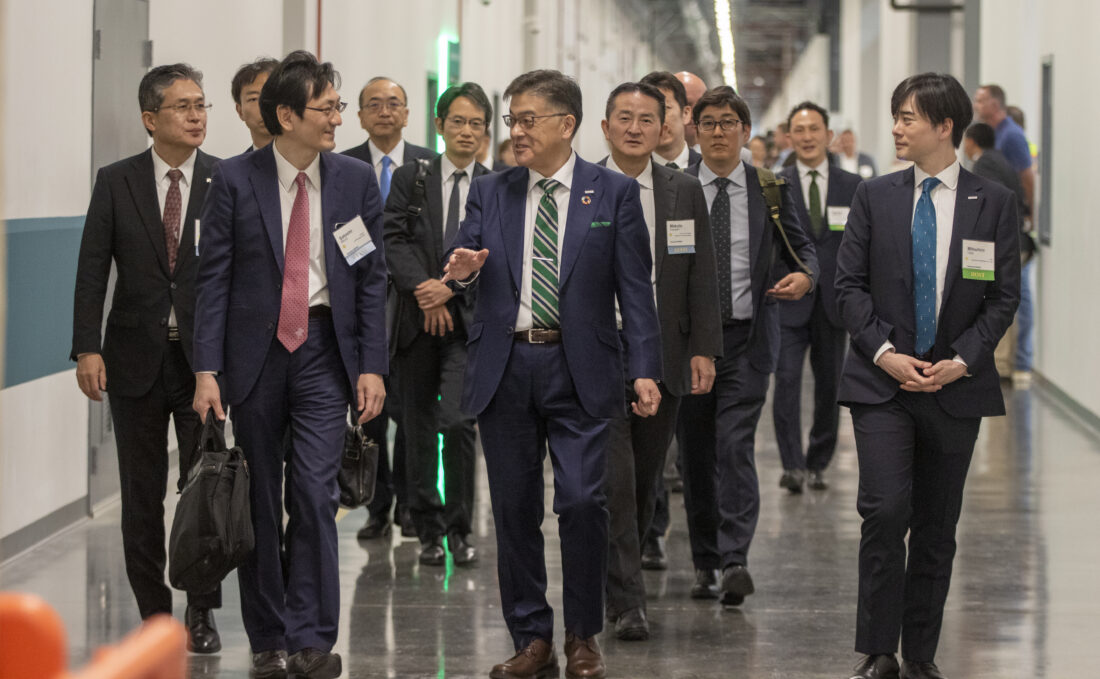
photo by: Mike Yoder
Yuki Kusumi, president and group CEO of Panasonic Holdings Corp., center, and other dignitaries tour Panasonic’s electric vehicle battery manufacturing plant in De Soto on Monday, July 14, 2025, during its grand opening.
In addition to Panasonic Holdings President and CEO Yuki Kusumi, the event was attended by Shigeo Yamada, the Japanese ambassador to the U.S., and was covered in person by several dozen members of the Japanese media.
The Monday morning ceremony — which also included U.S. Sen. Jerry Moran, U.S. Rep Sharice Davids and a video tribute from the Kansas Statehouse that included a musical performance about Kansas values — marked the official opening of the facility.
Production at the facility, however, actually began on a small scale last week, Swan said. About 50,000 batteries per day were produced last week, which is a fraction of what the plant will produce in the future. Swan said the plant is going through about a six week ramp-up stage where batteries are being produced in small quantities and tested.
Eventually, the plant will produce billions upon billions of the small batteries that are similar in size to traditional AA batteries, but will be bundled together to create the power source for electric vehicles. The De Soto facility is Panasonic’s second electric vehicle battery plant in the U.S. Its first facility is near Reno, Nev. and has produced about 11 billion batteries since its opening in 2017. That plant is co-located with a Telsa automotive production facility.
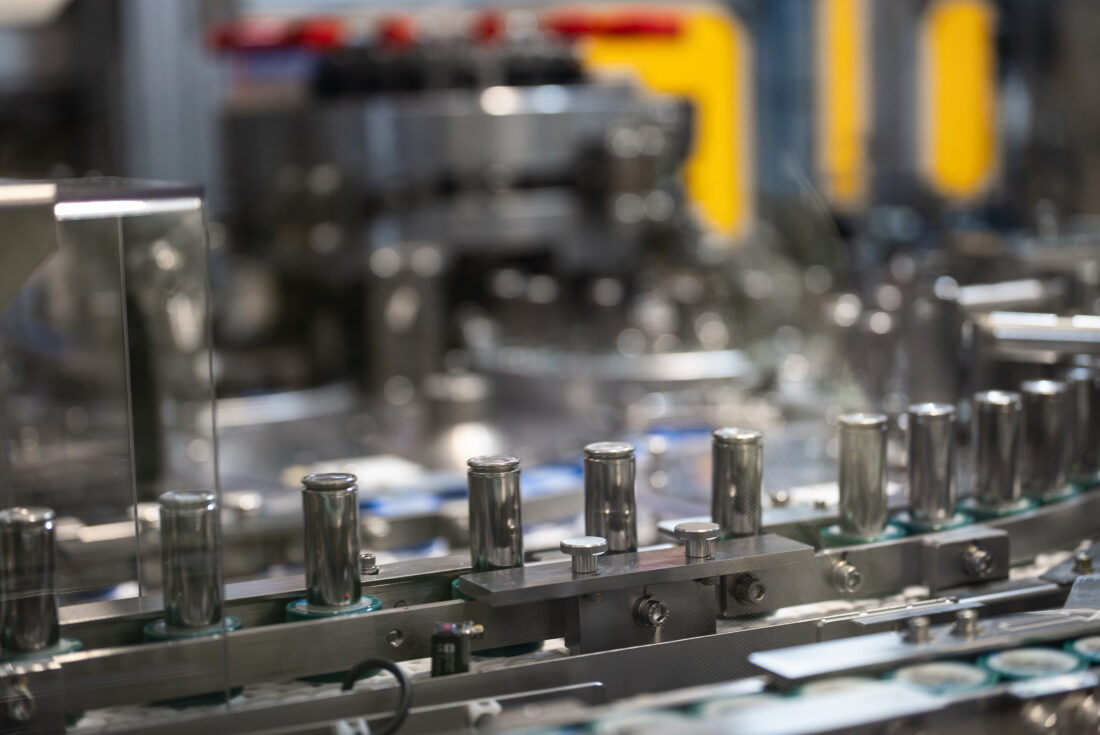
photo by: Panasonic
A portion of the production line at Panasonic’s De Soto electric vehicle battery plant is shown.
There have been no plans announced for Tesla or any other auto company to locate a production facility next to the De Soto facility. However, the De Soto plant sits on the former site of the Sunflower Army Ammunition Plant, which was one of the largest industrial sites in the region during World War II. Today, there are 6,000 additional acres of cleaned land that is available for development, state and local officials said.
Swan said Panasonic is in discussion with suppliers and customers about locating facilities near the De Soto plant.
“We would like our suppliers to be as close as possible, obviously,” Swan said. “We’ve already got three suppliers located in this plant. They are actually here making product in this plant. We would like to do more for sure.”
De Soto Mayor Rick Walker said he can envision other Panasonic suppliers wanting to locate in the new industrial park. But he also expects non-related ventures to target De Soto for future facilities. The Panasonic project has created a large amount of infrastructure — everything from a new fire station to massive amounts of electrical power lines — that can serve the entire industrial park. Walker said De Soto and state officials are interested in other advanced manufacturing facilities, and he said a data center also could be a possibility for the park.
The options for future industrial development are numerous, he said, but many have a common theme: They are big in size.
“We are at the front of the conversation for anybody that needs big acreage in an area that has a good workforce,” Walker said.
Walker said De Soto already has seen some of the benefits that big projects can bring. About 3,800 construction workers have been at the De Soto site during the last two years. The city’s sales tax revenues grew by nearly 50%, or about $700,000 last year. At the same time, the city council approved the largest property tax rate decrease in the city’s history. The property tax rate dropped by about 30%, producing an estimated $200 per year property tax savings for the average homeowner in the Johnson County community of about 6,500 residents.
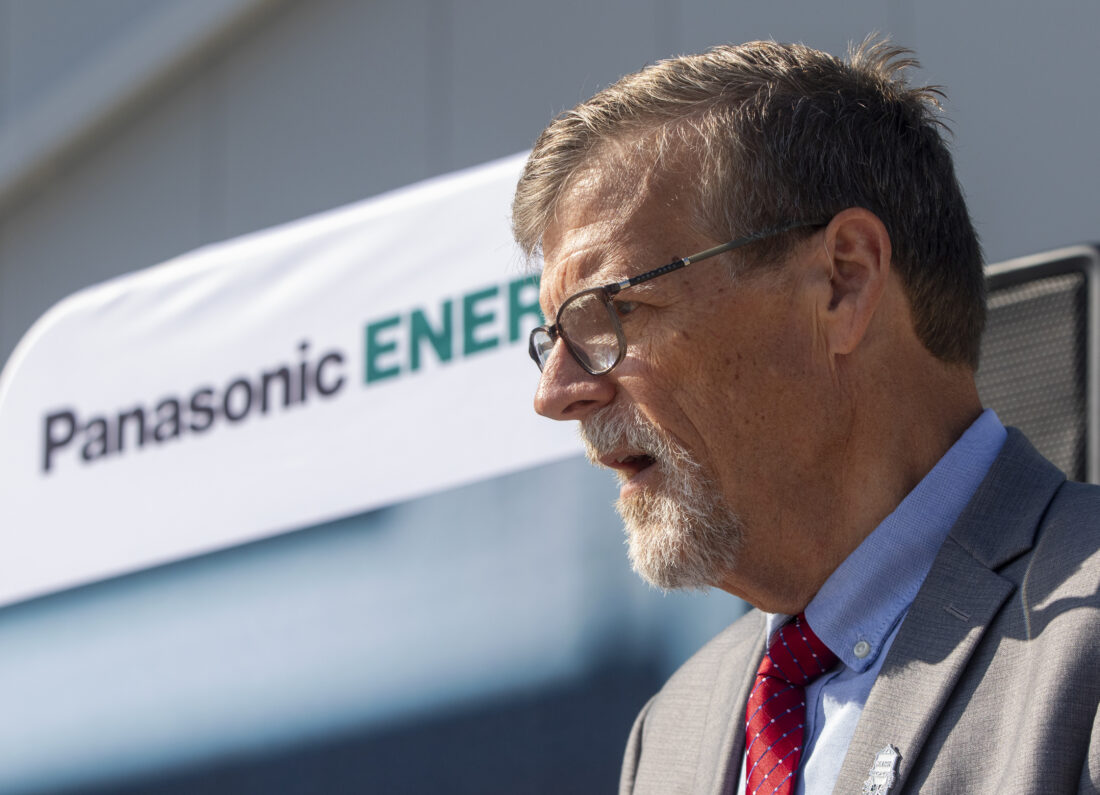
photo by: Mike Yoder
De Soto Mayor Rick Walker speaks at the grand opening for Panasonic’s new De Soto battery plant on July 14, 2025.
Numerous construction projects also are underway in the community, ranging from new places to eat to more places to live. Walker said about 380 apartment units are under construction, about 50 townhomes, and excavation work has started on a new residential neighborhood right across the street from the Panasonic plant. Walker said that project hasn’t yet received its final approvals, but developers likely will seek approval for about 300 new single family and townhomes to be built over several years.
“I think we’ll continue to see growth at a faster pace than we saw over the last 10 years, but I don’t think it’s going to be astronomical growth,” Walker said. “I think we’ll just continue a steady growth over the next 10 years to a size that probably puts us about twice as big as we are now.”
One element that is not popping up around De Soto, though, is a wall that keeps out all the national talk about whether the electric vehicle battery revolution will die off before it even gets started. The recently-approved Trump administration budget bill ends the $7,500 electric vehicle tax credit in September.
Tesla — who had executives on hand in De Soto on Monday — is the largest customer for Panasonic’s battery operations, but the world’s largest EV maker is in a real slump. Sales in the most recent quarter were down 13% from a year ago, with even sharper declines in several key European markets after founder Elon Musk has become a lighting rod on both the political right and left.
Then there is the mood from the White House. President Trump — whose name did not come up once during the official remarks — has at times been critical of the EV industry and skeptical of the hold it will take on the U.S..
Panasonic officials are clearly betting otherwise. When officials were asked on Monday, their answers often centered on how the worldwide auto industry already has built so many of its plans around an EV future. While they could see a slowdown of implementation during the Trump administration, they didn’t see an abandonment of the strategy.
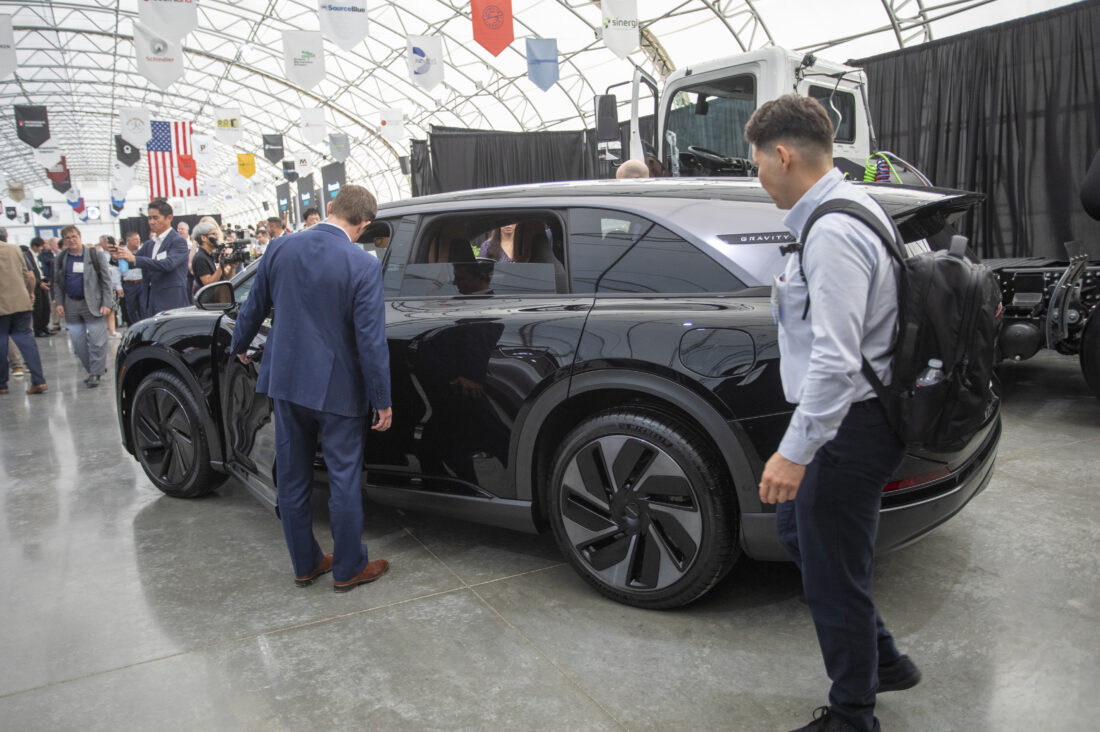
photo by: Mike Yoder
Lucid Motors Gravity SUV was displayed during grand opening celebrations for Panasonic’s electric vehicle battery plant in De Soto, Monday, July 14, 2025. The vehicle will be powered by Panasonic Energy’s next-generation lithium-ion battery cells.
For his part, Walker, the De Soto mayor, said he had a similar message for constitiuents who had the same worries.
“This is a 50 year investment,” Walker said. “We can’t get focused on a two or three year cycle when you are talking about a longterm investment.”
But beyond that, he tells residents that his Midwestern, value-conscious upbringing leads him to believe that electric vehicles are still a major growth industry. He knows it recently grew in his garage. He bought an electric vehicle — a Chevy, not a Tesla — for about the same amount he would have bought a traditional vehicle, and has seen his monthly fuel bill drop from about $250 for gasoline to about $30 for electricity.
“I just think if we can get the political discussion out of what kind of fuel your car uses and just focus on what makes sense for you, what saves you money, what can get you back and forth to work the cheapest, I think the answer is becoming pretty clear,” he said.
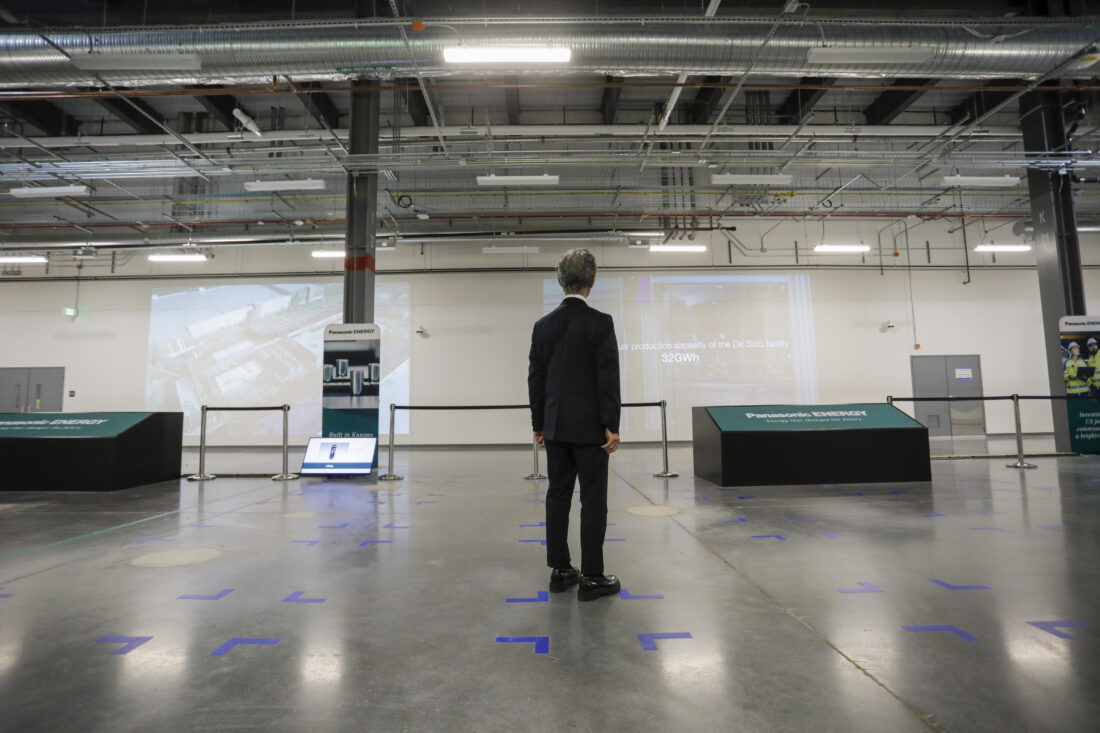
photo by: Mike Yoder
An attendee at the grand opening celebrations for Panasonic in De Soto, Monday, July 14, 2025, views video displays as he tours the plant.
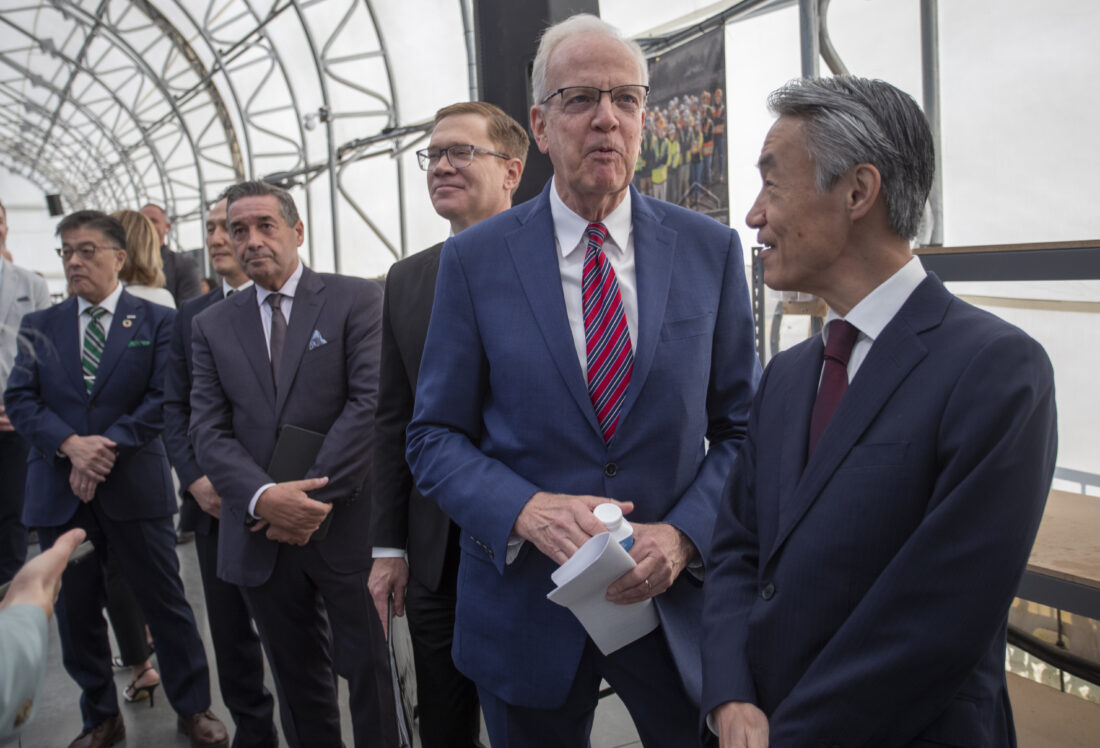
photo by: Mike Yoder
U.S. Sen Jerry Moran, second from right, visits with Shigeo Yamada, ambassador of Japan to the United States, right, during grand opening ceremonies for Panasonic’s electric vehicle battery plant in De Soto, Monday, July 14, 2025. Lt. Gov. David Toland is at center next to Moran.
State Government
GOP’s highest profile figures are on rescue mission in once-reliable Kansas

In debate, Marshall says the Ukraine war, not the Iran war, has caused high diesel prices
Candidates lean on their prominent supporters in District 2 race
TOPEKA — Democrat Don Coover and Republican Derek Schmidt stood with partisan allies as their congressional race ...
Funding for new Chiefs stadium moves forward, setting sales tax revenue district
TOPEKA — State officials answered a key question this week underpinning the complex financing of the Kansas City ...
Voters Guide: A look at the candidates seeking to become Kansas Insurance Commissioner
The Kansas Department of Insurance regulates insurance companies that sell policies in Kansas. Voters will decide ...
Voters Guide: A look at the candidates seeking the job of Kansas State Treasurer
In the Nov. 3 election, Republican Kansas Treasurer Steven Johnson faces two challengers for his job as the chief ...