

Kansas Supreme Court agrees to hear Holland’s arguments that he’s being gerrymandered out of state Senate seat

photo by: AP File Photo
Kansas state Sen. Tom Holland, D-Baldwin City, talks to reporters Tuesday, March 10, 2020, at the Statehouse in Topeka.
A longtime Democratic state legislator from Douglas County will get his day in front of the Kansas Supreme Court to argue that Republicans are trying to gerrymander him out of state politics.
But state Sen. Tom Holland, D-Baldwin City, said his case — which the state’s highest court agreed earlier this week to hear — goes deeper than his political fortunes.
“The Republican GOP has it out for Douglas County,” Holland told the Journal-World. “They know quite honestly that per capita, Douglas County probably has the strongest Democratic turnout of anywhere in the state, and they are scared of that.”
The political redistricting battle that has gotten the most attention locally has been about Congressional seats, as the GOP-controlled Legislature approved a map that moves Lawrence into the conservative central and western Kansas-dominated 1st Congressional District. A district court judge already has ruled that map a violation of state law, and its fate remains uncertain as challenges continue.
But as the Journal-World reported last month, Holland is challenging the validity of the redrawn Kansas Senate district maps, which have Holland no longer in his longtime Douglas and Leavenworth County-based 3rd Senate District, but rather have him in the Johnson County-dominated 9th District. That means Holland, if he wants to seek re-election in two years when his term expires, likely would have to run against incumbent Republican Beverly Gossage, who already represents the 9th District.
The new maps have Holland’s 3rd District no longer representing places like Baldwin City, Eudora, Tonganoxie and southern and eastern Lawrence. Instead, the entire district has shifted west to represent places like Osage County, Ottawa, and parts of far west Lawrence.
As a result, Baldwin City, Eudora and Tonganoxie remain together in the new 9th District, but they no longer will be politically connected to Lawrence or other parts of rural Douglas County (including the rural area where Holland resides.) Instead, Baldwin City, Eudora and Tonganoxie will be politically connected to Olathe, which is the largest city in the redrawn 9th Senate District.
In his lawsuit, Holland argues that goes against state regulations that say lawmakers — who must redraw political maps each decade to align with new Census population figures — should not separate communities of interest.
“Tonganoxie, east and south Lawrence, Eudora and Baldwin City form an economic and cultural community,” Holland said in his court filing. “Residents of those towns do their business in Lawrence. They do not go to Johnson County to shop or socialize.”
In an interview with the Journal-World, Holland said he thinks residents of those communities won’t be well served by being represented in such a Johnson County-heavy district.
“I’m very passionate about the fact that there are strong cultural and economic interests between Tonganoxie, Baldwin City, Eudora and east and south Lawrence, and to tear it up is unwarranted,” he said.
Holland also is making an argument that the new map is an example of political gerrymandering, where the lines were drawn in such a way as to intentionally pit him against a Republican incumbent in a newly drawn district that is much more Republican than Holland’s current district.
Whether such political gerrymandering, however, is illegal in Kansas is an open question. That is a matter that is being litigated regarding the congressional map, the one that moves Lawrence into the heavily Republican 1st Congressional District.
There is a key difference between the congressional maps and the Kansas Senate district maps, however. The congressional maps were vetoed by Democratic Gov. Laura Kelly, but the GOP-controlled Legislature overrode her veto. The Kansas Senate district maps were approved with Kelly’s signature. Kelly has called the maps “fair” and said legislators did a “pretty good job” in crafting the Kansas Senate and House maps.
Holland said he was disappointed that the governor didn’t fight the Kansas Senate maps like she did the congressional map, but he remains undeterred. He said he was uncertain why Kelly and other Democrats haven’t done more to protest the changes to a Senate district that has reliably produced a Democratic state senator for years. Holland has held the seat since 2009.
“At the end of the day, I honestly don’t know,” Holland said. “All I can do is look out for my constituents, even if others don’t.”
The new maps, however, may provide a glimpse at why Democrats haven’t fought harder to keep Holland’s seat intact. While the maps seemingly put one Democratic state Senate seat, Holland’s, in jeopardy, the maps also create a new Senate District No. 19, which has no incumbent currently living within it. That district pairs northwest Lawrence with eastern Topeka. Based on basic demographics, the district would appear to be one that has a strong chance of electing a Democrat, meaning that Holland’s Democratic seat might be replaced with another Democratic seat, albeit one that is more tied to Topeka.
When asked whether he had been informed about the thinking behind the newly drawn Senate District No. 19, Holland demurred.
“I’m sure there is a story behind that, but I don’t know the particulars, so I’m not going to speculate on it,” Holland said.
Republican lawmakers haven’t yet had a chance to respond to Holland’s lawsuit, but they soon will. Kansas Attorney Gen. Derek Schmidt, a Republican, is representing the state in the lawsuit and has a deadline of Tuesday to file briefs in the case. The Supreme Court is expected to hear arguments in the case in mid-May.
State Government
Marshall camp settles unpaid bakery bill after 6 years
HUTCHINSON — The owner of a south-central Kansas bakery did not expect a Facebook post she made last Thursday to ...
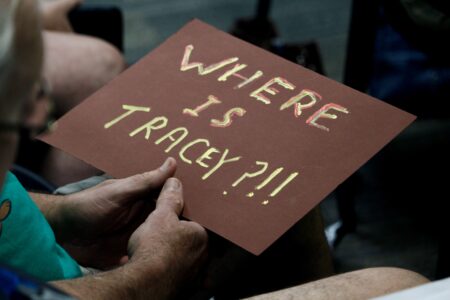
Opinion: Lawrence deserved more from its Congressman at Saturday’s candidate forum
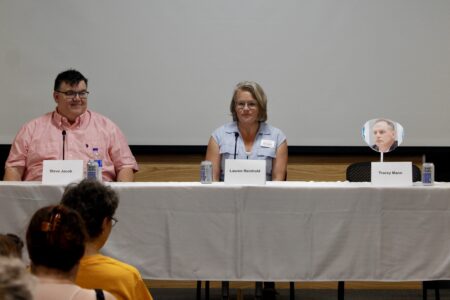
Candidates for ‘The Big First’ Congressional district talk affordability, immigration, Iran in Lawrence forum
US Rep. Sharice Davids introduces healthcare reform package
TOPEKA — U.S. Rep. Sharice Davids introduced healthcare legislation intended to benefit families grappling with ...
Opinion: The Lawrence man seeking to break the power of Republican, Democratic parties this election
State tax receipts top estimate by $147M for quarter
TOPEKA — The state of Kansas collected $147 million more in taxes than anticipated during the first quarter of ...