

What to know about amendment seeking to restrict noncitizen voting in Kansas
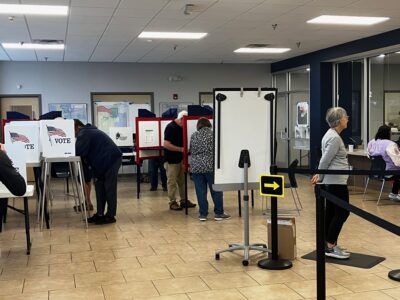
photo by: Kim Callahan/Journal-World
Douglas County voters fill the elections office on the first day of early voting on Oct. 14, 2026.
When Kansans look at their ballots for the upcoming election on Nov. 3, they will notice a question on whether or not the state constitution should be amended to clarify that only those who are United States citizens can vote in elections.
There will be a section of the Kansas Constitution printed on the ballot with italicized and crossed-out words, reflecting the changes legislators are seeking to make. The changes may appear minor, but their impact will, as proponents of the amendment have put it, remove any ambiguity or “alternative interpretation” from the state’s supreme law.
To those questioning the purpose of the amendment, proponents say that it will tighten the screws around what some describe as ambiguous language and make it clearer that noncitizens are prohibited from voting in elections, especially municipal elections. Opponents say that the amendment is redundant and creates nothing but fear and confusion.
Here are some questions and answers about the amendment, and arguments that have been made for and against it.
What would the amendment do?
The amendment would modify language in Article 1, Section 5 of the Kansas Constitution to make it more explicit that only U.S. citizens are eligible to vote in elections.
The goal is to prevent noncitizens from voting in any elections in Kansas, from statewide to municipal elections.
The most relevant change the amendment is proposing is the removal of the word “Every” in “Every citizen of the United States…” in the current language and replacing it with more explicit language, as demonstrated in the two versions below.
Current language: “Every citizen of the United States who has attained the age of eighteen years and who resides in the voting area in which he or she seeks to vote shall be deemed a qualified elector.”
Proposed language: “No person shall be deemed a qualified elector unless such person: (1) Is a citizen of the United States (2) has attained the age of eighteen years; and (3) except as provided in subsection (b) or (c), resides in the voting area in which such person seeks to vote.”
What does a “YES” vote or a “NO” vote mean?
A “Yes” vote would adopt the proposed language and make it more explicit in the Kansas Constitution that only U.S. citizens are eligible to vote in elections.
A “No” vote would keep the current language unchanged.
Are there any states with similar laws?
Yes. In 2024, voters in eight states approved similar measures that make it explicit that only U.S. citizens are eligible to vote in elections. Those include Iowa, Kentucky, Missouri, North Carolina, Oklahoma, South Carolina, Wisconsin and Idaho. Voters in three states — Arkansas, West Virginia and South Dakota — will consider in November whether to approve similar measures. Several other states already have some form of legislation that makes it more prohibitive for noncitizens to vote.
Most of these voter-approved constitutional amendments mirror each other’s language. The most prominent change often is swapping “all” with “only” when referring to U.S. citizens, so that the adopted language states that “only” U.S. citizens can vote in elections.
That was the case in Oklahoma, when voters adopted an amendment that replaced “all citizens” with “only citizens”; in South Carolina, when voters approved an amendment that changed the word “every” with “only”; and in Ohio, when voters approved an amendment that swapped “Every citizen” with “Only citizens.”
Who supports the amendment, and why?
Every single Republican in the Kansas State Senate — including Ty Masterson, who is running for governor — voted in favor of the amendment when it passed in 2025, as well as every Republican in the House. Masterson’s Democratic opponent, Cindy Holscher, also supported the amendment.
Becky Arps with Americans for Citizen Voting, a lobbying group from Virginia, testified in favor of the amendment during a House committee hearing last year. Arps, who called Kansas home for three years in the 1990s, said the amendment would prevent noncitizens from voting in municipal elections and would clarify that only U.S. citizens are eligible to vote.
She cited several examples of cities across the nation where noncitizen voting is allowed, including Burlington, Vermont, where in 2023 voters approved a measure that allowed legal residents to vote in local elections. Arps said that in each of those cities the measures passed because the state constitutions there weren’t explicit enough in prohibiting noncitizens from voting.
Another group, Opportunity Solutions Project, a nonprofit in Florida, testified in favor of the amendment, saying it “would remove any alternative interpretation of the current language.”
Who opposes the amendment, and why?
Opponents of the amendment include the Kansas chapters of the American Civil Liberties Union and the League of Women Voters, both of which submitted written testimony in opposition to the amendment during the 2025 legislative session. Davis Hammet, president of Loud Light Civic Action, a voting rights advocacy group in Kansas, also opposed the measure.
Hammet argued that the amendment is redundant. He cited a 1924 Kansas Supreme Court decision that said that although noncitizen voting in Kansas was once allowed under limited circumstances, the provision had since been amended when in 1918 voters approved a resolution that clarified that only U.S. citizens can vote.
“There has never been any other interpretation,” Hammet said during an in-person testimony at a House committee hearing. “The highest court in Kansas, the court that has the highest authority to enforce the Kansas Constitution, has already understood this.”
Hammet warned legislators that one possible risk of approving the amendment could be inserting doubt into the minds of voters who might think that noncitizen voting is legal in Kansas. He said that the amendment could also encourage xenophobic views among certain radical groups.
Hammet received pushback from Rep. Pat Proctor, a Republican from Leavenworth County who chairs the House Committee on Elections and is the sponsor of the amendment. Proctor, who is the Republican nominee for Secretary of State, said that it isn’t entirely clear that the 1924 Kansas Supreme Court decision applies statewide, and, as such, may still allow noncitizens to vote in municipal elections; the amendment would clarify the language and prevent that.
Hammet, in an interview with the Journal-World on Tuesday, said he believes the push for the amendment is politically motivated and built on “exploiting xenophobia against immigrants.” He accused Proctor of using the amendment as a tool for his bid for Secretary of State. Proctor filed to run for the office two weeks after the amendment passed.
Proctor, during a Senate hearing for the amendment, said he filed the measure to prevent ambiguity around who can and cannot vote in Kansas. He said U.S. citizenship either means something or it doesn’t.
The ACLU, in its written testimony, said the amendment sets a “dangerous precedent of meddling with the Kansas Constitution,” adding that it is “nothing more than an unnecessary attempt to reinforce what is already established.”
The League of Women Voters also made the case that the amendment is redundant.
“The Secretary of State’s personnel and election officials have verified in various testimony that our constitution allows only citizens to vote and that the officials follow the law,” the group said.
Hammet on Tuesday said he worries the amendment would confuse voters into thinking that just because something is on the ballot that it’s important.
Election Day is Nov. 3, and advance voting is already underway.
State Government
What to know about amendment seeking to restrict noncitizen voting in Kansas
2 Douglas County District Court judges up for retention on November ballot
General Election Voter’s Guide
Two state senators vying to be Kansas governor

14 candidates for Kansas House of Representatives will appear across Douglas County ballots in November. See who they are.
Three candidates vying to become state’s chief election officer
There will be a new Secretary of State in Kansas after the incumbent decided not seek re-election to the post that ...