

Special session offers hint of what awaits Kansas lawmakers in 2022 legislative session
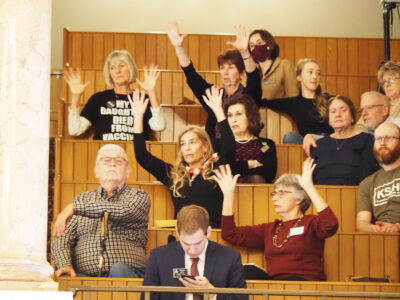
photo by: Sherman Smith/Kansas Reflector
Vaccine mandate opponents observing House debate Monday, Nov. 22, 2021, from the chamber gallery raise their hands in silent support after being admonished for previous outbursts.
Topeka — After this month’s special session intended to fight COVID vaccine mandates, plenty of Kansas legislators left with less than what they wanted.
Republican Sen. Rob Olson was one of them.
During the session, the House and Senate approved and Gov. Laura Kelly signed a bill to support workers who objected to COVID-19 vaccination and presented their employers with religious, medical or philosophical objections to a mandate. If they were fired for refusing the vaccine, they could qualify for unemployment benefits under the new law. The law also opened the door to a state-run process of financially punishing companies that didn’t accept vaccination exemption applications from their workers.
Olson, who said he refused the vaccine, approved of those protections. “I can’t force someone else to go in and take that vaccination for a job,” he said. “If it was me, I would quit that job.”
But during the Senate’s debate, he also proposed an amendment that would have shielded employers from paying more into the state’s unemployment trust fund if there was a spike in jobless claims. It wasn’t part of the final bill because House and Senate GOP leaders blocked a cluster of COVID-19 reform ideas crafted by lawmakers.
Now, Olson and other legislators must wait until the start of the 2022 legislative session in January to make their cases.
Expect the Legislature to grapple with an assortment of coronavirus bills, including one taking away the authority of private businesses to require employees to get vaccinated. Another proposal would add COVID-19 vaccination status to the list of prohibited forms of employment discrimination along with race, religion, color, sex, disability, ancestry, national origin and age.
Waiting in the wings is a measure prohibiting any form of “vaccination passport” indicating who did or didn’t get a shot. Another would make it illegal to “profile,” or easily identify, people who secured exemptions to vaccination. There could be a bill designed to block businesses from sanctioning workers who take time off the job to get a COVID-19 vaccination.
COVID-19 and more
Sen. Tom Holland, a Democrat from Baldwin City, said the COVID-19 bill adopted during the special session created a confusing situation for employers.
Businesses now face two contradictory measures from two levels of government — a federal vaccination mandate through President Joe Biden’s executive order, and the state law aimed at countering the president’s directive. Depending on what employers do, they could be stripped of federal funding or fined through the attorney general’s office.
Adding to the turmoil, Holland said, was the fact that Kansas is a right-to-work state. In other words, Kansas has at-will employment, which enables an employer to fire a worker for any reason or for no reason at all.
“We’re giving Kansas citizens the false impression that they are getting additional privileges and rights which violate that right-to-work tenet,” Holland said. “This bill did not do our Kansas employers any favors. It creates confusion.”
He said he would introduce an unemployment reform bill applying specifically to people who refused mandates to get a COVID-19 shot.
The 2022 session, fueled by election-year politics and reinforced by public frustration with the pandemic, could be a blockbuster. There will be pressure to adopt a medical marijuana law, expand eligibility for Medicaid and implement sports wagering. Don’t forget critical race theory, funding of mental health services, election reform and repeal of the sales tax on groceries. And the Legislature is preparing to redraw Kansas House, Kansas Senate and U.S. House district boundaries.
There could also be an intriguing debate on the legal theory of “nullification,” which some believe would enable the invalidation of any federal law that a state viewed as a violation of the U.S. Constitution.
“I think that as we look at the next session … there will be conversations about going further, and what does that look like, and how can we further protect people? How can we contemplate banning mandates?” said Rep. Stephen Owens, a Hesston Republican who served on the special committee on government overreach, which produced the special session bill.
“Whether those prevail is to be determined,” Owens said.
Cease-and-desist orders
Attorney General Derek Schmidt, a Republican who is running for governor, said the law that took effect Tuesday meant public and private employers couldn’t inquire about the sincerity of an employee’s religious belief when that worker sought a waiver to a vaccination requirement.
Schmidt said he would begin contacting public employers in Kansas potentially in violation of the law. In a statement, he didn’t identify the employers. He said some had required workers to complete detailed questionnaires to gather information or documentation about an employee’s faith history.
That form of discretionary evaluation was made illegal by the new law, Schmidt said.
“In Kansas, an employee’s religious faith may not be put on trial in order to obtain the waiver to which the employee is entitled by law,” Schmidt said. “It is particularly distressing when a public-sector employer — an agent of the government — sits in judgment of the sincerity of an employee’s religious faith.”
The new law includes potential fines of up to $50,000 for each infraction by a company found to have acted improperly when handling exemption requests. Under the new system, a worker alleging he or she was fired for refusing a vaccination mandate could file a complaint with the Kansas Department of Labor. It would be up to the attorney general’s office to secure a civil judgment against the company in state district court.
‘Wagging the dog’
Rep. Randy Garber, a Sabetha Republican who expressed concern for what COVID-19 vaccines might do to people “in the long run,” questioned where government rights stopped and human rights began. He suggested using ivermectin and hydroxychloroquine to treat COVID-19, even though both of those drugs have been widely discredited for use against the deadly virus.
Garber wanted lawmakers to take a stronger position on government mandates tied to the pandemic, and he twice made motions to stop the special session bill from advancing to a vote in the House.
“Folks, if we don’t start going against the federal government, the tail is going to keep wagging the dog, so to speak,” Garber said. “They continue to step outside their boundaries, more and more, every year. And I will contend it’s not just when one party is in power. We’ve got to put a line in the sand and say, ‘This is enough. We will not bow down.'”
Sen. Mike Thompson, a Republican from Johnson County, claimed that the vaccination mandate issued by Biden violated six constitutional amendments. He also said the special session was only the tip of the iceberg in terms of guaranteeing bodily autonomy in health care decisions. He framed the issue in the context of COVID-19, and not in terms of the Kansas Supreme Court’s declaration that women in Kansas had a constitutional right to abortion by virtue of bodily autonomy.
“If we cannot stop this intrusion into our most personal decisions about our health, where does it end?” Thompson said. “Is this bill the perfect remedy? No. But this is a victory for liberty and the patriots standing tall across Kansas, whose voices do matter.”
Risk of unintended consequences
During the special session Monday, House and Senate Democrats weren’t keen to work on modifying a bill that many of them loathed and voted against. Some were apprehensive about extending debate due to the possibility that other objectionable bills could surface.
House Minority Leader Tom Sawyer, a Wichita Democrat, said he understood the frustration with federal mandates associated with the pandemic. He said he was upset with the possibility of people losing jobs, but he was also convinced that state legislators couldn’t overrule federal mandates.
“Whatever we do here today does not change the fact that (the) federal mandate is still in place,” Sawyer said. “That’s been adjudicated by the courts. The courts will decide that issue. We need to be very careful.”
Sawyer said he was wary of legislators driven to “hurry up and do something, and then there’s lots of unintended consequences later.”
“All we’re doing is adding some additional regulations and mandates on our businesses,” Sawyer said. “We’re trying to solve a problem we can’t solve.”
Senate Minority Leader Dinah Sykes, a Democrat from Lenexa, said Kansans were justifiably eager to put the coronavirus behind them — but she said the new law delivered little more than a false sense of security.
“It does not guarantee that you will have a job regardless of your personal health choices or religious beliefs. Instead, it provides a patina of support while leaving Kansas businesses in an impossible position,” Sykes said.
Democratic Sen. David Haley, of Kansas City, Kan., said the special session reinforced to him that some people in government weren’t willing to share the burden of defeating a virus that has killed thousands of Kansans. COVID has factored into the deaths of 1,060 people in Sedgwick County, 960 in Johnson County, 473 in Shawnee County and 387 in Wyandotte County, and there are eight other counties in Kansas with more than 100 COVID deaths.
“I hope, honestly,” Haley said, “for Kansas’ sake, the country’s sake, for the world, that we find some way to curb this scourge.”
— Tim Carpenter and Sherman Smith report for Kansas Reflector.
State Government
Marshall camp settles unpaid bakery bill after 6 years
HUTCHINSON — The owner of a south-central Kansas bakery did not expect a Facebook post she made last Thursday to ...

Opinion: Lawrence deserved more from its Congressman at Saturday’s candidate forum

Candidates for ‘The Big First’ Congressional district talk affordability, immigration, Iran in Lawrence forum
US Rep. Sharice Davids introduces healthcare reform package
TOPEKA — U.S. Rep. Sharice Davids introduced healthcare legislation intended to benefit families grappling with ...
Opinion: The Lawrence man seeking to break the power of Republican, Democratic parties this election
State tax receipts top estimate by $147M for quarter
TOPEKA — The state of Kansas collected $147 million more in taxes than anticipated during the first quarter of ...