Opinion: The Lawrence man seeking to break the power of Republican, Democratic parties this election
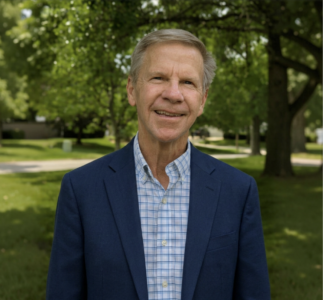
photo by: Submitted
Scott Morgan
It is the ugliest scoreboard in America — which makes sense given that it is measuring politicians. Recent public polling by the Pew Research Center shows that 58% of Americans view the Republican Party unfavorably and 59% view the Democratic Party unfavorably.
The scoreboard sucks not only because of its negativity, but also because of how meaningless it is. Elections will be held next month across the country, with more than a thousand races to be decided. Nearly ever single one of them will be won by either a Republican or a Democrat.
Wow, imagine what somebody actually popular could do.
Opinion
Chad Lawhorn
Editor & Publisher
Have your own take? Send 250 words or less to letters@ljworld.com.
Have a column idea or a tip for Chad to investigate?
Send a message to clawhorn@ljworld.com.
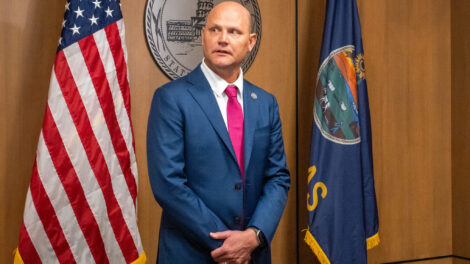
Lawrence resident Scott Morgan is hoping to be one of the few scoreboard surprises. He’s running for Kansas Secretary of State under the banner of the relatively new third-party United Kansas. Morgan hasn’t just taken note of how unpopular both parties are, but also has paid attention to which citizen are most likely to have no use for either party. A separate poll indicated that people 18 to 29 years old were nearly 2.5 times more likely to be dissatisfied with both parties than residents who are 65 years or older.
Morgan has a theory on why.
“The scariest part of it right now is you have the newest generation coming of age to vote, and it has very little use for the process or parties because they’ve never seen them work in their lifetimes,” Morgan told me.
Morgan also has a fear of what happens if we let such indifference or anger continue.
“You are just playing with your republic when you make it so distasteful that when new people arrive to it, they go ‘Well, I could vote for that party or I could vote for this party, but nothing ever changes.'”
One constant in politics is the lack of success of third-party candidates. Morgan, of course, is seeking victory, but acknowledged that if he could win 5% of the vote that would be very significant. If 10% of the vote went his way, it would be a game-changer in attracting larger numbers of quality United Kansas candidates for the next batch of elections.
There’s a simple reason that numbers higher than those are tough to imagine.
“It is ingrained in voters that third-parties don’t work,” Morgan said.
So Morgan, who also is the executive director of the United Kansas party, is taking a time-consuming, uphill approach of trying to change people’s mindset.
What else is a guy to do? Changing the mindset is a lot more feasible than changing the actual system at this point.
“It has to be a work of love and passion because it is intentionally very difficult to do,” Morgan said when I asked him what it is like trying to win an election as something other than a Republican or a Democrat. “They — the two parties, and it really is both parties — have created a system structurally designed to make it hard to have competition.”
If you truly wanted to have a system represented by more than two parties, you would let third parties conduct primary elections just like the Republican and Democratic parties do. Giving voters a chance to directly elect their nominees is a good way to build interest in a party. State law doesn’t currently allow Kansas’ two recognized third parties — United Kansas and the Libertarian Party — to conduct primaries.
There are numerous other ways to inject more competition into the system, such as ranked choice voting, primary ballots that list candidates from all parties, fusion voting and other such ideas that would turn this column into a political science class. Or, we could discuss wizards with magic wands. Today that solution is as likely to emerge as any of those others.
The two parties — particularly Republicans in Kansas, but Democrats in other parts of the country — don’t have any incentive to change the system.
“People want to keep power, and one of the easiest ways to do it is to keep others from having access to that power,” Morgan said.
Due, in part, to a lack of a voter referendum system in Kansas there’s no straightforward way for voters to force the change. If you want to create change in the system, you first have to break into the system by winning elections, it seems.
It’s a system Morgan understands well. He once was very much an establishment member of the Republican Party. He was a staff member for Republican senators Nancy Kassebaum and Bob Dole, and also served as chief counsel for Republican governor Mike Hayden.
Morgan’s position on third parties changed when the Republican Party changed, he told me. When he realized that the party’s role as a moderate conservative party had disappeared, he said it was like someone who had been “disappointed by their faith.” He took it hard, and considered whether the simpler route would be to find a home in the Democratic Party. If he could be just a Kansas Democrat, maybe that would work.
“But the problem with Democrats is their national brand,” Morgan said.
So, in short, his mindset about third parties changed. But can he change anybody else’s? Math, of all things, should give him some hope.
In 1988 the polling organization Gallup asked Americans whether they were Democrats, Republicans or Independents: 33% said Independents. In 2025: 45% said they were Independents. They have Republicans and Democrats beat. Each came in at 27%.
Then, there are those numbers we started with: 58% dislike the Republican Party, 59% dislike the Democratic Party. In 1994, it was 27% disliked Republicans, 44% disliked Democrats.
Math, though, doesn’t often sway Americans. But a belief in possibility can. Right now, there are plenty of people who think they don’t have the power to make change. That, Morgan said, is just power playing one its grandest tricks on you.
“Power knows that it doesn’t need to actually have more power than what its up against,” Morgan said. “It just needs the other folks to think it has that much power.”
State Government
Opinion: The Lawrence man seeking to break the power of Republican, Democratic parties this election
State tax receipts top estimate by $147M for quarter
TOPEKA — The state of Kansas collected $147 million more in taxes than anticipated during the first quarter of ...
Rep. Tracey Mann to skip candidate forum in Lawrence; spokesman scarce on details

Kobach, Mann debate criminal justice priorities at Tuesday event as they campaign in attorney general race
Kansas must count mail ballots that arrive three days after November election, appeals court rules