

Judge criticized by abortion foes named to Kansas Supreme Court
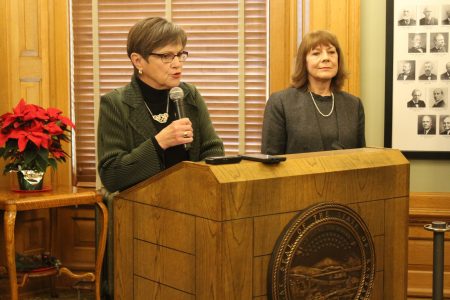
photo by: Lauren Fox
Kansas Gov. Laura Kelly, left, announces Shawnee County District Court Chief Judge Evelyn Wilson, right, as her appointee to the Kansas Supreme Court on Dec. 16, 2019, in Topeka.
Story updated at 11:53 a.m. Monday
TOPEKA — Democratic Gov. Laura Kelly on Monday named a veteran trial-court judge opposed by the state’s most influential anti-abortion group to the Kansas Supreme Court, an appointment that’s likely to intensify a backlash against the court from conservative legislators.
Kelly’s selection of Shawnee County District Judge Evelyn Wilson comes with many Republican lawmakers already seeking to change the process for picking Supreme Court justices to give the GOP-controlled Legislature power it does not have now to block an appointee. Abortion opponents also are pushing for a change in the state constitution to overturn a ruling from the high court in April protecting abortion rights.
Kelly passed over two veteran lawyers who work in Republican state Attorney General Derek Schmidt’s office. Kansans for Life, an anti-abortion group long influential in GOP politics, opposed Wilson’s appointment because of her husband’s past political contributions to Kelly and other abortion-rights candidates.
“It’s my sense that Judge Wilson is more than qualified to fill this role,” Kelly told reporters during a Statehouse news conference. “Ideology was not really part of the conversation with any of the nominees. ”
But Kansans for Life said Kelly’s action demonstrates the need for a change in the selection process to “ensure that women and their babies can be protected.”
“Kansans for Life is not surprised that the governor chose as a Supreme Court justice someone who supports her vision for unlimited abortion in the state,” lobbyist Jeanne Gawdun said.
Wilson declined to to comment on the court’s abortion-rights ruling declaring that access to abortion is a “fundamental” right under the Kansas Constitution. She will replace former Justice Lee Johnson, who retired in September and was a member of the 6-1 majority in that case.
Her appointment is not subject to legislative oversight, but she will face voters in November 2022 for a yes-or-no vote on whether she remains on the court for another six years.
“I believe I am a calm person and I am thoughtful,” Wilson said, in response to a question about her judicial temperament.
Wilson, 60, has been a judge since 2004, appointed to the trial-court bench in the county that includes the state capital, Topeka, by then-Democratic Gov. Kathleen Sebelius. Wilson has been the county’s chief administrative judge since 2014 and before going on the bench was a lawyer in private practice in Topeka and Oberlin, a small, northwest Kansas town near the Nebraska border.
Kelly pointed to all of those experiences and Wilson’s growing up in western Kansas as reasons to name her to the high court.
Past political contributions by her husband, Michael, have included $3,000 to Kelly’s campaign for governor in 2018 and another $3,000 to Kelly campaigns for the state Senate in 2016 and 2012, online campaign finance records show. But he has also given to Republicans and was elected as a GOP precinct committee member last year.
He has said his wife avoids politics. Kelly cut off a question directed to him from a reporter during the news conference.
The other two finalists were Deputy Kansas Attorney General Dennis Depew, formerly a lawyer in southeast Kansas for three decades and Kansas Bar Association president, and state Assistant Solicitor General Steven Obermeier, who worked as a prosecutor for three decades in Johnson County, the state’s most populous county.
Finalists for Supreme Court appointments are chosen by a lawyer-led nominating commission.
It is Kelly’s first appointment to the seven-member high court, and it came a day before the retirement of Chief Justice Lawton Nuss. While Nuss’ departure elevates the next senior justice, Marla Luckert, to the top position in the state’s court system, it creates another vacancy for Kelly to fill by mid-March.
Nuss is stepping down after serving on the court since 2002 and as chief justice since 2010.
Luckert, who was appointed to the court in January 2003 by moderate Republican Gov. Bill Graves, will be the second woman to serve as chief justice. The late Kay McFarland was chief justice from 1995 until 2009 after having been the first woman appointed to the court in 1977.
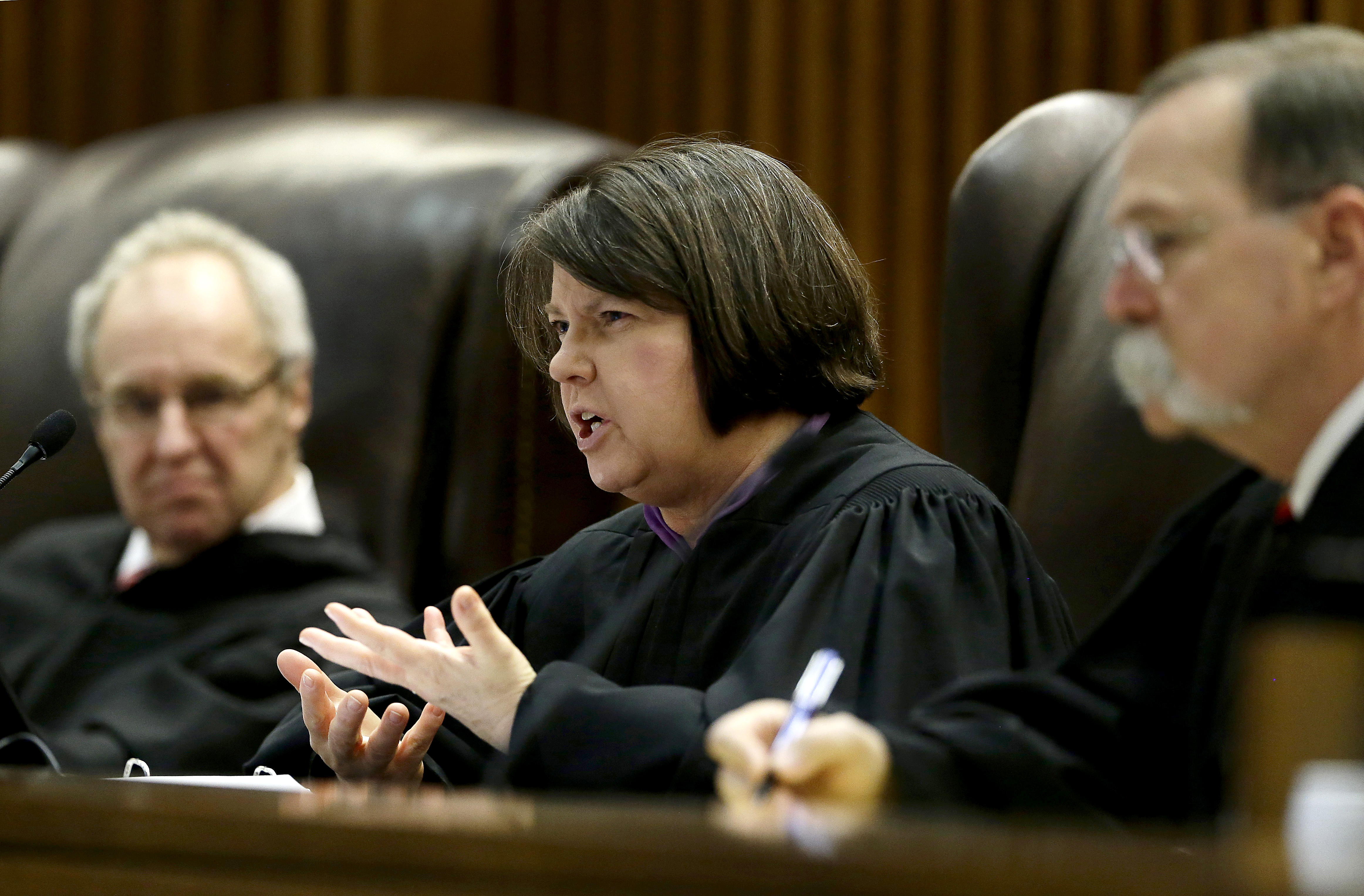
photo by: Associated Press
Flanked by Justice Eric S. Rosen, left, and Chief Justice Lawton R. Nuss, right, Justice Marla J. Luckert questions an attorney for Reginald Carr as during a hearing before the Kansas Supreme Court Tuesday, Dec. 17, 2013 in Topeka, Kan. The hearing was the first of two held on separate appeals by Carr and his brother Jonathan Carr, who were sentenced to death for the shooting deaths of four people on Dec. 15, 2000, as the victims knelt on a field in Wichita, Kan. (AP Photo/Charlie Riedel)
Kelly will have more appointments in a little more than a year in office than her two Republican predecessors did in eight years.
Conservative Republican legislators plan to push next year for an amendment to the state constitution to eliminate the nominating commission and have justices named by the governor subject to Senate confirmation. While Kansas has had five Democratic governors in the past 50 years, Republicans have had a Senate majority for more than a century.
Conservatives have long argued that the current system, in use since 1960, results in a court that’s more liberal than the electorate and makes the justices less accountable to voters. Supporters of the system contend it preserves judicial independence.
The Legislature reconvenes Jan. 13 for its annual session, and conservatives also plan to push for another constitutional change on abortion. Kansans for Life wants an amendment declaring that the Legislature retains the authority to regulate abortion as it sees fit, but at least a few abortion opponents would prefer an amendment banning abortion outright.
State Government
Marshall camp settles unpaid bakery bill after 6 years
HUTCHINSON — The owner of a south-central Kansas bakery did not expect a Facebook post she made last Thursday to ...
Opinion: Lawrence deserved more from its Congressman at Saturday’s candidate forum
Candidates for ‘The Big First’ Congressional district talk affordability, immigration, Iran in Lawrence forum
US Rep. Sharice Davids introduces healthcare reform package
TOPEKA — U.S. Rep. Sharice Davids introduced healthcare legislation intended to benefit families grappling with ...
Opinion: The Lawrence man seeking to break the power of Republican, Democratic parties this election
State tax receipts top estimate by $147M for quarter
TOPEKA — The state of Kansas collected $147 million more in taxes than anticipated during the first quarter of ...