‘Every kid can bring something to the table’ for Eudora’s Scholars Bowl team, which just won its 3rd straight state title
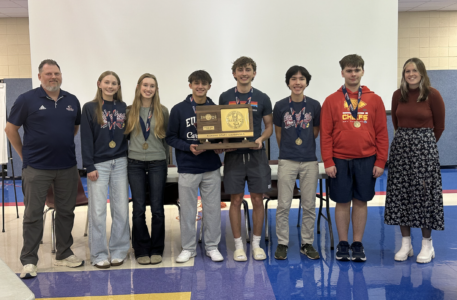
photo by: Contributed
The Eudora High School Scholars Bowl team holds the 4A state championship trophy after winning the competition Feb. 14, 2026. Under head coach Jim Barnard, the team has won three straight titles, and he said he's seen many students grow in confidence through the activity over his years. From left to right: Barnard, Evey Steele, Leah Barnhart, Colton Jenkins, Ben Pierron, Eugene White, Wyatt Boose and assistant coach Lilly Richards.
It takes a lot to build a championship team — let alone a dynasty. And that’s the case whether you’re in the Super Bowl or in Scholars Bowl.
And while Eudora High School teacher Jim Barnard chuckles at his Scholars Bowl team being called a “dynasty,” he’s seen more consistent success in his field than dominant sports teams like the Chiefs and KU basketball have in theirs. In his three years as head coach, Barnard has led his team to three straight state titles.
Most recently, the team won the 4A state tournament on Feb. 14 in dramatic fashion against Buhler High School. Eudora’s team, made up of junior Evey Steele, sophomore Leah Barnhart, senior Colton Jenkins, senior Ben Pierron, senior Eugene White and junior Wyatt Boose — who was the alternate — shrugged off early losses in the pool play portion of the tournament before advancing to the final. In the state title match, the final score was tied and the contest came down to sudden-death tiebreaker questions. Both schools missed the first three tiebreakers, but Steele answered the fourth one to give Eudora its third title in a row.
Winning a title is exciting, but what has made Barnard the happiest is to see the students find an outlet to compete and grow, both academically and as people.
“This activity does instill confidence in kids,” Barnard said.
At first glance, Scholars Bowl looks like a more intense version of a trivia contest, but Barnard said there is a lot of preparation and practice that goes into it.
Eudora’s program normally has about 25 to 30 students involved, even though each team at a tournament can only have five players. Barnard said he brings an alternate to each event in addition to the five-person tournament team. They face off with other schools’ teams, answering questions on a variety of academic subjects.
There are 16 questions per match: three questions each in English language arts, science, social studies and math; a foreign language question that typically requires them to translate a phrase from another language; a current events question; and two fine arts questions.
A moderator asks the questions, and any player can press the button on their electronic buzzer if they think they have the right answer. If the first person to buzz in gets the answer wrong, then the other team gets a chance to answer. Each correct answer is worth 10 points.
At most tournaments, 16 to 20 schools are competing, and the Eudora team normally plays eight to 10 matches per event, Barnard said.
While many of the questions are on things the students learn in the classroom, it still takes practice to be able to perform well under pressure. Barnard said the team typically practices four days a week for about 45 minutes to an hour. During each practice, the students can get through 80 to 120 questions and answers, and things they were asked in practice might come up in the actual tournaments.
“There’s a lot of behind-the-scenes practice and rehearsal and preparation that goes into a match with a school,” Barnard said.
Barnard, who is in his ninth year teaching at Eudora and also coaches the cross country teams, is a “very competitive person by nature,” he said, and when he is doing something, he wants to take it seriously. So the team doesn’t just read off questions and answer them at practices; they do their best to simulate an actual match environment, including using real buzzers.
Besides making the students more comfortable with the equipment, it also helps them practice other “procedural issues” that the activity requires. For example, before a player who has buzzed in can say their answer, the moderator has to recognize them. If the player just blurts out the answer, the team could miss out on the points even if the answer was right. Training with real buzzers helps the team avoid such mistakes.
“So when we’re in big stages or big moments, we know how to do it right,” Barnard said.
Barnard thinks his competitive nature and attitude of “giv(ing) 100% effort” has led the students to be similarly diligent and focused on preparing. Some members of the team take their roles so seriously that they do their own studying outside of practices. They create flash cards on their own to review topics they know are popular in tournaments.
“They just have a passion for learning,” Barnard said. “They want to learn new things and find it exciting (to show that off).”
Although the team has had a lot of success so far, Barnard knows from coaching sports how difficult it is to rebound from a loss. In this year’s state tournament, Barnard said the team lost two of the first three matches during pool play. He sensed the nerves and responded much like a coach in a sport would, by telling his team to “relax and reset.” Eudora then rattled off four wins to advance to the knockout round and eventually win the title. Those sorts of moments in competition are important for the students to handle well, Barnard said.
Building the players’ confidence is important for a successful team. Barnard said he casts a “wide net” when recruiting for the team, looking for all kinds of students, and he said the biggest reason that students initially aren’t interested is they are “afraid of being wrong.” As new recruits go through practices and compete with the team, Barnard said he tries to reinforce the fact that “they’ll be wrong sometimes and that’s OK.” He said he has seen some recruits who “never once try buzz in” grow and go on to become team leaders later on.
“You see kids grow in confidence over the years, which is outstanding,” Barnard said.
You also have to be confident in your teammates, because nobody can be an expert in everything. Some players are better at solving math problems, while others might be avid readers and excel at questions about literature, so it’s important for Barnard to build a team with a diverse mix of skills.
For some people on the team, Scholars Bowl might be the only team activity they’re involved in at school. Barnard said half the students who were part of the state title team didn’t compete in any school sports, and Scholars Bowl provides a “competitive outlet” for those students who may not excel at or be interested in athletics but “still want to do something and be on a team.”
Although Barnard would surely love to win four titles in a row, he’ll be happy with however the team does as long as they “represent Eudora High School and (themselves) the best (they) can.”
“It’s exciting … watching them develop and grow and mature with this activity,” Barnard said. “Every kid can bring something to the table.”
K-12 Education
‘Every kid can bring something to the table’ for Eudora’s Scholars Bowl team, which just won its 3rd straight state title
New Choice Campus at Centennial to offer personalized, flexible path for Lawrence high schoolers

Protesters gather in downtown Lawrence for student-led demonstration against Trump administration, ICE
Lawrence school board approves bid for improvements to middle school theaters

Students suing the school district over Gaggle seek court order for district to respond to unanswered KORA requests