Lawrence school district has started budget discussions, staff proposes lower property tax for 2026-2027
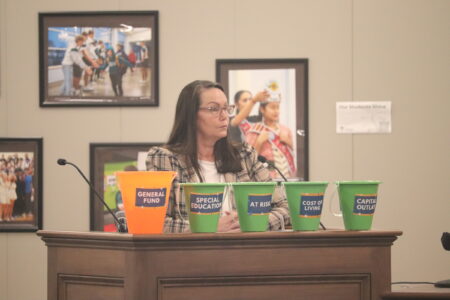
photo by: Josie Heimsoth/Journal-World
Cynde Frick, the district’s executive director of finance, speaks at the school board meeting on Monday, Aug. 10, 2026.
The Lawrence school district has introduced the key elements shaping the budget for 2026-2027, and staff is proposing a property tax rate decrease.
The school district notified the Douglas County Clerk in July that the mill levy – also known as the property tax rate – for the 2026-2027 budget will not exceed 52.204 mills. One mill is equal to one dollar of property taxes for every $1,000 of a property’s assessed value.
The maximum mill levy was shared with board members earlier this week, and no action was taken on the 2026-2027 budget. This mill levy means the district can decide on a mill levy lower than this amount, but it cannot go higher.
The mill levy is the total between four separate mill levy amounts: one each for its general operating fund, debt service fund, capital outlay fund and various other levies. Those levies are combined to calculate the current budget’s mill levy.
Frick told board members on Monday that the challenge with putting together a budget each year is the district’s fiscal year has already started – on July 1 – before key budget activities take place.
One example is how the general fund is calculated each year. The general fund is based on a student enrollment count conducted on Sept. 20 and other weightings, including transportation costs for students who live 2.5 miles or more from school; students eligible for free lunch; and special education funding.
“So right now, as we’re calculating our budget,” Frick said, “we don’t know how many free lunch students we’re going to have this coming Sept. 20. We don’t know exactly how many transportation students are going to be eligible for that.”
Currently, the district is estimating what those numbers will be, Frick said, meaning the mill levy may change as the school year progresses.
“We will get to Sept. 20. The data team will do a lot of work with the schools to get everything exactly lined out,” Frick said. “We’ll have an audit by the state come November, and then we’ll have a little bit better idea of where our budget is going to land.”
“We don’t get to determine what our budget is,” Frick said at the meeting. “It’s enrollment plus weightings. It’s a formula.”
In Kansas, local entities submit their maximum property tax levies to the county clerk in order to comply with revenue-netural laws. The school district – like other entities – submitted those numbers in July.
The maximum mill levy of 52.204 mills exceeds the revenue-neutral rate – which is the tax rate that generates the exact same amount of property tax dollars as the previous year, based on the current year’s total property values. The district’s revenue-neutral rate is 49.613 mills.
However, in comparison to some of the mill levies proposed by district staff in previous school years, it’s lower. In 2023-2024, the proposed mill levy was 52.210 mills and the following year, it was 52.273 mills. Last school year, staff proposed a mill levy of 52.345 mills.
The district is also seeing an increase in its Base Aid for Student Excellence state funding, which is allocated to support each individual student. For the 2026-2027 school year, the district will receive $5,778 per student, up from $5,615 per student the previous year.
Monday’s meeting was the first of three scheduled conversations surrounding the 2026-2027 budget. There will be another presentation on the budget on Aug. 24. The public hearing on exceeding the revenue-neutral rate and on the adoption of the budget itself are scheduled for Sept. 14.
Other News

Lawrence’s first bike lanes with physical barriers are installed on Ninth Street

Data center company plans up to $1,000 a year in tax, utility credits for De Soto households

Supernatural thriller filmed in Lawrence to have multiple showings at Liberty Hall

Eudora voters to decide sales tax election to fund increased fire protection in the city
Perry-Lecompton voters to weigh new joint recreation system funded by property tax levy