Lawrence school board member, state board official denounce vouchers for private schools, call for special education funding
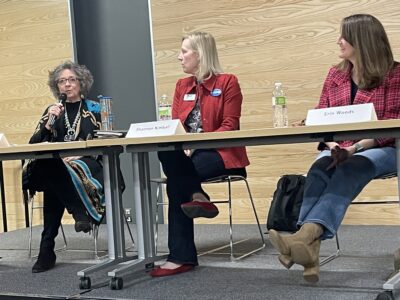
photo by: Matt Resnick/Journal-World
Kansas State Board of Education member Ann Mah, left, speaks during a panel discussion at the Lawrence Public Library on Saturday, Jan. 27, 2024. Also pictured are Shannon Kimball, center, and Erin Woods.
At a panel discussion on Saturday, a longtime Lawrence school board member and a member of the state board of education denounced voucher programs and called on the Legislature to fully fund special education.
The discussion about education issues during the current legislative session was hosted by the parent legislative advocacy group Educate Lawrence at the Lawrence Public Library. Its panelists were Ann Mah, a Kansas State Board of Education member who represents parts of Douglas County; Lawrence school board member Shannon Kimball, who is also a government relations specialist with the Kansas Association of School Boards; and Erin Woods, a K-12 education activist with the group Game On for Kansas Schools.
One of the biggest topics on Saturday was something that Republicans in the Legislature have been pushing for especially hard in recent years: voucher programs that would use state education funding to help families pay for private school tuition. A voucher proposal failed in the Kansas Senate last year, but the issue could come up again during the current legislative session.
Mah said that with voucher programs, rural schools tend to suffer the most. For one, “most counties in Kansas don’t have a private school option,” she said. And, when students leave a district for private schools, the district gets less money from the state, because the funding formula allocates money on a per-pupil basis. Smaller rural districts can’t absorb those losses as well as large urban districts can.
To illustrate, Mah used a hypothetical scenario in which five students from the Perry-Lecompton district transfer to private schools in Lawrence.
“Let’s just say that each kid, in terms of state funding, was worth about $10,000 each,” she said. “Can you imagine what a $50,000 hit would do to Perry-Lecompton’s budget? The district doesn’t save a dime, but they lose a bunch of money.”
Texas, she said, is a state that’s recognized the threat that voucher programs pose for rural schools.
“Even they got it,” she said. “Texas keeps voting down school vouchers because they recognize it’s a hit to rural communities.”
Kimball, who has served on the Lawrence school board for more than a decade, said there’s another big problem with vouchers: that private schools can’t be held accountable for their performance as easily as public schools can.
“Those schools are not required to take state assessments, and those schools are not held to any of the same standards that public schools are,” she said. “So you have a system where public dollars go to an education system that’s completely unaccountable for the way that they spend money. On the flip side, public schools are accountable for all of those things, to you as parents and taxpayers. So, it’s really hard to understand why there is such a double standard in these conversations.”
Kimball also said that the expansion of voucher programs in several other states has resulted in “subprime education institutions” — “You’re seeing schools pop up in empty storefronts and strip malls,” she said.
Both Kimball and Mah were concerned that vouchers wouldn’t benefit lower-income families nearly as much as wealthier ones. Kimball said the programs amount to “welfare for those already wealthy,” and Mah argued that it “was never about the kids; it’s all political, and driven by (Charles) Koch,” referring to the CEO of Wichita-based Koch Industries.
“Charles Koch is a free market guy and truly believes that the best thing for education is competition,” Mah said. “And if you push these kids out to particularly religious private schools, his taxes will go down.”
Kimball said that Kansas should look at Arkansas, which recently expanded its voucher program, as an example of who benefits from these policies. In that state, she said, 95% of students using the program had already been attending private schools before the program was enacted. Iowa also has a voucher program, and 67% of students using that program had never attended a public school, Kimball said.
She blasted the Republican-controlled Legislature for “rampant disinformation going around in the Statehouse,” specifically “that public schools are failing.”
“The advocacy around this goes to pushing back on the disinformation that public schools are failing, because they are not,” Kimball said. “But if you listen to the people who are in support of these kinds of programs in our Legislature, they are talking about student achievement data in a way that is just simply wrong.”
•••
On the topic of increasing special education funding, Woods said that this legislative session was the time to act. She said there “seems to be a lot of momentum” behind the issue and that “this is the year to push for it.”
According to the Kansas Association of School Boards, the Legislature is legally required to fund 92% of school districts’ special education costs, in addition to base aid and other weightings for special education students. But the state has continually struggled to reach that percentage, and school districts have had to dip into their general operations budget to cover the gap.
“We need to be emailing our legislators and putting as much pressure on them as we can,” Woods said. “Special education has not been funded to the 92% level since 2011.”
Kimball said that Lawrence Public Schools spent $25.6 million on special education during the 2022-23 school year, but had to transfer $8.4 million from the district’s general fund to cover its special education shortfalls. She added that special education underfunding has affected the district’s ability to pay competitive wages and retain people in “those hard-to-staff areas of special education.”
“Every time that we lose staff because we can’t afford to pay them, that’s a lost opportunity for our kids,” she said.
K-12 Education
Perry-Lecompton voters to weigh new joint recreation system funded by property tax levy

KU professors, middle school band director, radio personality among this year’s Phoenix Award honorees: ‘It’s a cool mix’
Baldwin High already has won $25K and is competing for $1M through national sports program
A student-run coffee shop will open at Community Connections at Pinckney next week
‘No day is like the other here’: Students from Lawrence’s German sister city discover football, new foods and new friends on exchange