After a year, New York Elementary’s public Montessori program is in high demand; superintendent says it would expand even more ‘if we could afford it’
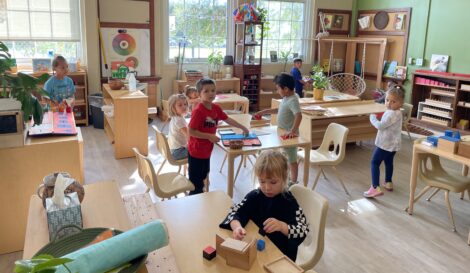
photo by: Matt Resnick/Journal-World
Students enrolled in the Montessori program at New York Elementary School work on activities.
When Superintendent Anthony Lewis was first toying with the idea of a public Montessori school in Lawrence, he had a talk with a local private school director about these nontraditional schools — and about everything that Montessori education shouldn’t be.
That director was Lleanna McReynolds, of Raintree Montessori, who told him she’d been doing an experiment. She’d been asking people around town to say the first thing that came to mind when they thought of a Montessori school.
And “the answers she was getting were ‘private,’ ‘elitist,’ ‘snooty,’ ‘well-to-do,’ ‘privileged,'” Lewis said. “And she was almost in tears.”
Now, more than a year after the launch of the district’s Montessori program at New York Elementary, Lewis is confident that it’s dispelled those myths.
He says it’s brought a new kind of education — one that’s worked well for his own family — to less affluent families on the eastern side of Lawrence who might not be able to access it otherwise.
And, at a time when the district recently reported an enrollment decline of hundreds of students, the New York program doesn’t have enough room to keep up with demand. The program started last year with three classrooms for ages 3 through 5, and has since added two more classrooms and two more teachers for last year’s 5-year-olds, who have outgrown the early-childhood classrooms. Despite this, it still has a waiting list of more than 20 preschoolers and kindergartners.
According to district spokesperson Julie Boyle, the district has plans to keep expanding the Montessori program to serve more students “as funding allows,” and Lewis said that if the district had the resources right now, it would add another early-childhood classroom to the ones it already has.
• • •
While Lawrence’s public Montessori school is new, the Montessori education method — which is named after its inventor, the Italian physician and educator Maria Montessori — dates back more than 100 years. According to the American Montessori Society, the method involves multi-age classrooms and lots of self-guided activities, and it gives students more freedom to learn at their own pace than a conventional elementary school would.
When you visit one of New York Elementary’s Montessori classrooms, those differences are immediately evident.
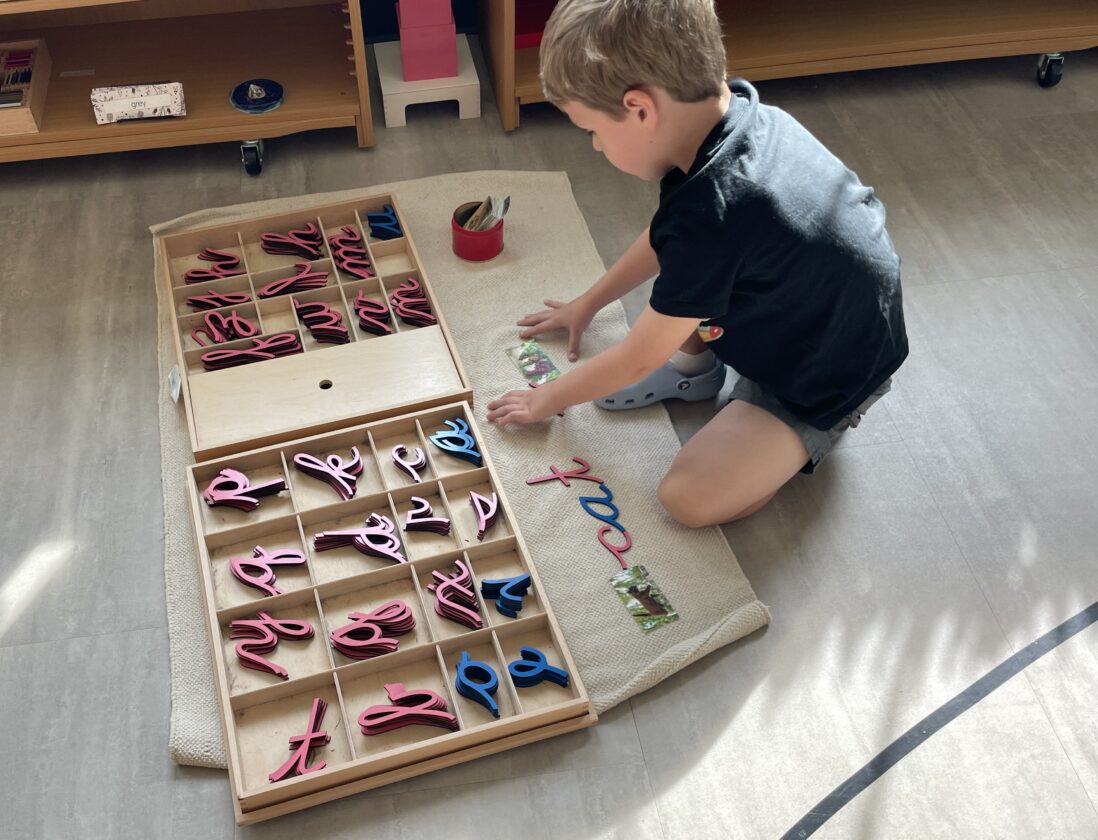
photo by: Matt Resnick/Journal-World
A student enrolled in the New York Elementary School Montessori program works on an individual activity.
The kids in the classroom aren’t just sitting at desks. They might be gathered around a table doing activities in a group or practicing handwriting on their own on a kid-sized chalkboard. One child is sitting on the floor, using cursive letters cut out of wood to spell words that match a set of pictures — “c-a-t” alongside a picture of a brown cat.
Even the furnishings here are different from other schools, with lots of natural materials such as wood, wicker and cotton and not as much plastic or metal. (Boyle said they’re more expensive than normal classroom furnishings, but that they also “last a lifetime, or at least 50 years.”) Houseplants bask in the sunlight by the windows, and a macramé swing is suspended from a wooden frame in the corner of the room.
New York Elementary School Principal Sunny Halsted said the unique design of the rooms is intentional.
“Everything in the room has functionality, and nothing is for show,” Halsted said.
Karen Branum is one of five Montessori-certified teachers at New York, and one of three who teach in the ages-3-through-5 classrooms, which in Montessori terminology are called “Children’s Houses.” She said that in a Montessori school, there’s always a mix of more formal instruction with self-guided study and experimentation. A student might first receive an individualized lesson based on their own interests and abilities, she said. Then, after that, they’re allowed some free rein to “explore and make discoveries.”
“The children are allowed to make choices,” Branum said. “But there are no bad choices. All the choices are beneficial to them.”
Halsted said that when kids can “do lessons at their ability level and pace,” they’re also more engaged. They “don’t feel overwhelmed or bored or anything that maybe happens sometimes in a traditional classroom.”
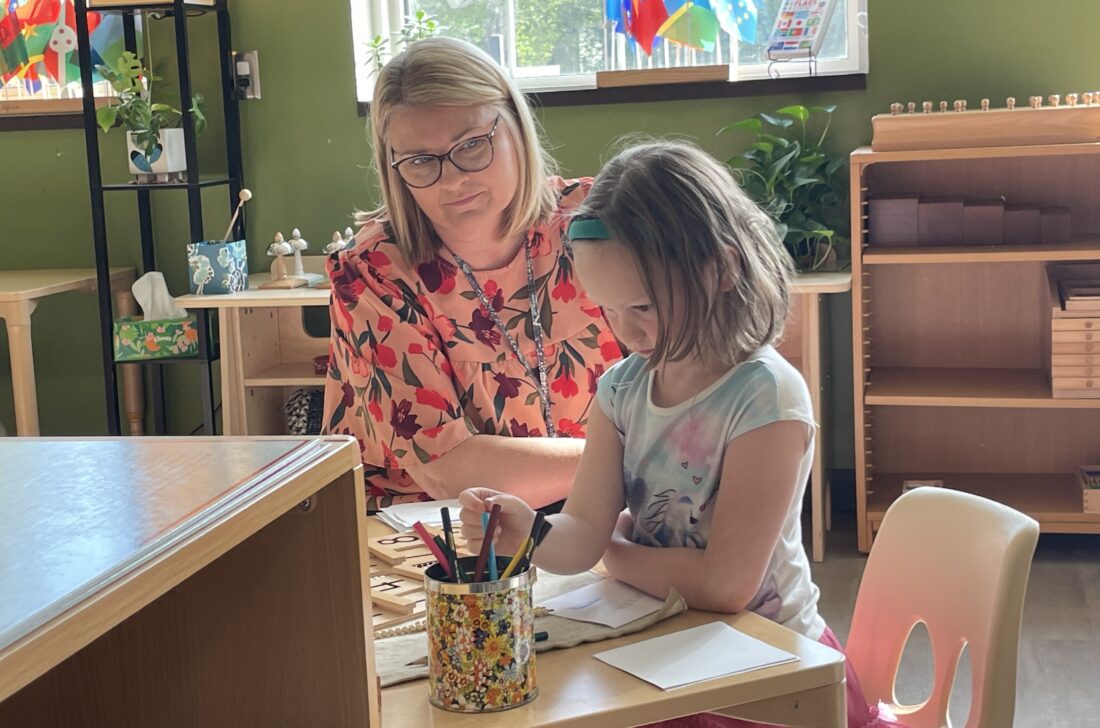
photo by: Matt Resnick/Journal-World
New York Elementary School Principal Sunny Halsted works with a student enrolled in the district’s Montessori program.
Another Montessori-certified teacher at New York is Laura Hosek, who appreciates being able to teach in a way that “facilitates independence in the children.” She said that in a Montessori classroom, students aren’t just a class — they’re like a little community.
“There is a lot of freedom, with responsibility,” Hosek said. “It’s really cool to watch a community of children function in such a manner.”
Stability and longer-term relationships are a key part of creating that functional community, she said. The Montessori classroom’s multigrade structure doesn’t just mean that children interact with peers of different ages; it also means they stay with the same teacher for three years instead of just one.
“It builds a relationship, not only with the family — but with the community and environment that sustains them for long periods of time,” Hosek said. “It allows us to see them through on their development.”
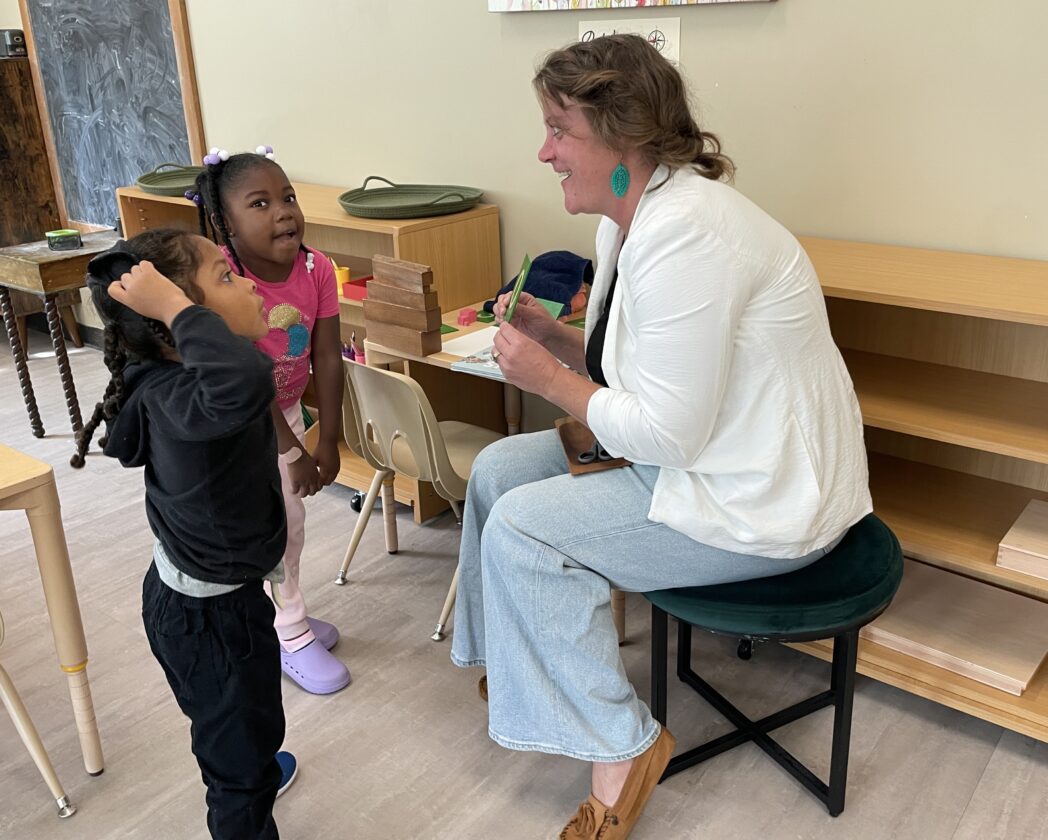
photo by: Matt Resnick/Journal-World
Laura Hosek, a Montessori teacher at New York Elementary School, guides students through an activity.
• • •
To keep the kids’ Montessori journey going, though, the Lawrence district needs more teachers who are Montessori-certified, and it will eventually need instructors who can teach older students.
Currently, only kids age 6 and under at New York are in Montessori classes; the district is phasing in the program starting with the younger kids, and the upper grades at New York still learn in a traditional classroom setting. But Lewis said the district had been working on getting instructors in place for upper-elementary Montessori students, which Boyle said would include kids ages 9 through 12.
Still, “we’re good for another one or two years” before there’s a real need for those teachers, Lewis said. The real pressing need now is for more Children’s House classes and working to get more kids off the wait list and into the Montessori program.
Before the program launched in August 2022, the district had originally planned to have just two Children’s Houses, Lewis said. But demand was so high it had to add a third one, he said. Each Children’s House class has 20 students in it, and Boyle said all three were at capacity last year. That hasn’t changed this year, and Lewis said there also are 42 6-year-olds in the two new classes.
Then, there’s the issue of ages. Halsted said more and more new families have been enrolling their older kids, who are kindergarten-age instead of preschool-age, in the program. That creates a problem, she said, because each year in a Montessori program builds heavily on the last.
“We would like to add more of the Children’s House primary classrooms, because right now we’re off-balance in our ratios of 3-, 4- and 5-year-olds,” she said. “We are really heavy on kindergartners, and that doesn’t provide the scaffolding foundation they need. So we spend a lot of time catching our kindergartners up because they’ve missed two years in the program.”
Another issue is finding the money to train new teachers in the method. The three Children’s House teachers already had Montessori certification, but the new teachers for the 6-year-olds had to undergo training to get Montessori-certified. Boyle said the Lawrence Schools Foundation paid for that training, which cost around $34,000 in total.
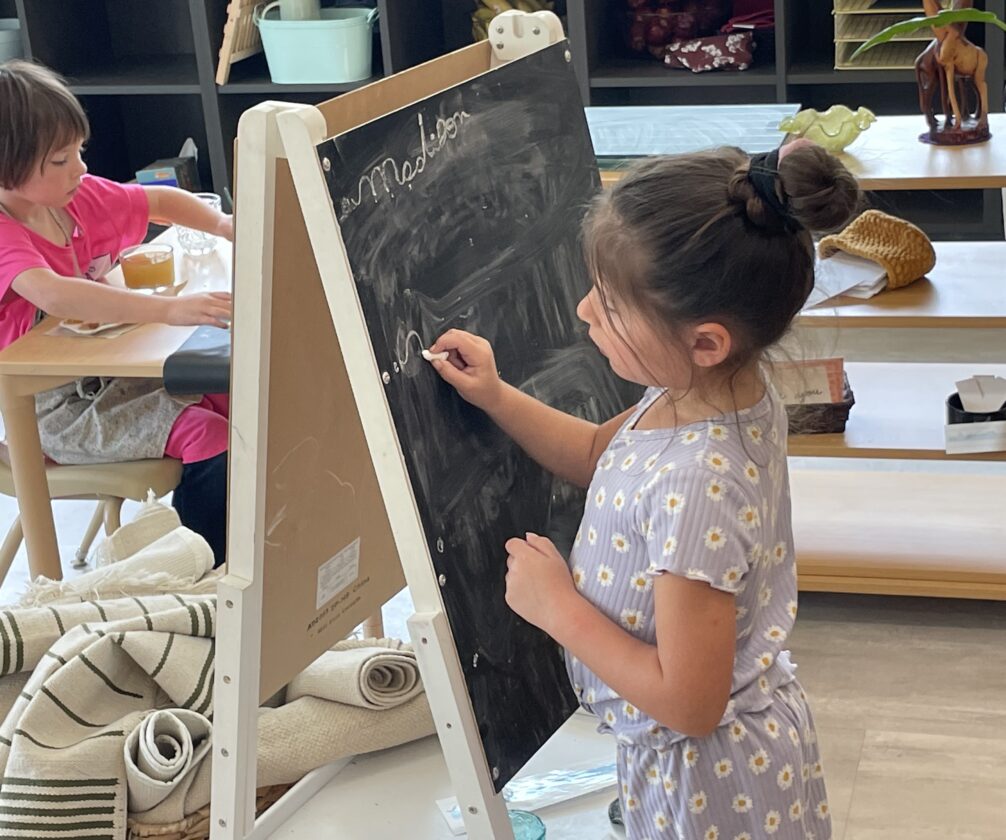
photo by: Matt Resnick/Journal-World
A New York Elementary School Montessori student works on her hand-writing skills.
• • •
Despite the logistical hurdles of getting a Montessori program off the ground, Lewis thinks it’s been a good decision – both for individual students and for the district as a whole.
In part, that’s because New York Elementary is far from Lewis’ first experience with the Montessori model.
Before he arrived in Lawrence in 2018, Lewis supervised multiple public Montessori schools in Kansas City, Missouri. That was when he “learned deeply about the model,” he said, and he decided to enroll his own children in one of those schools in the KC district.
But when he moved to Lawrence to take the superintendent job here, that caused a dilemma, because all of the Montessori options in Lawrence were private schools.
“It wouldn’t have been a good idea for the superintendent to come in and put his kids in a private school,” Lewis said. “That was a critical decision that my wife and I had to discuss — pulling our kids out of the Montessori model, which we believed heavily in.”
It got Lewis thinking about what a public Montessori school would look like in Lawrence. And he was thinking about those things that Raintree’s director was talking about — the stereotypes that people thought Montessori education was supposed to follow.
For one thing, “when you think of public Montessori schools, they are typically magnet schools that pull students from around the district,” Lewis said. “We purposely and intentionally did not want this to be a magnet school.”
He also said it was important to choose a location that would serve students who might not normally have access to a Montessori school. New York Elementary fit the bill, he said — it’s in a less affluent area of town, and out of all the district’s elementary schools, he said, it has the highest rate of students receiving free or reduced-price lunches.
That’s important when people are talking about school closures, Lewis said. Broken Arrow and Pinckney elementaries were the schools that the district ultimately closed this year to deal with its budget constraints and declining enrollment projections, but Lewis said that at one time, New York Elementary School was on the district’s shortlist of potential closures.
He said he saw the New York Montessori program as a chance to do something special on the east side of Lawrence. The program gives priority enrollment to families who live in the New York Elementary attendance boundaries.
“We also heard folks say that ‘you’re only looking at closing schools on the east side, or ‘you’re picking on the east side,'” Lewis said. “Well, no. We put a public Montessori school in East Lawrence to attract families to move in. Because in order to go there, you have to live in the New York Elementary area.”
Lewis also told the Journal-World that he didn’t want to compromise on the quality of the New York program: He wanted a “true, authentic” Montessori school, he said, not what he jokingly referred to as a “Monte-something.” He said he’d heard a lot of misconceptions about the program, including that it was an attempt to “privatize education and have charter schools in Lawrence,” which he said wasn’t true.
At listening tours and speaking engagements around the district, he said, he’s emphasized that having a Montessori program is about strengthening the district as a whole and addressing bigger problems like declining enrollment.
“What I shared was that we can sit back and watch kids leave and suffer the consequences,” he said, “or we can do something innovative to increase enrollment.”
Whether it’s doing that job isn’t clear. The district’s preliminary enrollment figures came in earlier this month, and they showed that enrollment in the district had dropped by about 300 students from last year. But in Lewis’ eyes, the Montessori program has “done what we thought it would do in terms of increasing enrollment” — he pointed to the waiting list, and said that’s a “good problem” for the district to have.
“If we could afford it, we would open a fourth Children’s House classroom,” he said.
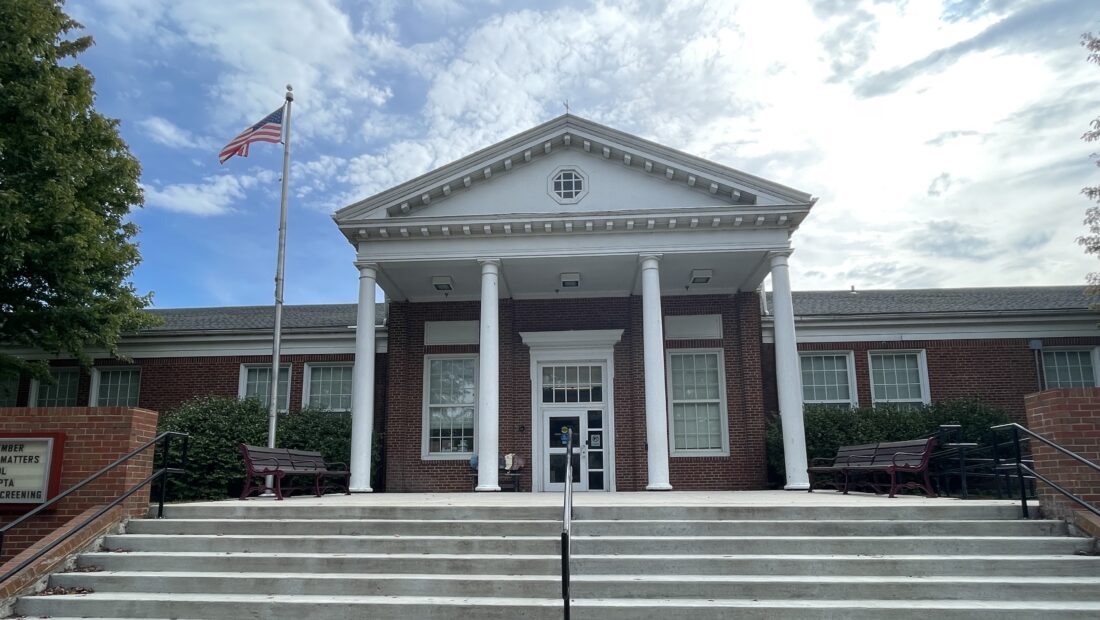
photo by: Matt Resnick/Journal-World
A front view of New York Elementary School.
K-12 Education
Student-run coffee shop opens at Community Connections at Pinckney, teacher receives surprise $1,000 award
Perry-Lecompton voters to weigh new joint recreation system funded by property tax levy
KU professors, middle school band director, radio personality among this year’s Phoenix Award honorees: ‘It’s a cool mix’
Baldwin High already has won $25K and is competing for $1M through national sports program
A student-run coffee shop will open at Community Connections at Pinckney next week